Green-Faced Terracotta Warrior
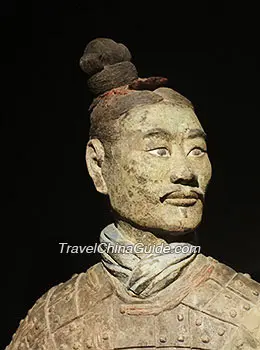 |
| Head of Green-faced Terracotta Warrior  Terracotta Warriors Pictures Terracotta Warriors Pictures |
What Does the Green-Faced Terracotta Warrior Look Like?
Why Is the Warrior Green Faced? - 9 Guesses
Guess 1: A prank made by Qin terracotta artisans.
Guess 2: The only Nuo person available for exorcism ceremony.
Firstly, the Nuo ceremony performed by Nuo people was common in the army at that time. Secondly, the Nuo ceremony was related to military matters in ancient times, and the Terracotta Army is a reproduction of the Qin army, so this Nuo warrior was in charge of exorcism as a professional military officer. Thirdly, there was a close relationship between the Qin and Chu states. Attaching importance to mysterious witchcraft is the greatest feature of the Chu culture. Many cultural relics related to the Chu state were excavated from the Terracotta Army, hence the guess.
Guess 3: To frighten enemies
Guess 4: A mistake by the artisan
Maybe the craftsman who painted this warrior was color-blind. However this seems impossible, due to the strict management rules of Qin.
Guess 5: A special protective talisman
Some visitors guess that the green face is a special protective talisman for the warrior, because the ancients thought highly of the ceremony of praying for safety. Others refute this by pointing out that there are no historical records on this.
Guess 6: An ethnic soldier
Some think that the green-faced warrior is a symbol of a national minority. In Chinese opera, a red face represents loyalty, black represents frankness, and green represents ethnic monitories. In addition, from the geographical location, Qin has close relations with minority people. From historical records, the citizen of Qin is composed of different races. Therefore, this special warrior is possibly a representative of the minority people in the Qin army.
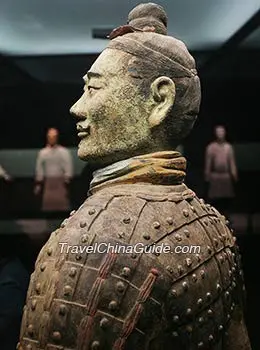 |
| Side of the Green Face |
Guess 7: A soldier for jungle war
In modern jungle wars, soldiers usually paint themselves, including their faces, green as camouflage. There were also jungle wars in ancient times and the green-faced warrior may represent a soldier in a war. As to why the other parts of the warrior are in normal colors, it is probably because he has not reached the battle field yet.
Guess 8: A sniper in the army
A student from Shanghai Jiaotong University offers a new explanation – that the green-faced terracotta warrior is a sniper in the army. Firstly, the "Shi Ji" (the Book of History) records that sniper tactics were already in use by the Qin Dynasty (221 BC – 207 BC). The warrior was a kneeling archer, in a position of controlling the bow, which is the basic stance of a sniper. Secondly, both in ancient and modern times, snipers are generally required to fight in isolation which means that their representation in the army is very slight when compared with regular soldiers. The fact that this warrior was the only one of his kind unearthed in Pit 2 supports the student's assertion. Finally, snipers traditionally use camouflage in order to blend in with the surroundings and remain unseen. A green-faced sniper like the painted terracotta warrior could silently approach the enemy without being noticed.
Guess 9: A symbol of youthfulness and vibrancy
It is interesting to note that the ancient Chinese viewed the color green as a symbol of youthfulness and vibrancy. Based on this knowledge, some experts assert that the green-faced terracotta warrior could have been placed there to demonstrate the braveness of all the soldiers and the power of the army in battle.
 Recommended Tour Itinerary:
Terracotta Warriors Tour: One-day to visit Terracotta Warriors and Horses and more
More Xi'an Tours
 Next: Hairstyle and Headgear of Terracotta Warriors