Datong Attractions- Things to Do
As one of the twenty-four famous historical cities in China, Datong is known for its abundant historical relics and natural beauty. Unlike the pretty and elegant scene in cities south of China, sceneries here boast the air of majesty and grandeur. Datong was originally the capital of Northern Wei (386~534) and the 'support capital' of Liao (916~1125) and Jin (1115~1234). Northern Wei is a stage during which Buddhism developed quite rapidly in China. In the later Liao and Jin, the belief in Buddhism also increased to a high level. Therefore, as the country's political and economic center, many temples, pagodas and other buildings related to Buddhism were set up during these periods in Datong.
Top Things to Do in Datong
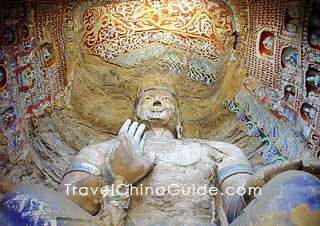
As the first on the must-go attractions of Datong, it is situated 16 kilometers (9.9 miles) to the west of the city center. According to the record, the construction of these grottoes lasted 50 years, and more than 40 thousand people took part in the project. There are now 53 grottoes with 51000 statues remaining. It is one of the largest grotto-groups in China.
The grand natural sceneries of the area can be found in Mt. Hengshan. It is located in the Hunyuan County about 60 kilometers (37.3 miles) to the south east of the urban area of Datong. As one of the Five Sacred Mountains in China, Mt. Hengshan is a great attraction to people all over China for its charming natural beauty as well as its intriguing manmade miracles.
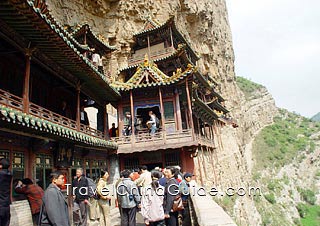
The peculiar wood-structured Hanging Monastery on the cliff at the foot of Mt. Hengshan gives a breath-taking view of Chinese architecture.
Because of the numerous pagodas in Datong, the city has been known as the 'City of Pagodas'. Though there are only six left today, each of them is elaborate, especially the Wooden Pagoda in Ying County. This attraction is over 900 years old and is attractive for its exquisite design and delicate appearance.
|
|
More Attractions
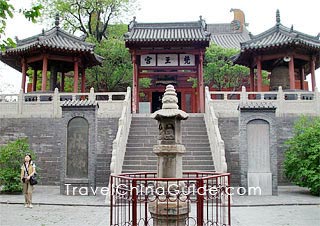
The Huayan Monastery in Daxi Street of Datong City established in Liao is typical. The statues, frescos and some of the buildings in Huayan Temple betray the typical artistic and architecture style of the Liao Dynasty.
Inside the south gate of the city, Shanhua Temple is a majestic well-preserved building group of Liao and Jin which is famous for the well-spaced layout as well as the vivid statues of Buddhas and Buddhism frescos.
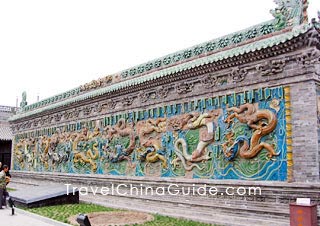
The Nine-Dragon Screen in the East Street of the city is also worth a visit. This attraction is the largest and earliest one of the three famous Nine-Dragon Screens in China (Note: the other two are respectively in Forbidden City and Beihai Park.
It is within the Hengshan Mountain range is one of the three important passes through the inner line of the Great Wall in Shanxi section.
Great Wall in the city is mostly composed of ruined parts built of rammed earth rather than brick. Nowadays, people can see the majority of the remains of the Ming Dynasty.
|
|
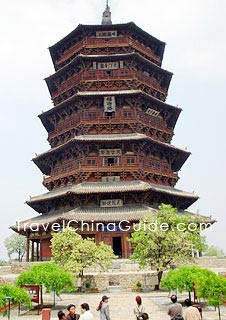 |
| Wooden Pagoda in Yingxian County |
Recommended Routes:
 1-Day Tour:
Route 1: Shanhua Temple→Huayan Monastery→ Nine-Dragon Screen→ Yungang Grottoes
The first three points of interest are all in the downtown area - you could get around it within half a day and then take the city-bus heading for Yungang Grottoes.
Route 2: Hanging Temple→ Mt. Hengshan→ Yungang Grottoes
2-Day Tour:
Day 1: Shanhua Temple→ Huayan Monastery→ Nine-Dragon Screen→ Yungang Grottoes
Day 2: Wooden Pagoda→Hanging Monastery
Tips:
1. The city-bus No.3-2 can take you to Yungang Grottoes.
2. Buses from Xinnan Passenger Transport Station can take you to the Wooden Pagoda.
 Reply
Reply1)My plan is to visit the Hanging Temple, Yungang Grottoes,Wooden Pagoda and Wutaishan. As we will be staying the hotel in the central city, we can visit the nearby temple such as Huayan temple, shanhua temple, the nine dragon and datong great wall which some are within walking distance.
2)Do the city has day/night market or shopping district like Shanghai or Beijing?
We are not rushing for time but need some planning if to stay for 6 to 7 days , any suggestion or
should we shorten the trip?
We have no plan to visit Pingyao or Taiyuan as we have been there and will be visiting Wutashian to stay for
a night and will it be too cold in 1st week of November?
Thanks.
 0
0 0Reply
2. You can go to Shuaifu Street featuring various street food and local cuisine. It is located in the ancient city. You can go to Parkson Mall to go shopping. It is located in South Yongtai Rd, Pingcheng District. Maybe you can shorten the trip.
3. The average temperature of Wutaishan will be between -10 - 0C in November. So you might need to take winter clothing like padded jacket, wollen sweater.
00ReplyWe will be staying at Datong Garden hotel which has good review.
But one of the traveler is an elderly, is it convenient for her if to take bus or subway?
But we will take our time as we are not rush for time.
I need advise on my planning and how to reach the destination if to travel by ourselves?
Day 1 - Reach hotel in the late morning and in the afternoon visit temple near to the hotel
Day 2 - Hanging temple and Yungang Grottoes (Is half day enough?)+ shopping
Day 3 - Wutaishan for a night stay(Any idea how to book a hotel?)
Day 4- Wutaishan back to hotel+ temple
Day 5- Wooden Pagoda + shopping
Day 6-Either to rest for a day or last minute shopping or fly back.
Thanks.
00ReplyThe Yunzhong Inn on Wutaishan is recommended to stay.
Reply2)How many days to stay in order to visit the famous tourist spot and temple and Wutaishan?
3)Can we travel to the tourist spot by ourselves in the city? Or it is best to join 1 day tour ? Cause we
have an elderly with us.
4)Any recommendation of hotel(3/4 Star) and near to the city area?
5)Any vegetarian restaurant/shop in the city?
6)Is it better to join the hotel tour to visit Wutaishan? or Can we travel by ourselves?
Thanks.
00Reply2. If you are not in a hurry, 6-7 days will be nice.
3. I think you can travel by yourselves but joining travel group could save a lot of trouble since you have an elderly people.
4. There are many nice hotels in the downtown or near tourism attractions, such as Datong Garden Hotel, which is located at No.93, Yongtai Street.
5. Sorry, I haven't found yet.
6. It depends on you. I think there is not much difference.
Replyis it any bus from train station to hanging monastery?
2. after that, from hanging monastry, how can i go to yungang grottoes?
3. if time available, want to see nine dragon wall, how can i go there from yungang grottoes?
4. and last one, how can i back to train station from yungang grottoes or nin dragon wall?
any other suggestion for 1 day trip in DT?
planning to go there by sleeper bus from beijing and back to beijing in the same way.
Thank you
Regards
Susi
00Reply2. You can take the bus line 603 from DT Railway Station directly to yungang grottoes, so you are advised to see yungang grottoes first.
3. Take bus line 3 from Yungang Station to Tongquan Road West Circle Station and walk about 100 m to take bus line 38 from another Tongquan Road West Circle Station to dragon wall.
4. Take a bus I mentioned above or take a taxi.
00ReplyThanks for your information,
as your suggestion, if i go to yungang grottoes first, can you tell me :
1. if i go to yungang grottoes first, then how i suppose to go to hanging monastry after that? any bus from yungang grottoes to hanging monastry? or should i go back to dongguan bus station and take bus from there?
2. did you know the tourist bus timetable? in case i missed the tourist bus, what option i have to go back to train station?
Regards,
susi
00Reply2. I’m sorry I didn’t find any timetable. However, maybe you can go Hanging Monastery first and it won’t take long time to visit. The transportation of yungang grottoes is more convenient so you can put it later.
00ReplyHe took us to the the hanging monastery, dirt forest (interesting), and the Grottoes which was a good day of travel.
00ReplyThanks for your information
Regards
Susi
ReplyWhich route would you recommend? We'd like to hire a taxi, how much would that cost?
Thanks?
00ReplyThe car fare is around 300-500RMB par day based on car types.
As for the attractions, you are suggested to go to Hanging Temple in the morning and Yungang Grottoes in the afternoon. After visiting, if you still have some time left, you can visits other places you listed.
00Reply