 |
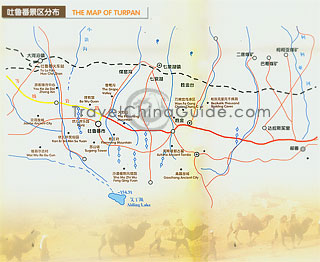
| Turpan Tourist Map |
Located in the eastern part of the Xinjiang Uygur Autonomous Region, Turpan, which was called Gaochang in ancient times (from 328AD to 1275AD), is an important place on the Silk Road. Lying in the Turpan Basin, it is at the lowest-elevation anywhere in China. Recently, it has become a tourist hot spot of Xinjiang with its unique landscape, abundant historical relics, and fertile farmland.
Because Turpan is rich in high-quality grapes of many kinds, it is known as the Hometown of Grapes. Grapes have even proved to be a attraction. Lying to the northeast of the city, Grape Valley is a peaceful heaven and a welcoming place for visitors. The valley is a Grape Kingdom worthy of its name. Outside of the vineyards, you will also see grapevines along the road and around the houses with clusters of crystal-like grapes hangingon the dense vines. You can taste the sweet grapes after paying a small fee. Recently, a new Grape Valley was built near the old one, but the newly developed one is rather commercial. To get a taste of the romantic feeling of Turpan, it is better to visit the old Grape Valley. Additionally, in 2001, Grape Street was built on Qingnian Road of the city. It is 1.7 kilometers (1.06 miles) longand 14 meters (15.3 yards) wide and the pillars on both sides are festooned with exuberant grapevines. Visitors can go for a stroll under the grapevines to enjoy a cool respite from the hot city and taste the grapes there.
After enjoying the beautiful vineyards and the sweet grapes, you can try something totally different at Flaming Mountain - the hottest place in China. The surface temperature here can reach over 70

C(158
F).
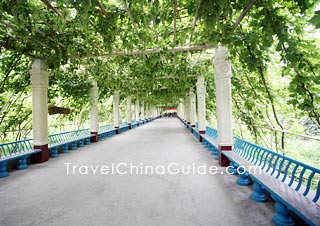 |
| Grape Valley |
With the scorching sun directly overhead, the red mountain rocks glow and theair shimmers in the heat. It looks like raging flames, so the mountain got namedFlaming Mountain. The highest temperature in summer can reach 47.8
C(118
F),so bring plenty of sun-block and water when you visit.
Lying to the north of the Flaming Mountain, the Bezeklik Thousand Buddha Caves is one of the most important Buddha grotto relics in Xinjiang Uygur Autonomous Region. It was built during the Northern and Southern dynasties (386-589) andfor 700 years, it remained the Buddhist center of the Western Regions (the areaincluding what is now Xinjiang and parts of Central Asia).
Not far from Bezeklik Thousand Buddha Caves sits the ruins of the Ancient City of Gaochang.The ancient city of Gaochang was first built in 1BC and was destroyed by warby the end of 13AD. It is the largest set of ancient city ruins ever found inthe Western Regions. After over 2,000 years of exposure, the outline of the ancientcity still exists, and the city wall stands imposingly at the foot of the FlamingMountain. Six kilometers from the Ancient City of Gaochang sit the Astana-Karakhoja Ancient Tombs which were the public cemetery of the ancient Gaochang residents.
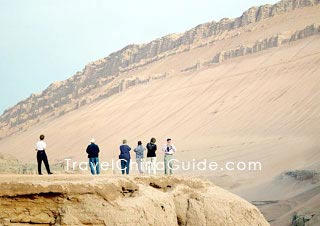 | | Flaming Mountain | | 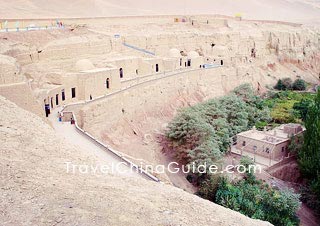 | | Bezeklik Thousand Buddha Caves | |
The Ancient City of Jiaohe ,situated to the west of Turpan, is another set of ruins from an ancient city on the Silk Road. Jiaohe was the capital of the former Gushi Kingdom, which was first built in 60BC to the west of Turpan City. It has a long history of about 2,300 years. It is the largest and best preserved ancient city built from compressedearth anywhere in the world. As early as 1961, the Ancient City of Jiaohe waslisted as the first group of Key Cultural Relics Units under State Protection.When traveling there, be sure to take plenty of drinking water as you will walkfor several kilometers on dry, barren land.
Aydingkol Lake is at the bottom of the deepest depression in China's land mass, known as Turpan Basin (Tulufan Pendi in Chinese). Situated on the ventral portion of Turpan Basin,the Desert Botanical Garden is the largest botanical garden in China. Its average altitude is -80 meters(-262 feet).
Other sites to see include the Karez System ,a delicate irrigation system devised by the smart Xinjiang people 2,000 years ago; the Emin Minaret ,the largest ancient Islamic tower in Xinjiang; the Turpan Museum ,the second largest museum with the richest and largest collection in Xinjiang;and the Sand Therapy Health Center.
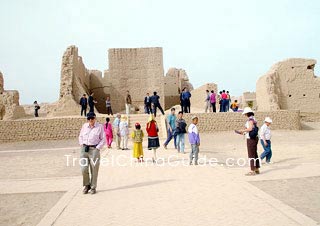 | | Ancient City of Gaochang | | 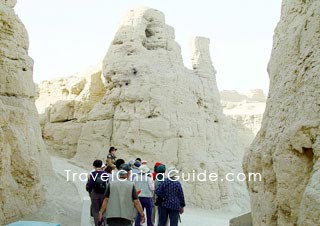 | | Ancient City of Jiaohe | |
- Last updated on Aug. 15, 2025 by Demi Li -
