Bezeklik Thousand Buddha Caves
 |
Bezeklik Thousand Buddha Caves More Pictures More Pictures |
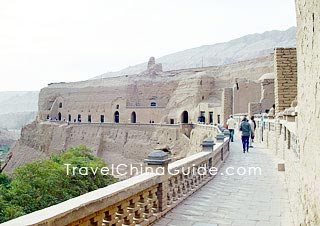
Bezeklik Thousand Buddha Caves stand high on the cliffs of west Mutou Valley under the Flaming Mountain, 45 km (28miles) east of Turpan. Of the 83 original caves, 57 remain. In addition, the murals cover an area over 1, 200 square meters (12,917 square feet) in more than 40 of them.
Beginning in the Southern and Northern Dynasties, the construction experienced Tang, the Five Dynasties, Song and Yuan. The Caves had been the Buddhist center of Gaochang. Near the end of the 13
 century, the royal family of Gaochang moved to Yongchang, Gansu. Around this same time, Buddhism in Turpan began to decline in popularity with the introduction of Islam. Subsequently, the religious importance of The Bezeklik Thousand Buddha Caves became less apparent. Many of them were destroyed during the ensuing religious clashes. Vandals dug out the eyes of many of the portraits human figures contained in the murals. Later, at the beginning of the 20 century, foreign explorers robbed the caves of much of the treasures. Despite all the destruction, the surviving parts, such as the delicate Buddha seat and the bright color of the murals, give us some idea of its past glory.
Bezeklik Caves was the royal temple of Huihu (the predecessor of today's Uigur) State and the present remains were enlarged or renovated during that time. The murals take us back to the ancient Huihu State, where we can see the King and Queen and people from all walks of life. The inscriptions, written in ancient Uigar, Chinese and other languages, provide authentic reference for valuable historic research.
|
|
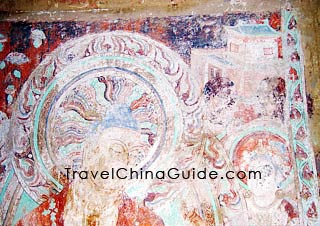
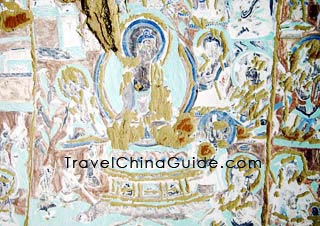
The mural Transformation in Hell in Cave No.17 supports the notion Huihu Gaochang was the center of Manicheism from 9
to 12 century.Buddhist disciples wailing in mourning and Bhikku wailing in mourning in Cave No.33 are also highly praised for their vivid depiction.
In addition to the murals and inscriptions, a piece of gold foil wrapping paper found at the site is also intriguing. A stamp on it revealed the address of the shop on the south side of Tiahelou Street, Hangzhou, Zhejiang of Song Dynasty. It also advised clients to examine their goods carefully before purchase to avoid being cheated. As an apparent piece of advertisement, the foil shows that Gaochang Huihu kept close economic ties with Song Dynasty as the trade extended as far as to the East China Sea.
|
|
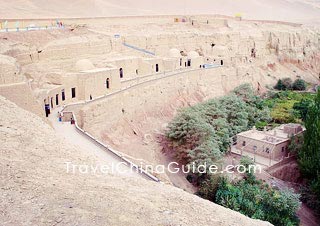
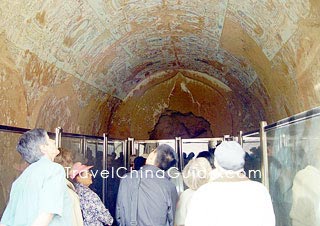
1. As the Caves are located on the cliff, stay within the marked areas.
2. To protect the murals for future enjoyment, visitors should refrain from touching the murals and artifacts.
3. Remember, smoking is strictly prohibited there.
4. After your visit to the caves, you may consider stopping at some of the other nearby attractions including:
1) Astana-Karakhoja Ancient Tombs, 12 km (7.5miles) from the Caves
2) Flaming Mountain, 13 km (8.1miles) away
3) Ancient City of Gaochang, 15 km (9.3miles) away
 Note:
Note:
For detailed information on Dynasties, please refer to History of China
| Admission Fee: | CNY 20 |
- Last updated on Aug. 15, 2025 by Demi Li -