Turpan Travel Guide
Turpan Facts
Chinese Name: 吐鲁番 (tǔ lǔ fān)
Population: 633,400
Area: 70,049 square kilometers (27,046 square miles)
Location: in the central area of Xinjiang, northwest China
Administrative Division: 1 district (Gaochang); 2 counties (Shanshan, Toksun)
Area Code: 0995
Zip Code: 838000
GDP (2018): CNY 31.059 billion (USD 4.694 billion)
Nationalities: Uygur, Kazak, Han, Hui
China’s Death Valley as World’s Second-Lowest Depression
Turpan City is located in the middle of Xinjiang and close to Hami to the east, Bayingolin to the west and south, Urumqi to the north. It is an olive-shaped intermountain basin in the east of the Tianshan Mountains, surrounded by mountains on all sides. The Aydingkol Lake in the south Turpan, 155 meters (509 feet) below sea level, is the second-lowest depression in the world. Turpan is widely known by many visitors because of the Flaming Mountain. It is the hottest place in China, with the highest temperature of 47.8 ℃ (118 ℉) in summer and 89 ℃ (192 ℉) on the surface. Tourists can also explore the magic Karez system which is actually a unique water intake project in Xinjiang and witness the ancient city ruins in the desert. Pictures
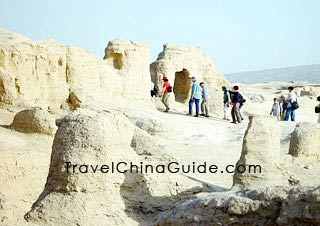
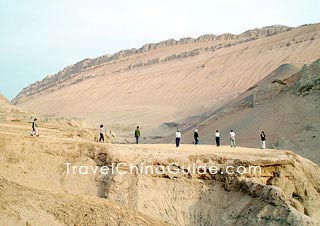
 Flaming Mountain, which is mentioned in a classical Chinese novel The Journey to the West is the hottest place in China. Emin Minaret is the largest ancient Islamic tower in Xinjiang. Jiaohe Ancient City and Gaochang Ancient City are witnesses to the long history of Turpan. Aydingkol Lake, at the bottom of Turpan Basin, is the lowest point in the country. Astana-Karakhoja Ancient Tombs, Bizalkik Thousand Buddha Caves and Tuyu Valley are also popular attractions. Karez System is one of the four great irrigation system of China and it is a crystallization of ancient people's wisdom and the life source there.
|
|
Recommended Tour Itineraries:
Pearl of Silk Road: 11 days of Shanghai, Xian, Lanzhou, Turpan, Urumqi and other cities
Hiking Adventure
Turpan is an important city along the ancient Silk Road and the transportation here is very convenient. It is considered to be the hub between Xinjiang and the eastern part of China. Turpan Jiaohe Airport has flights to about 20 domestic cities, such as Shanghai, Guangzhou, Shenzhen, Xi'an, Changsha. Also, trains and intercity buses serve the people. Except these usual vehicles, there is a special 'donkey taxi' here. It is a kind of flatbed drawn by donkey. Visitors can sit and ride on the vehicle to get a broad overview from a leisurely look around the city.
The city, which is also known as Huo Zhou (a place as hot as fire), is the hottest place in China. The annual average temperature is 14 C (57.2F). It is reckoned that there are 152 summer days on average, and 28 really broiling days with the temperature above 40C (104F). Although the high temperature can be oppressive people can also get some benefits from it. The abundant sunshine gives the melons and grapes ideal conditions to grow. The fruit here is widely known for its high sugar content, especially the grapes. The place is praised as the 'Hometown of Grapes' and the Grape Valley is a good place to enjoy the grapes of hundreds of varieties. Apart from that, the locals are quite fond of sand therapy which has a history of hundreds of years. People lie or sit under sheds, burying their bodies in hot sand about 50C (122F) to 60C (140F). It is said to be a good way to treat rheumatism and skin ailments. There is a Sand Therapy Center in the northwest of the city which is popular among visitors.
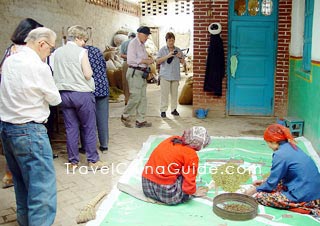
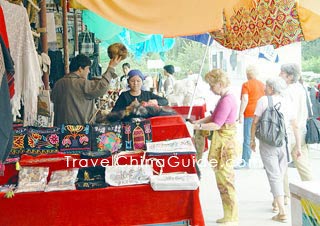
 History: This is an old city with a long history. Traces have been found of humans living there, dating as far back as 6,000 years ago. The city was known as Gushi in the Western Han Dynasty (206BC-24AD); and in the Ming Dynasty (1368-1644), it got its name Turpan, which means 'the lowest place' in the Uygur language and 'the fertile land' in Turki. Lying in the Turpan Basin, the elevation of most of the places in the area is below 500 meters (1,640 feet). Turpan is the city with the lowest elevation in China. Local Highlights: The city has star-level hotels as well as economy hostels. Nearly all of them have their own grape wines and wineries. Visitors can take a walk or taste the sweet grapes under the grape vines. Traditional Uygur singing and dancing shows can be seen there, too. Special Local Products: As a city inhabited by minority groups, you can find Uygur snacks in the streets and lanes. Kebabs, Zhua Fan (Rice Eaten with Hands), Nang, Roast Lamb will make your mouth water. There are also many traditional drinks there, including milk tea, black tea, grape wine and mare's milk. The traditional handcrafts are exquisite and are worth collecting. Carpets, clothes, caps and knives are favorites, with distinctive folk characteristics.
|
|
 Further Reading: Dinning Shopping