Ancient City of Gaochang
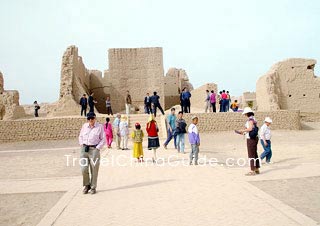 |
Visitors in the Ancient City of Gaochang Picture of Ancient City of Gaochang Picture of Ancient City of Gaochang |
The city was initially built as a garrison town in the first century B.C., called Gaochang Wall, and later renamed Kharakhoja, Kocho or King City. It was a key point along the Silk Road. During the successive dynasties, it was ruled as Gaochang Prefecture, Gaochang Kingdom and West Prefecture. By the 14th century, the city was damaged and abandoned due to warfare between Mongolian aristocrats and Uigurs. After 2,000 years, the weather-beaten ancient city still displays its past greatness and glory even though the walls are incomplete the magnificent outline remains.
The ruins are an irregular square, covering an area of about 2,200,000 sq meters (2,631,178 sq yards). The layout is similar to that of Chang'an City in the Tang Dynasty (618-907). The city is composed of three sections: an outer city, an inner city and a palace city. The outer city with a perimeter of 5.4 kilometers (3.4 miles), is enclosed by a city wall of 12 meters (39 feet) thick and 11.5 meters (37.7 feet) high, and built with tamped earth. Nine city gates are located in the four cardinal points: three in the South, and two in each of the other directions. The gates in the west are the best preserved. In the southwestern and southeastern parts of the outer city stand two temples ruins. The temple in the southwestern corner consists of a gate, a courtyard, a sermon hall, a sutra depository and monks' abodes. The southeastern temple consists of a polygonal tower and a worship grotto, where splendid murals remain well preserved.
|
|
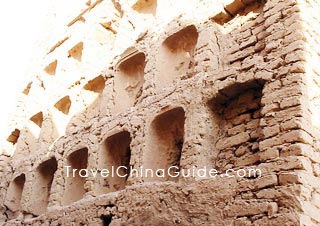
The Palace City is located in the north of the inner city, sharing its southern wall with the inner city and northern wall with the outer city. It is a rectangle with a perimeter of 700 meters (2,296 feet). Within the city, many large cornerstones remains are still visible, with an average height of 3.5 meters (11.5 feet) to 4 meters (13 feet). These cornerstones are relics of a 4-storied palace. An irregular adobe square standing in a high earthen platform is called "Khan's Castle", which was the imperial residence.
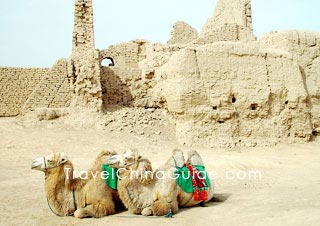 |
| Camel, the main form of transportation in Xinjiang in the ancient times |
| Admission Fee: | CNY 40 |
| Opening Hours: | 08:00 - 17:00 |
How to get there:
1. Take the tourist bus from Turpan to Doushan, it stops at Shengjinkou, then transfer to motorcycles from Shengjinkou to the site.
2. Take a bus from Turpan to Sanbao Township Government, and then transfer to motorcycles to get there.
3. Take a taxi.
Tips:
The best time to visit Turpan is from June to August when various melons and fruits are ripe, so you may taste the delicious fruits. The Grape Festival held in August every year is also quite exciting and very enjoyable. During the Grape Festival, a variety of cultural activities such as evening parties, and the grape wine festival are enjoyable events to attend.
- Last updated on Aug. 15, 2025 by Demi Li -