Yuantong Temple
 |
| Yuantong Temple |
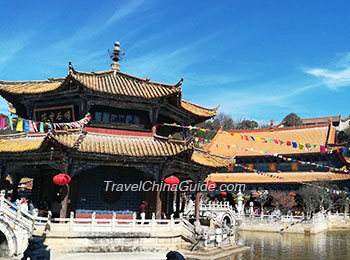
Yuantong Temple is at the foot of Yuantong Hill in the northern part of Kunming. With a history of more than 1,200 years, it is one of the grandest as well as the most important Buddhist temple in Yunnan Province. King Yimouxun of the Nanzhao Kingdom built it during the late eighth century as a continuation of Putuoluo Temple, and the restorations performed from the Qing Dynasty (1644 - 1911) onward had not changed its unique mixed architectural style of the Yuan (1271 - 1368) and Ming (1644 - 1911) Dynasties.
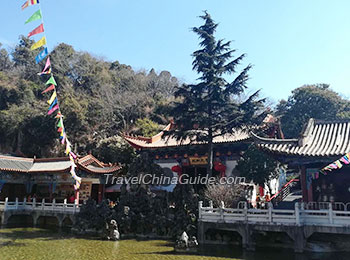
Unlike all other Buddhist temples, which are built on an ascendant, you enter Yuantong Temple from above and descend along a gently sloping garden path. The view before you starting your peaceful walk beneath the gigantic cypress trees that line the garden path to the temple with its extensive array of flowers and foliage is deeply restful and impressive. A memorial archway with four Chinese characters -Yuantong Shengjing (Yuantong Wonderland)-is standing on the halfway; you can see the entire temple from here.
Yuantong Hall
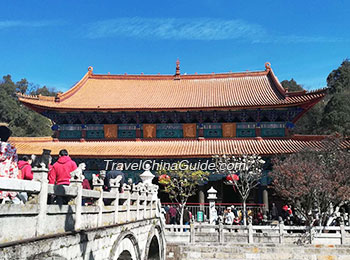
The temple complex is built around Yuantong Hall (Mahavira Hall), which is known as the Fane on the Water for it is surrounded by a very large pond filled with limpid water and fish. A delicate stone bridge which has an elegant octagonal pavilion stands in the center connects Mahavira Hall and the Yuantong Temple entrance. The pavilion is connected to the rest of the complex by various bridges and walkways.
Yuan Dynasty Statues
Sakymuni, Amitabha and the Medicine Buddha, all Yuan Dynasty statues, are found in the main hall. The surrounding 500 Buddhist Arhats who are carved in the walls are rare treasures noted for their perfect proportions and lively appearances. Also in this hall are two ten meter high pillars from the Ming Dynasty that are each engraved with a dragon - one yellow and one green - who are trying to extend their bodies and claws into the air as if they are ready to fly. Like the Arhats, they impart the feeling that at any moment they could spring into action.
Stone Staircases
Outside, on each side of the main hall, there are stone staircases that are carved out of the mountainside and wind their way to the top of the hill. As you climb these stairs, there are ancient inscriptions along the way and various tone artworks that are considered the most important historical relics in Kunming. From the top of the stairs, you are presented with a terrific panoramic view of the entire complex. It is from here that you can most appreciate the architecture of the remarkable temple complex.
 |  |
Copper Buddha Hall
In 1982, Thai Buddhists sent a copper statue of Sakymuni to Yuantong Temple as a symbol of friendship, and the statue is three and a half meters high and four tons in weight. A few years later, in 1985, a Copper Buddha Hall was built in a combination of Chinese and Tai styles to house this exquisite gift.
Buddhist Scriptures
Surrounding the temple pond are a series of halls where you will find old women praying, people sitting and chatting, ongoing classes in Buddhist scriptures, a magnificent calligraphy studio, an exhibit of temple photographs taken at the end of the Qing Dynasty by Auguste de Francois, a shop, a restaurant, and more.
Yuantong Temple is a working temple that also represents the Buddhism of China today. Along with the patronage of the local people of Kunming and Yunnan in general, Buddhists from around the world come here on pilgrimages to pay homage, there are special Buddhist services two times each month, and the Buddhist Association of Yunnan Province is located here. This temple plays a very important role in history and in the modern world.
How to get to Yuantong Temple
1. Take Metro Line 2 to Chuanxingulou and walk west for about 15mins to the Yuantong Temple.
2. Take bus 85, 92, 100, 101, 119, 187, 235 or Z5 to Yuantongjie.
3. Take bus 4, 83, 129 to Yuantongshan.
| Entrance Fee | CNY 6 |
|---|---|
| Opening Hours | 8:00 - 17:00 |