Peak Flown From Afar (Fei Lai Feng, Ling Jiu Feng), stands next to
Lingyin Temple and is a must-see in Hangzhou, Zhejiang Province. There are many legends about the peak's name. A well-known legend states that an Indian monk named Huili arrived in the valley 1,600 years ago and was surprised to see a peak so dissimilar from any other one in the valley. He believed that the peak had flown over from India because the shape, although unique in China, was common in India. However, he did not know why the peak would have flown to this spot so far from his country. Hence the peak's name was created and has passed down to the present day.
Peak Flown From Afar, 209 meters (about 700 feet) tall, is a pure limestone mountain that is very distinctive from the sandstone mountains around it. Large stones scattered along the peak are said to resemble animals like a flying dragon, a running elephant, a crouching tiger, and a fleeing monkey.
On the other side of the peak, a pavilion named Cui Wei was erected to immortalize the national hero Yue Fei. This man contributed greatly in the war against Jin Tribe during the Southern Song Dynasty (1127-1279).The pavilion was destroyed many times before the large restoration of 1942. The current pavilion keeps its old face with fresh paint.
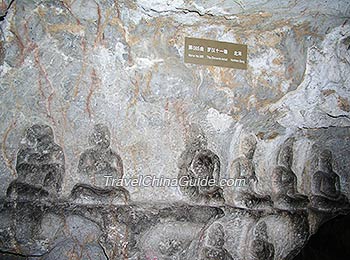 |
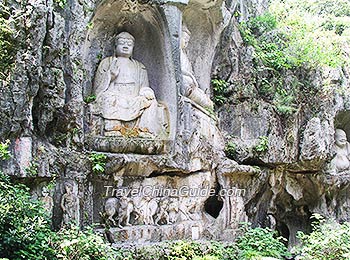
The caves of this mountain shelter about 330 stone statues dating from the 10th to the 14th centuries. The statues appear in a variety of poses ranging from standing, to sitting, to sleeping. A favorite may be the Laughing Buddha, sitting on the cliff along the stream with exposed breast and belly. If you wonder why he has such a big belly, the answer is that his belly is where the Buddha keeps all of the world's troubles. The question always comes out 'why are there so many Buddha statues in the cave?' Local legend has it that the peak had destroyed many villages before it settled down in Hangzhou. In order to prevent the peak from causing even more damage, over 500 Buddha statues were caved out of the peak to suppress it. Consequently, the water-eroded caves in the peak are regarded as the very birthplace of many local legends.
 |
In 1993, a new site by the name of 'China Grotto Art Garden' was set up around the Peak Flown From Afar. Thousands of professionals and aficionados in the fields of engraving and grotto research flock to this place to study the unparalleled Chinese classical rock carvings.
Among all the mountains around
West Lake, Peak Flown From Afar is the one most likely to simulate the imagination and make one reluctant to leave. Some even say that one experience at Peak Flown From Afar will leave you with memories that will last the rest of your life.
How to get to Peak Flown From Afar
1. Take Bus 7, 324, 807, j1 or y2 to Lingyin Station.
2. Take Bus 103, 103b, 121, 121b or 324 to Lingyin Dong.
| Entrance Fee | Free |
| Opening Hours | 7:30 - 17:30 |
- Last updated on Jul. 24, 2026 by Sherry Xia -

