Chifeng Travel Guide
Chifeng Facts
Chinese Name: 赤峰 (chì fēng)
Population: 4,643,000
Area: 90,275 square kilometers (34,855 square miles)
Location: in the southeast of Inner Mongolia, north China
Administrative Division: 3 districts (Hongshan, Yuanbaoshan, Songshan); 2 counties (Ningcheng, Linxi); 7 banners (Alukeerqin Banner, Balin Left Banner, Balin Right Banner, Keshiketeng Banner, Wengniute Banner, Kalaqin Banner, Aohan Banner)
Area Code: 0476
Zip Code: 024000
GDP (2018): CNY 154.98 billion (USD 26.42 billion)
Nationalities: Mongol, Han, Hui, Man
The Most Populous City in Inner Mongolia with Vast Grasslands
Chifeng is the most populous city located in the southeastern Inner Mongolia Autonomous Region at the convergence of Inner Mongolia, Liaoning and Hebei. Its southern extremity is 315 kilometers (196 miles) from downtown Beijing. It treats visitors with a magnificent and beautiful geographical spectacle where mountains, hills, grasslands, forests, rivers, lakes, lava platforms and dunes are all distributed. Chifeng grassland is an important part of Inner Mongolia grassland. The famous grasslands include Ulanbu Grassland, Gonger Grassland and Bahrain Grassland, among which Ulanbu Grassland is the most beautiful grassland close to Beijing. Many cultural and historical sites can also be found in this city such as the Harqin Palace which is the largest existing Mongolian prince’s mansion in the Qing Dynasty (1636 - 1912).
Chifeng Attractions - Things to Do
Gongger Grassland
This is the Mongolian grassland nearest to Beijing, where the fascinating Mongolian nomadic culture can be seen against a backdrop of beautiful natural landscapes. The grassland is located in Keshiketeng Banner, boasting one of the world's two remaining stands of Korean spruce wood, which is regarded as a 'living fossil'.
Arshihaty (Asihatu) Stone Forest
The stone forest is classified as a geo-park, where quaternary glacial relics have been carved by the wind and sand over millions of years. Like an ancient castle, the stone forest is set in the vast grassland backing onto spacious a birch forest.
Dalinor Lake
Dalinor Lake, known as "Swan Lake", is the second largest lake in Inner Mongolia where more than 70,000 migrating white swans rest from October to November. The lake is surrounded by a wide range of volcanoes. Summer and autumn is the best time to shoot the natural scenery of Dalinor. A spectacular birds’ migration can be seen from April to May, or from October to November.
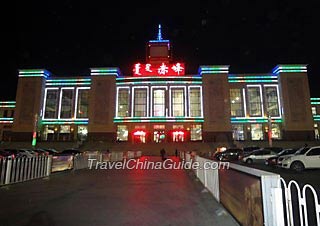 |
| Chifeng Railway Station |
 Other Scenic Spots: Bokelong Desert Tourist Zone, Longquan Temple
How to Get to/around Chifeng
1. Chifeng Yulong Airport is situated on the southwest outskirts of the city. It has flights to/from Beijing, Shanghai, Guangzhou, Shenzhen, Xi'an and more major domestic cities.
2. Long-distance Bus Station is located in the square in front of Chifeng Railway Station, from where visitors can journey to Beijing, Shenyang, Tianjin and Shijiazhuang. Buses to Chifeng can be easily found in Beijing Xizhimen Long-Distance Bus Station and Liuliqiao Long-Distance Bus Station. The whole journey will take six hours from Beijing to Chifeng.
Weather
Chifeng enjoys a semi-dry continental monsoon climate. Spring is dry and windy. Summer is short and the rainfall occurs mainly during this period. The average temperature in summer ranges from 18-23  C (64 - 73 F). Winter is long and chilly. Extremely low temperatures are usually experienced during January and February.
 When to Go: The best times to visit Chifeng are from June to September.
Chifeng Travel Tips
History: In the Neolithic Age, the Inner Mongolian ancestors created the brilliant Hongshan Culture in this area. An abundance of archaeological discoveries testify that, as with other noted locations in Central China, Chifeng is also a vital pillar of Chinese civilization. It was once the political, economical and military center of the Liao Dynasty (916-1125) of the Kitanyes. It was named after the red peak northeast of the city.
Physical Features: At the junction of the southeast ranges of the Great Xing'an Mountains (Daxing'anling), Inner Mongolian Plateau, the West Liaohe River Plain and the northern foothills of the Yanshan Mountains, Chifeng is situated in a basin. Medium and low mountains as well as hills occupy the majority of the city's outlying territory, as the city is surrounded by mountains to the north, the west and the south.
Special Local product: Balin Stone, tapestry, Longtoushan precious stone
Local Highlights: Several local ceremonies and activities will be held during August, such as the Balin Stone Festival, Liao and Hongshan Cultural Tourism Festival. Festivals in the city demonstrate its unique folk customs and pastimes and cultural treasures.