Xinzhou Facts
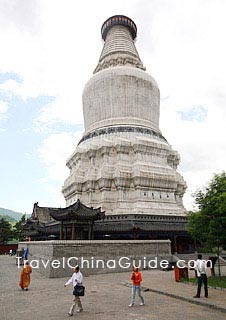 |
| White Dagoba, Mt.Wutai |
Chinese Name: 忻州 (xīn zhōu)
Population: 3,172,900
Area: 25,180 square kilometers (9,722 square miles)
Location: in the north-central of Shanxi Province, north China
Administrative Division: 1 district (Xinfu); 12 counties (Dingxiang, Wutai, Daixian, Fanzhi, Ningwu, Jingyue, Shenchi, Wuzhai, Kelan, Hequ, Baode, Pianguan); 1 county-level city (Yuanping)
Area Code: 0350
Zip Code: 034000
GDP (2019): CNY 100.16 billion (USD 14.52 billion)
Famous for Buddhist Holy Mountain - Mt. Wutai
Xinzhou City lies in north-central Shanxi Province, neighbors Datong to the north and Taiyuan to the south. In the west, it is separated from Shaanxi Province and Inner Mongolia by the Yellow River, and it is separated from Hebei Province by Taihang Mountains to the east. Like many cities in Shanxi, Xinzhou is rich in coal, iron ore, bauxite and gold resources. It is also covered by lush mountains, springs, caves and numerous ancient sites such as temples and passes. Mt. Wutai, one of the four Chinese Buddhist holy mountains, is a must-see place where visitors can see many temples and enjoy the sunset and cloud sea. The Nanchan Temple and Foguang Temple are very precious Tang Dynasty (618 - 907) buildings which preserve many exquisite paintings and murals.
Xinzhou Attractions - Things to Do
 Mt. Wutai
Located in northeast Wutai County, can be considered the top natural scenery in Shanxi. It is also a famous sacred Buddhist mountain in China characterized by a grand Buddhist temple complex, beautiful mountain scenery and folk customs. The mountain is made up of a cluster of five peaks with the north peak being the highest, 3,058 meters (10,033 feet) above sea level, ranking at the head of the four famous Buddhist mountains in China. There were more than 360 temples in Buddhism's prime. Among the extant temples, the oldest was constructed in the Eastern Han Dynasty (25-220). Wanghai Peak in the east, Guayue Peak in the West, Jinxiu Peak in the south, Yedou Peak in the north and Cuiyan Peak in the center are galaxies of Mt. Wutai.

Other Scenic Spots: Guancen Mountain
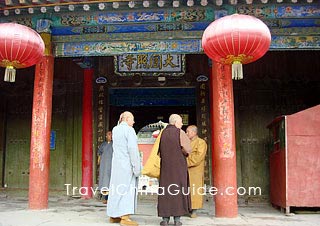 | | Yuanzhao Temple, Mt.Wutai | | 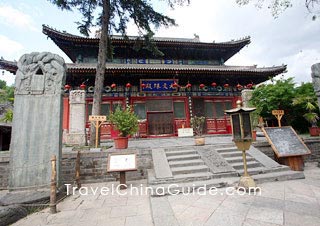 | | Shuxiang Temple, Mt.Wutai | |
How to Get to Xinzhou
Transportation in the area is convenient. Xinzhou Wutaishan Airport operates flights to/from more than 20 doemstic cities, including Changsha, Chongqing,Guangzhou, Hangzhou, Kunming, Shanghai, Xiamen... airport shuttle buses travel between the airport and downtown & Mount Wutai.
Taiyuan is only 75 kilometers (47 miles) from the city and can be reached in thirty minutes. With the construction of an expressway network around this area, only two to four hours are needed from Xinzhou to Beijing, Tianjin, Tangshan and many other cities in Hebei Province.
Visitors can take a bus from Taiyuan Bus Station and Taiyuan Railway Station directly to Mt. Wutai, a trip of three hours. Xinzhou city proper is about two hours' drive to the mountain. During the sixth to the seventh lunar month, high season to travel to Mt. Wutai, towns and counties around the mountain will open tourist bus lines.
Xinzhou Bus Station: 5, Wutaishan Nan Lu, Xinfu District
Xinzhou Passenger Transport station: 1, Yingbin Jie, Qiyi Bei Lu, Xinfu District
See more Xinzhou to Beijing Train
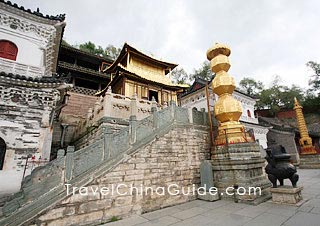 | | Xiantong Temple, Mt.Wutai | | 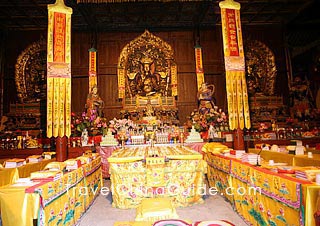 | | Bronze Hall, Xiantong Temple, Mt.Wutai | |
Weather
-
Enjoying a temperate continental monsoon climate, the region has an annual average temperature of 4.3-9.2℃ (39.7-48.6℉). Xinzhou weather is favorable, warmer in winter and cooler in summer. Summer and autumn are the best seasons to admire the beautiful natural sceneries here under bright sky.
Xinzhou Travel Tips
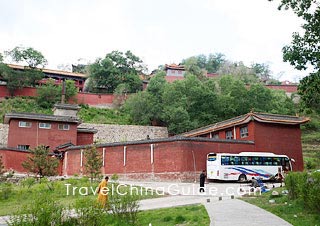 |
| Shancai Cave, Mt.Wutai |
History: Xiurong was the ancient name for Xinzhou. Before it was brought into the shires that the Qin Dynasty (221BC-206BC) established in this region, it successively belonged to the Jin and Zhao kingdoms. It gained the present name in the early Western Han Dynasty (206BC-24AD). Since the Tang and Song dynasties, it had become a town of great military importance in northern Shanxi.
Physical Features: Xinzhou is a part of the Loess Plateau with a mountainous region occupying over fifty percent of the city's territory. The interior of the city is rugged and uneven. The terrain is higher in the northeast from the Taihang Mountains; Mt. Wutain is situated in eastern Xinzhou.
Special Local Products: mushrooms, Codonopsis Root (Dang Shen), Mt. Wutai mineral water, apricots, pears and Daixian County yellow wine, sea buckthorn fruit
- Last updated on Aug. 14, 2025 by Demi Li -