Code: TB09
Journey to Sichuan
North Route: Chamdo - Jomda - Dege - Manigango - Garzi - Luhuo - Daofu - Danba – Boxing - Ya'an - Chengdu
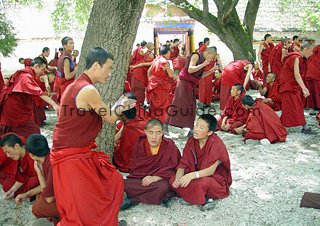
Sutra-debate, Sera Monastery
There are two main routes for visiting the Sichuan-Tibet Road: northern route and southern route. Today we will lead you along the northern route and start the adventure from Chamdo. The road condition is rather rough, but the sightseeing along the road is fabulous and will be far beyond your expectations. As with the Sichuan-Tibet southern route, you have to cross high mountains, tackle rivulets and valleys, many of which show signs of repair following sporadic landslides. However, this is where the beauty lies.
The accommodation and meals along the way are very poor. You should prepare some fast food or snacks if you are unaccustomed to simple Tibetan food. Also, please be aware of your health as it could be affected by the high altitude and poor local conditions.
Again, we suggest you charter a car in order to fully view the scenery along the way, it is sometimes charged per day, sometimes charged per mile. You are advised to book the car in advance and find some companions to share the cost.
Jokhang Temple, Lhasa
From Lhasa to Nyingchi to Basu, you may follow the itinerary previously provided. Form Basu, go along the famous ninety-nine curves to the lakeside of Nujiang, and then arrive at the biggest natural barrier of the Hengduan Mountain Region - Nujiang Mountain (4839m). You will reach Chamdo today, stay here overnight.
The next day morning, visit the Jampaling monastery, which was built in the 15th century and the biggest monastery of the Gelugpa sect in the east Tibetan area of Kham. In its heyday there were more than 1000 monks in the monastery. Afterwards, go to visit the Karuo Ruins (3100m) which are situated at the west of Dza-chu (Langcang River), 12km away from the Chamdo Area. From Chamdo, cross Mt. Damala and drive along the 4000m high mountain ridge; you will reach Jiangda after passing through 4 mountain passes. Jiangda is the last Tibetan county on your trip. Rest here at night.
On the third day, after leaving Jiangda and driving across the Gangtuo Bridge, you enter the first county of Sichuan province, Dege, which is the cultural center of the Tibetan area and is the hometown of the legendary Saer King. Stay overnight in Dege.
Scenery along the way
On the fourth day, drive up to Mt. Que'er (6184m), this part of the road not only has high elevation, but also steep and narrow valleys with many curves. There is another dangerous section of the Sichuan-Tibet Road alongside Mt. Erlang. Then arrive at Yilhun La-tso, 7 to 8km from Manigango and situated at the foot of Mt. Que'er. It is a glacier lake having the highest altitude and biggest area in Sichuan province and beautifully surrounded by mountains and forests. Travel on to Garzi (3390m) to stay overnight. Garzi is an important trading post for Sichuan, Qinghai and Tibet and the county is flourishing. You may recover and rest well here.
On the fifth day, go on to Luhuo. On the way there you will have a chance to take photos at Kasuo-Tso, a waterfowl habitat. Visit the Shengli White Tower, the Shouling Temple and Saka Lake, then pass through Daofu, "Eight Beauties" and across Mt. Gedaliangzi, arriving at Danba for a rest.
On the last day, visit Danba Tibetan village and the splendid blockhouse at Suopo village. Passing over the Danba Bridge, viewing the elegant sceneries along the way, you will reach Xiaojin County. Then passing Mt. Jiajin, Boxing and Mt Lu, you arrive at the last destination Chengdu, the capital city of Sichuan Province.
 Recommended Itineraries with Cheap Price:
Expedition to the challenging Roof of the World: 10 Days, Lhasa - Gyangtse - Shigatse - Dingri - the Everest Base Camp - Dingri - Shigatse - Lhasa
More Hiking Routes: Sichuan-Tibet Overland Adventure
Yunnan-Tibet Overland Journey: 8 days from Deqin to Markham, Chamdo, Riwuqi, Tengchen, Bachen, Sok, Nakchu
Shigatse In-Depth: 3-Day Shigatse Exploration