Xuyuan Garden
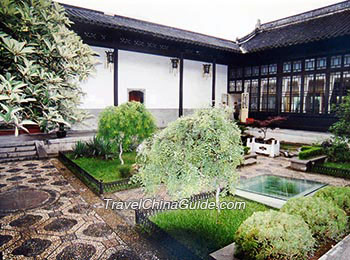 |
| Xuyuan Garden, Nanjing |
Built during the Ming Dynasty (1368-1644), Xuyuan Garden derives its name from a prince, Zhu Gaoxu, who once lived there. Later Xuyuan Garden became the residence for the governors of Zhejiang and Jiangsu provinces. Xuyuan is also known as West Garden for it was located west of the palace of Taiping Heavenly Kingdom (1851-1864). The kingdom was established by a peasant leader, Hong Xiuquan, who then proclaimed himself the king. The Xuyuan Garden later served as the presidential mansion of Sun Yat-sen, the Interim President of the Republic of China (1912-1949). Visitors will find that Xuyuan is the epitome of the modern history of China.
Xuyuan's scenery is definitely worth viewing especially because of its historical significance. It is one of the two most famous gardens in Nanjing City, the other being Zhanyuan Garden. With water covering about half an acre of its total area, Xuyuan Garden is small, but exquisite. Its architecture is rather ingenious, exhibiting the unique beauty and charm of southern gardening. One of the most popular spots here is Buji Zhou, a handcrafted stone boat. Other attractions include Tongyin Guan; Xijia Lou; Wangfei Pavilion and Yuanyang Pavilion.
Buji Zhou was built in 1746 by Yin Jishan, the governor of Zhejiang and Jiangsu provinces. This stone boat has become the symbol of Xuyuan Garden. It is made of marble and is 14.5 meters (about 47 feet) long, 4.6 meters (about 15 feet) wide and 2.7 meters (about 9 feet) high. Its roof is covered by yellow glazed tiles. Its brick railings are inscribed with many fine colored pictures on two sides of the boat. The boat is divided into front and back cabins. There is a stone walkway providing access to the vessel. The boat was named and personally inscribed by Emperor Qianlong of the Qing Dynasty (1644-1911) while he was on a tour of southern China. Buji Zhou has two meanings - one relating to the banks of the lake where it sits; the other, a belief that the nation can only enjoy permanent stability when supported by the masses. When the breezes blow in Xuyuan, the surface of the lake ripples giving the impression that the boat is floating over the waves.
How to get to Xuyuan Garden
2. Take bus 9, 29, 44, 65, 95, 304 or G5 to Zongtongfu (Presidential Palace).
Nanjing Bus / Metro Search
| Entrance Fee | CNY40 (coverd by the ticket of Presidential Palace) |
|---|---|
| Opening Hours | Mar. - Oct.: 8:30 - 18:00; Nov. - Feb. next year: 8:30 - 17:00; Closed on Mondays and Chinese New Year's Eve (except national holidays). Note: Ticket selling stops an hour earlier than closing time. |
- Last updated on Aug. 12, 2025 by Demi Li -