Xiaoling Mausoleum of Ming Dynasty
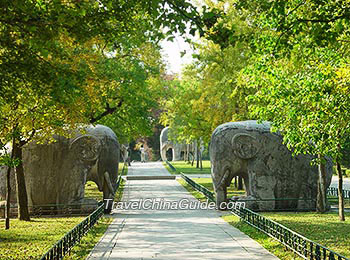 |
Stone Elephants in the Sacred Way Pictures of Ming Xiaoling Mausoleum Pictures of Ming Xiaoling Mausoleum |
Xiaoling Mausoleum is renowned for its unique design, its eminent status, its amazing beauty and its magnificent scale. It's the milestone in the historical development of Chinese mausoleums. As an extension of the 'Imperial Tombs of the Ming and Qing Dynasties, it is listed by UNESCO as a world cultural heritage site.
Construction of the Xiaoling Mausoleum of Ming Dynasty began in 1381 and was completed in 1431. In 1384, Queen Ma died and was buried there. Emperor Chengzu had bestowed upon her the title 'Queen of Xiao Ci' which means 'Queen of Filial Piety and Kindness.' Hence, the name Xiaoling derives from her title.
Xiaoling Mausoleum of Ming Dynasty has two discreet sections: One is the Sacred Way area and the other is the main body of the mausoleum itself.
Sacred Way
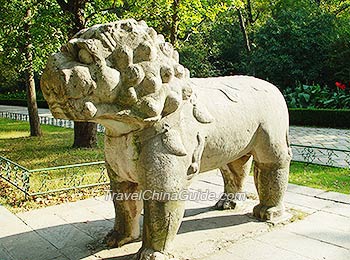
Walking northwesterly across the bridge, you will see the winding 1,800-meter (1.1 miles) long Sacred Way in Xiaoling Mausoleum of Ming Dynasty. Its middle section runs east-west and is called Shi Xiang Road. It is lined with several pairs of stone sculptured animals guarding the tomb. Each animal is postured differently and each conveys an auspicious meaning. For example, the lions, king of the animals, show the stateliness of the emperors, the camels, symbol of desert and tropical areas, indicate the vast territory of the dynasty and the elephants imply that the policies of the dynasty are to meet the desire of the grass root and the stabilization of the dynasty.
|
|
Beyond the animals is a pair of decorative columns called Hua Biao that are carved with dragons. From here the Sacred Way turns into a north-south direction and becomes known at Weng Zhong Road. This location is marked by stone carved statues of ministers and generals. Different from the straight sacred ways in the former dynasties, the Sacred Way at Xiaoling Mausoleum goes in different directions making it unique and unprecedented in Chinese history.
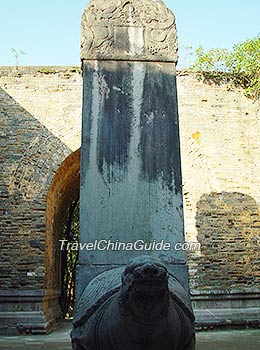 |
| Tablet carried by Bixi, a leganday animal |
Main Body of Xiaoling Mausoleum
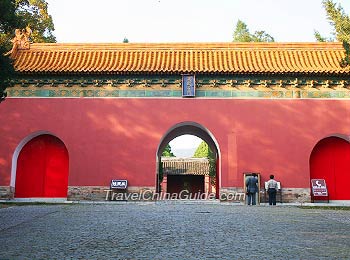
Continuing north along the Sacred Way, you will reach the main body of Xiaoling Mausoleum of Ming Dynasty. There you will start from the Golden Water Bridge (Jin Shui Qiao) and arrive at the main gate named Wen Wu Archway. Outside the gate, there is a stone tablet with words carved in six languages notifying visitors of the importance of the mausoleum.You next arrive at the Xiao Ling Hall, the main structure of the mausoleum. It was rebuilt in the Qing Dynasty (1644-1911) and was smaller in size than the original. Figures of Emperor Chengzu and Queen Ma are hanging inside on the wall.
There are also a variety of sculptures depicting various scenes like the 'Two Dragons Playing with the Pearl', 'the Heavenly Horses Flying in the Sky' and 'the Blazing Sun over the Country'. Then you will come to Fang Cheng (a castle-like building) and Ming Lou (a structure built in palace style with four walls left only). They are both innovations of the Ming Dynasty. The last part is Bao Cheng that looks like a massif and the tomb of Emperor Chengzu and Queen Ma is just beneath.
How to get to Xiaoling Mausoleum of Ming Dynasty
1. Take Metro line 2 to Muxuyuan, and leave from Exit 1. Walk north fpr 20 minutes to get there.
2. Take bus 20, 315, or G5 to Mingxiaoling (Xiaoling Mausoleum of Ming Dynasty).
| Entrance Fee | CNY 70 |
|---|---|
| Opening Hours | Mar. - Nov.: 6:30 - 18:30 Dec. - Feb. next year: 7:00 - 17:30 Ming Xiaoling Museum: 9:00 - 17:00 |
 Ming Xiaoling Mausoleum Ticket Booking
Tips:
The nearby attraction sites Dr. Sun Yat-sen's Mausoleum and Linggu Temple are easily to reach from Xiaoling Mausoleum of Ming Dynasty by sightseeing bus, battery car or small train. The sightseeing bus, small train and battery car ticket is CNY 10 per person, and the tourist special line costs CNY 2 for a single trip. Further Reading
Plum Blossom Hill Further Reading:
Top 10 Things to Do in Nanjing
12 Best Places to Visit in Nanjing