Southern Song Dynasty Guan Kiln Museum
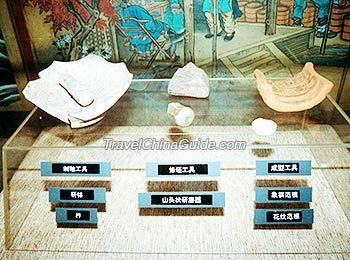 |
Old tools used to make ceramics  Photos Photos |
China is a country with a rich tradition of pottery and porcelain. The history of pottery can be traced back through 8,000 years, while porcelain in the country has a history over 2,000 years. During the Song Dynasty (960-1279), this culture came to a climax. A variety of chinaware appeared. Particularly representative of that time are the products of the official kiln (Guan Yao in Chinese). Guan Yao produces high-class chinaware for royalty - either for daily use or decoration. It is recorded that there were two official kilns in the Southern Song Dynasty (1127-1279): Jiaotanxia Guanyao and Xiuneisi Guanyao.
The Southern Song Dynasty Guan Kiln Museum has a floor area of 15,000 square meters (3.7 acres); the building area is 4,364 square meters (1.1 acres). It was opened to public in 1992 and was extended in 2002. Now the museum displays the products of the official kilns of Southern Song Dynasty, highlighting their charm and delicate beauty. It has been praised as the Civilized Museum of Zhejiang Province and the first group of Provincial Education Base of Patriotism.
Southern Song Dynasty Guan Kiln Museum consists of two parts: the exhibition area and the official kiln relic.
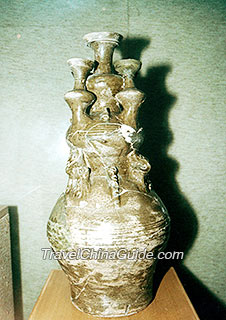
There are three rooms in the exhibition area. In the first exhibition room, many delicate chinaware treasures of past dynasties unearthed in Hangzhou are on display. While in the second room, one can study the history of China's ceramics as well as the social, political and economic base and development after the establishment of official kilns in Southern Song Dynasty. And in the third one, visitors can see the fruits of research on the ancient porcelain of the country and the products in imitation of the famous products of kilns made by modern technology. Now, over 8,000 restored chinaware samples dug up from the site are on display in the exhibition area.
|
|
|

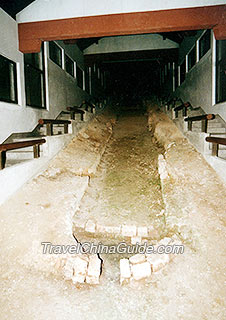
As a part of Jiaotanxia Guanyao, the Dragon Kiln clings to a slope with a total length of 40.3 meters (44 yards). The kiln was built with adobes whose profile is still visible. The remains of Dragon Kiln in the protection corridor have stairs on both sides. The visitors can climb the steps to appreciate the fantastic site.
In the Southern Song Dynasty Guan Kiln Museum, there is a pottery bar with a unique style. Visitors can see for themselves how pottery was made long ago. They can also have the experience of making their own pottery, and so enter into the hardship and exhilaration that must have been the lot of people in long-ago times.
How to get to Southern Song Dynasty Guan Kiln Museum
2. Take bus 20, 42 or 62 to Hangzhou Taocipin Shichang Station, and then walk east for 5 minutes to the museum.
3. Take bus 20, 39, 119, 189, 202, 308, 514a, or 514 to Shuichengqiao and walk north for about 10 minutes to the Southern Song Dynasty Guan Kiln Museum.
| Entrance Fee | Free of charge |
|---|---|
| Opening Hours | Tuesday - Sunday: 8:30-16:30 Closed on Monday except it's a public holiday. |
- Last updated on Jul. 24, 2026 by Sherry Xia -