History of Hutong
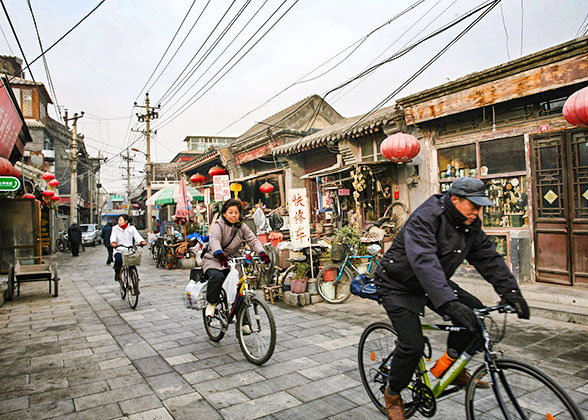 The history of Hutongs can be traced back to the Yuan Dynasty (1271 - 1368) when Beijing was the capital. After the establishment of the Yuan authority, the nobles and heroes were awarded with lands as feudal estates. They built houses and courtyards arranged orderly around the wells. Lanes in between houses were created in consideration of light, ventilation and easy accessibility. Though these countless lanes crisscrossed the old capital like a chessboard, there were only 29 of them called Hutong. As city planning was very strict at that time, roads measured 36 meters (39.4 yards) wide were called main streets. The 18-meter (19.7 yard) wide roads were named side streets and those nine meters (9.8 yards) wide or less were designated as Hutongs.
Later those people got accustomed to settling down around the well, so their original lifestyle – nomadism – was dropped. Different groups of people became stable communities and the cross lanes connected different courtyards, to form the rudiment of the city’s urban area.
These lanes were also places where grain was stored to satisfy the needs of the royal court and armies and to feed the starving populace in lean years. For example, Lumicang Hutong became famous because it was the location of Lumi Grain Depot. Built in the Ming Dynasty (1368 - 1644), it measured over 200 meters (218.7 yards) long, half of which is occupied by the Lumi Grain Depot.
It was in the Ming (1368 - 1644) and Qing (1644 - 1911) Dynasties that the Hutongs dramatically expanded. Based on the layout of Yuan Dynasty, the central government of Ming Dynasty built an outer court as a supplement to the inner city. Due to this construction, more people began to live in the outer court. More varieties of lanes were built to ease people’s life. The number of Hutongs is three times more than that in the Yuan Dynasty.
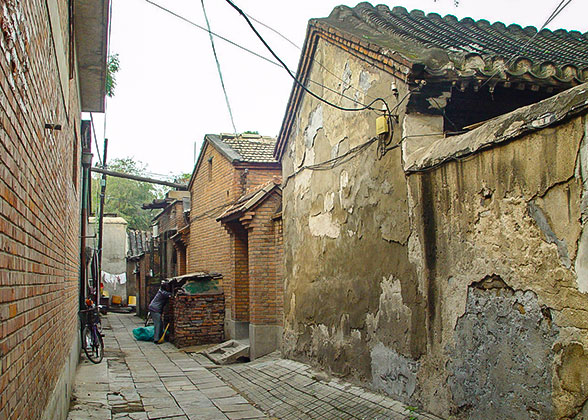 |  |
After the formation of the Qing Dynasty, the central government drove the Han and Hui people out of the city and made the inner city the Manchu’s meeting place. Hence, other nationalities had to build their houses out of the city, which led to fast development of these typical lanes outside Beijing city. The number of lanes inside and outside the city increased to about 2,000. Except the local people, some businessmen and candidates lived there, which made the outer city more prosperous.
From the end of the Qing Dynasty to early 1949, the number of Hutongs increased rapidly to about 3,000. After 1949, the rapid development of Beijing City promoted the construction of the lanes, making the total number to over 6,000. However, the number decreased rapidly due to the urbanization of the city in the later years. Up till 2003, there are only 1,571 lanes left but no more than 1,300 to date. These lanes had been overtaken by modern buildings over the years and people have moved out gradually too. Only the famous ones are preserved and converted into tourist spots.
- Last updated on Nov. 29, 2023 by Kate Liu -
Questions & Answers on History of Hutong in Beijing
Asked by Mr.Silva from AMERICA | Dec. 27, 2009 12:20 Reply
Reply
ReplyCan someone describe more of the Hutongs history and help me understand more facts about the Hutong?
Thank You
Thank You
Answers (2)
Answered by Ms.Kaye | Dec. 30, 2009 21:54 0
0 0Reply
00ReplyThe word "hutong"dated back to Yuan Dynasty (1271-1368), as it is a Mongolian word, meaning "water well". According to the old saying:"where there is a well, there are people living nearby". Now the exiting Hutong can reflect the development of Beijing, and today we can say where there is a hutong, there is a story.
Answered by Ms.Ellison | May. 17, 2010 09:2401Reply
01ReplyThere are currently very little hutongs left because many of them got demolished after the founding of the People's Republic of China. The land on which the hutongs were once on were used to built high rise buildings such as offices and apartments. Also, many sold their ancestry houses in order to purchase apartments with modern amenities. Soon, the goevernment realised the quick depletion of the hutongs. They named some of the hutongs as protected and prevented them from getting demolished. Since then, hutongs became a tourist attraction.