Top 10 Famous Hutongs in Beijing
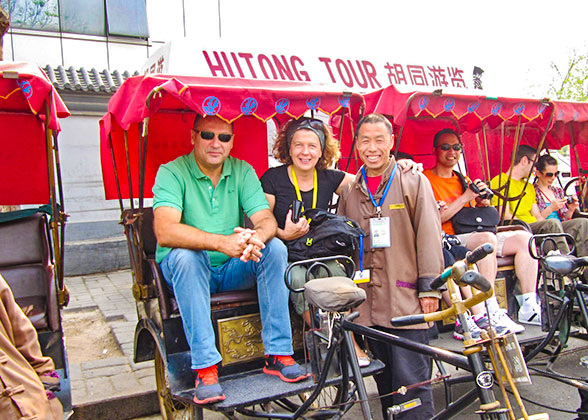 |
| Hutong Tour By Rickshaw |
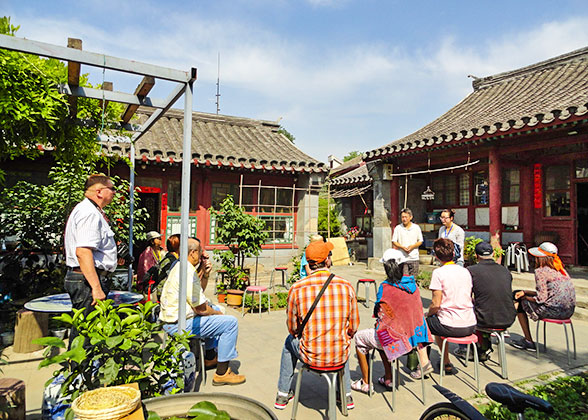
Crisscrossing hutongs and old courtyards form the living places of the natives in Beijing. Many folk activities still remain there.
In central Beijing, there are two main areas for the ancient small alleys - one is the Shichahai and Bell / Drum Towers Area not far to the north of the Forbidden City, and the other is the Qianmen and Dashilar Area to the south of the Tiananmen Square.
Nanluoguxiang
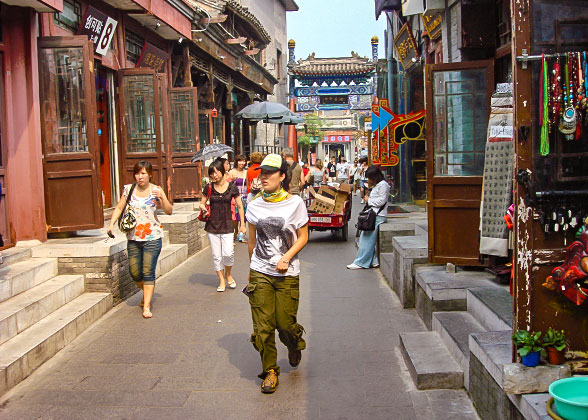
(South Gong and Drum Lane)This old lane is renowned for its long history, culture, specialty stores, and distinctive foods. It is 2,582 feet (787 meters) long and 26 feet (8 meters) wide, with its north end joining East Drum Tower Street, and the south end connecting East Di'anmen Street. This alley is also called Centipede Street because of the eight alleys symmetrically arranged on the two sides of the major lane.
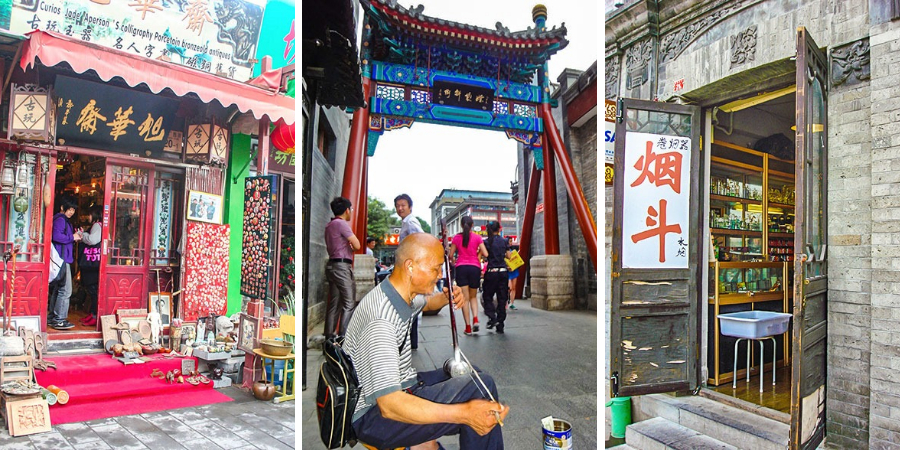
It measures 761 feet (232 meters) long, connecting Di'anmen Outer Street at the east end and the junction of Xiaoshibei and Ya'er Hutongs at the west end. The slender street is like a pipe's stem, stretching from northeast to southwest, and its east end looks like the pipe's mouth. Besides, there used to be a bunch of pipe shops in late Qing Dynasty (1644 – 1911). So people called this street Skewed Tobacco Pouch. Today, many different kinds of bars, tea houses, coffee rooms and souvenir shops have mushroomed on the street.It is in the northwest of Dongcheng District, stretching 1,919 feet (585 meters) from South Gong and Drum Lane to Di'anmen Outer Street. A lot of celebrities have lived there, such as Wan Rong - the last empress, Feng Guozhang - a leader of the Northern Warlords (1912-1926), and Hong Chengchou - a general in the Ming Dynasty (1368 –1644). Many of their former residences remain there.
Guozijian Street is to the west of Yonghe Temple, with its east end joining Yonghe Lamasery Street while the west end adjoins Andingmen Inner Street. The street is 2,195 feet (669 meters) in length and 36 feet (11 meters) in width. It is the only old alley in Beijing that still has traditional arches. Guozijian Street is renowned for its old-time Beijing layout and architectures, authentic native lifestyle, Temple of Confucius and Imperial Academy (Guozijian).
Liulichang Cultural Street
(Colored Glaze Factory Culture Street)Jinyu Hutong
(Goldfish Hutong)Dongjiaomin Lane
(Dongjiaomin Xiang)Xijiaomin Lane
(Xijiaomin Xiang)Ju'er Hutong
Bada Hutong
(Eight Great Hutongs)
|
|
Others
 Zhuanta Hutong: It was named after the Brick Tower (Zhuanta in Chinese) inside, commemorating an eminent monk - Wan Song in the Jin Dynasty (1115 - 1234).
 Fengfu Hutong: It is to the west of Wangfujing Street, housing the former residence of Lao She, one of Chinese famous writers in modern times.
One Foot Street (Yichi Dajie): It's the shortest one with a length about 33 feet (10 meters).
Qianshi Hutong: It was the location of money market (Qianshi) in the Qing Dynasty. Known as the narrowest one in Beijing, its narrowest point is about 1.3 feet (0.4 meters) wide.
Lingjing Hutong: It is the widest one with a width of 106 feet (32.18 meters) at the widest point.
Jiuwan Hutong: It has the most curves.
Sanmiao Street: It is the oldest one dated from the Liao Dynasty.
Dongsi Hutongs: It was lived by many celebrities.
 Beijing Day Tours