Translated as Imperial College or Imperial Academy, Beijing Guozijian was first established in 1306. It served as the supreme administrative headquarters for the organization of education and the highest seat of learning during the Yuan (1271-1368), Ming (1368-1644) and Qing (1644-1911) dynasties. Flanked by the Temple of Confucius and Lama Temple, it is located at 15 Guozijian Street (originally named Chengxian Street).
Being the imperial college, Guozijian attracted much attention from the state, and was rebuilt many times. After two large-scale repairs in the Ming Dynasty, and the construction of Biyong Hall in the Qing Dynasty, it became what we see today, covering an area of 9.1 acres (3.7 hectares). Gu is the last imperial academy in China and has been listed as an important cultural relic site under state-level protection.
Remarkable Architectural Complex
Facing south, Guozijian is the only imperial college from ancient times preserved up to now. It is a remarkable architectural complex, with over one hundred buildings. Jixian Gate (the front gate), Taixue Gate (the second gate), the glazed archway, Biyong Hall, Yilun Hall and Jingyi Pavilion are located along the central axis. On the east and west sides of the main building, four halls and six palaces were laid out to achieve the symmetrical effect of perfect unity.
Glazed Archway
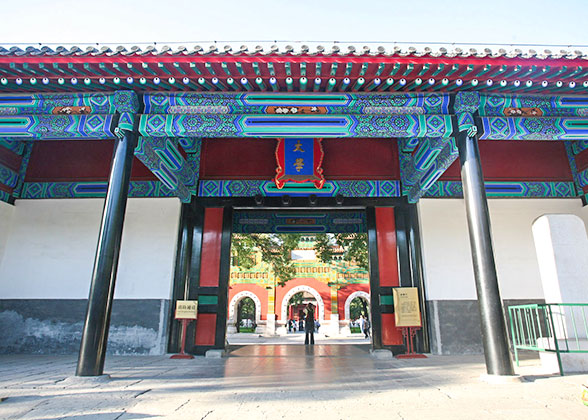
Tai Xue Gate
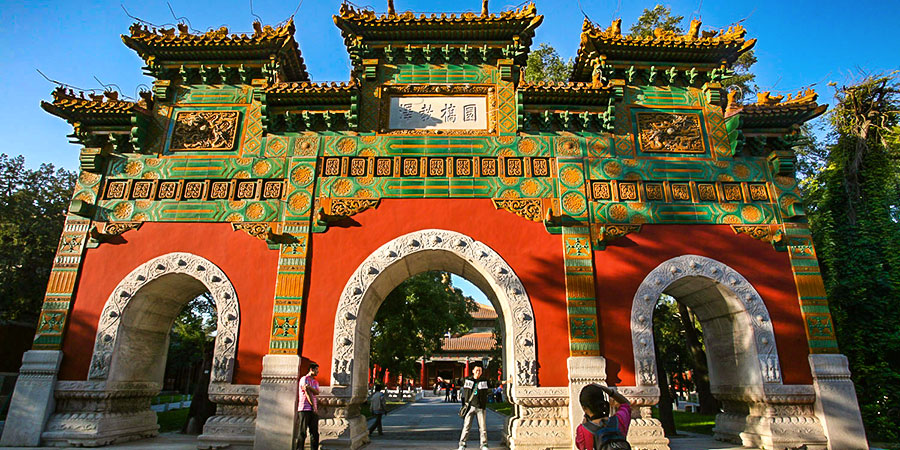
Inside the second gate, Taixue Gate, stands an imposing glazed archway. It is the only archway built to show the value of education in Beijing. Built in 1783, it has three portals, four pillars, and a roof in with four slopes and five ridges, of which the main ridge is formed by the front and the back slopes. On the glazed archway, there is a horizontal tablet, whose inscriptions on both sides were written by the Emperor Qianlong of the Qing Dynasty (1644-1911). Yellow glazed tiles cover the roof of the archway, showing the strong belief of the royal family in education. Side note: the color yellow is the representation of the ancient Chinese royal family.
Yilun Hall
Yilun Hall, the auditorium, is located north of Biyong Hall. Before Biyong Hall was built, Yilun Hall was the lecture room when the emperor gave lessons. The horizontal tablet bore its name Yilun Hall and was inscribed by Emperor Kangxi. There are four halls on the east and west sides of Yilun Hall, which served as separate venues for the officials who were in charge of documents, discipline, books, and education respectively.
Jingyi Pavilion, built in 1528, sits behind Yilun Hall. On the east and west sides of the pavilion, there are offices for Jijiu, the president of the Imperial Academy, and Siye, the deputy.
Biyong Hall
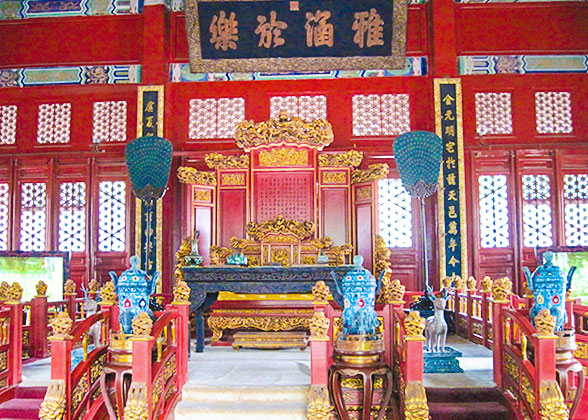
Inside Biyong Hall
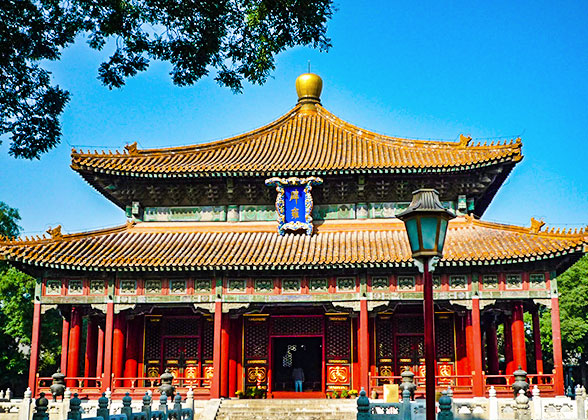
Biyong Hall, the main building of the Imperial Academy, sits north of the glazed archway. The hall, built on a high square platform, is surrounded by a circular moat. This architectural style embodies the traditional Chinese belief that the Earth was square and the Heaven was round. The south-facing Biyong Hall is 19.4 yards (17.7 meters) in both length and width. It was the venue where emperors gave lectures. The double-tier roof of Biyong Hall is covered by yellow glazed tiles, with a gold-plated pearl-like object on its peak. Hung between the eaves of the double-tier roof is a horizontal tablet inscribed by Emperor Qianlong with the two characters for Bi Yong, the name of the hall. Biyong Hall has four doors, one on each of the four sides: east, west, north and south. Outside the doors, there are stone bridges over the moat connecting Biyong Hall to the courtyard, symbolizing the spreading of the knowledge. Entering the hall, you will see the throne, the armchair, the screen and other imperial furniture which were used by Emperor Qianlong when he came here to give lectures. Hanging on the wall are the horizontal tablets inscribed by the Qing Dynasty Emperors Qianlong, Daoguang, and Xianfeng. The beautifully painted dome will also draw your gaze.
Six palaces containing 33 rooms are on the east and west sides of Biyong hall. The palaces are where the students had classes.
It not only has imposing buildings, but also has precious cultural relics such as books and stone inscriptions. A good collection of books is kept here. The most valuable ones are the books edited on the emperors' command, and some books are very rare in the world. It also houses a collection of a great number of steles, among which the most precious ones are the 189 steles carved with "the Thirteen Classics". The over 630,000 character "Thirteen Classics" carved in the steles are Zhouyi (the Book of Changes), the Book of History, the Book of Songs, the Spring and Autumn Annals, the Analects, Mencius and other Confucian classics. These books were copied by Jiang Heng in Kai (the regular script) character over a period of more than 11 years from 1726 to 1737. It took another four years to engrave these books in the steles from 1791 during the reign of the Emperor Qianlong of Qing Dynasty. So these steles are also called "the Stone Classics of Qianlong". The 189 steles together with 1 stele commemorated the completion of the stone "Thirteen Classics" originally in the six palaces, are now located in the lane between it and the Temple of Confucius.
How to get to Guozijian
By Bus: 1. Take bus 13 or 84 and get off at Guozijian Station. Walk northward for 50 meters (54 yards), turn left and walk for 300 meters (383 yards) to find the gate. 2. Take bus 116 or 117 and get off at Yonghegong (Yonghe Temple) Station, walk southward for 350 meters and turn right to find the gate. By Subway: Take Subway Line 2 or Line 5 and get off at Yonghegong Station. Get out from Exit G. Walk south along Yonghegong Street for about four minutes. Then turn right and walk west along Guozijian Street for two minutes. Enter Guozijian through the gate of the Temple of Confucius. Beijing Bus / Subway Search
Admission Fee
CNY 30 - combo ticket for Guozijian and the Temple of Confucius Free for the minors and the old over 60
Opening Hours
May to October: 08:30 to 18:00 (tickets sale ends at 17:00) November to April: 08:30 to 17:00 (ticket sale ends at 16:30) Closed on Mondays.

 By Bus:
 By Subway:
 Closed on Mondays.