Chinese Calligraphy

 General Introduction
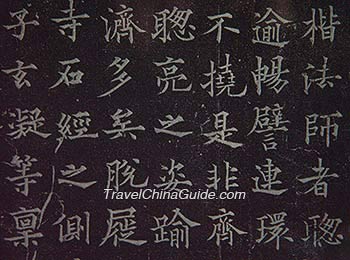
Chinese calligraphy worksIn China calligraphy occupies a distinguished position in the field of traditional art. It is not only a means of communication, but also a means of expressing a person's inner world in an aesthetic sense.

Ancient people paid great attention to calligraphy. It was the essential whereby a candidate could manifest his literary talent in the Imperial Examination, for it gave a first impression to the examiners. Children of high officials had to learn and try to write a good hand; even emperors themselves were good at calligraphy, for example, the versatile Emperor Qianlong in the Qing Dynasty (1644 – 1911) has left us many examples of his handwriting on steles in temples and palaces.

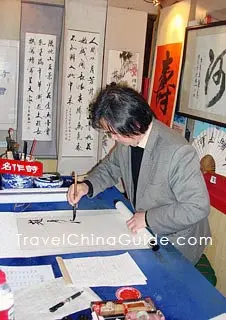
To practise calligraphy requires the basic tools of 'four treasures of study' (writing brush, ink stick, paper, and ink slab) as well as much concentration on guiding the soft writing brush charged with fluid ink, and writing on the paper where the ink will diffuse quickly. Once the brush movement hesitates, a black mark is created, so speed, strength and agility is the essence of fine artwork. When writing, many calligraphers will forget all worries and even themselves, combining all thoughts in the beauty of their art. Thus it can be compared with Qigong, which also can mould and improve a person's temper and promote well being.
Calligraphy, like a mirror, is a silent reflection of the soul. It is believed to have verve, of optimism, moderateness, or pessimism. Su Dongpo, one of the four litterateurs in the Song Dynasty (960 - 1279), composed many bold and unconstrained ci (a form of poetry that flourished in the Song Dynasty), also could write handsome characters in good taste.

Today, although various modern ways have been substituted for the original calligraphy, especially which created with a writing brush, people still love the ancient form and practise it untiringly. During the traditional festivals, propitious couplets are always indispensable decorations each written in a beautiful style.

 History of Calligraphy

Calligraphy has endured for more than 2,000 years, and evolved into five main ways of writing each with different techniques. Even today, these are still followed and practiced often as a hobby.
Just as calligraphy is an art practiced in western cultures so Chinese writing is a leading component in the four traditional arts, namely lute-playing, chess, calligraphy and painting. With the unification of the Chinese people by the Qin Dynasty (221 BC – 206 BC) the Prime Minister Li Si actively promoted a unified form of writing based on inscriptions on bronze wares of previous states. This was the first example of calligraphy – known as 'seal character' (Zhuanshu). Calligraphers of seal character stress a slender font, even speed and strength, and even thick lines and strokes. When seen as a whole, this calligraphy is quite round and contracted.

Cursive script in the Forest of Stone Steles Museum, XianIn the Eastern Han Dynasty (25 - 220), people tended to simplify the seal character which had many strokes and created the official script. The new calligraphy appeared to be much neater and delicate, turning the round style into a flat one. When beginning to write a horizontal line, one must let the brush go against the direction of point like a silkworm, and concentrate on stretching steadily, then end up with warp like a swallow's tail. This is one of the characteristics – 'silkworm's head and swallow's tail'.

Just as the name implies, the regular script features its regularity and varies from the flat font to a square one. In Chinese it provides a model that can be followed by calligraphy lovers. It has developed since the late Han Dynasty and is today's most popular and influential writing style. The Sage of Calligraphy, Wang Xizhi led the art of calligraphy to its summit. It is recorded that when a carpenter was asked to engrave the wooden stele where there were characters written by Wang Xizhi, he found the ink had filtered into the wood piece 'three fen' deep (3.3cm or 1.3 inch)! This demonstrated the magnitude of his force and people admired him all the more because of it. The period when regular script thrived most was during the Tang Dynasty (618 – 907), when Yan Zhenqing and Liu Gongquan successively established schools of their own styles noted for their strength and mellowness.

Cursive script has more flexibility, for it only maintains the essence of each character and expresses more personal exertion. Therefore its value lies in appreciation more than practicality. While the running hand makes full use of connecting lines between two strokes it can be regarded as the quickly-written form of regular script. These two seem to be more unrestrained than the previous styles.

 Four Treasures of the Study

 Writing Brush
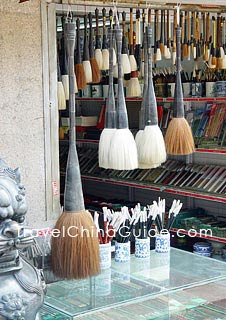
Writing brushesThe earliest writing brush that has been found is a relic of the Warring States Period (476 BC – 221 BC). From that time onwards, the brush has evolved into many forms. The nib can be made from rabbit's hair, wool, horsehair, weasel's hair, or bristles, and so on; while the shaft may be made from bamboo, ivory, jade, crystal, gold, silver, porcelain, sandal, ox horn, etc. It is important to see that there can be both soft and hard brushes each producing their own particular styles.

The delicacy gives literators and painters inspiration for creation, and has led to brush shafts being decorated with artistic patterns. One prized example was an ivory-weasel's hair writing brush. On the ivory shaft with the diameter of 0.8 cm, there carved eight figures of the immortals and pavilions concealed seemingly in the clouds. With this in one's hand, the threads of writing would hardly halt.

 Ink Stick
A good ink stick should be ground so as to be refined black with luster. With the invention of paper, they were improved accordingly. Since the Han Dynasty (206 BC - 220), ink sticks have been made from pine soot, using other procedures that include mixing with glue, steaming and molding. In ancient times, emperors such Qianlong in the Qing Dynasty (1644 - 1911) had paid great attention to the production of ink sticks and were expert in their appreciation of quality inks.

 Paper
Paper making is among the 'four great inventions' and one of the great contributions that ancient Chinese people made to the world.

Before the existence of paper, our ancestors utilized knots in cords to record events. They then carved on bone, ivory, tortoise shell and bronzes. For very many years they wrote on pieces of bamboo. There is a story that tells how Confucius was such an avid and diligent reader that he would wear away the strips of ox-leather used to bind the pages of bamboo books together. During the early Han Dynasty wealthy people would write upon white silk but this was beyond the reach of the majority as the cloth was so precious.
It was Cai Lun who made the valuable contribution and his research gave rise to paper. Afterwards, many varieties of paper were produced of different quality and usage. Today the Xuan paper originally made in Anhui Province still shines with its charm.

 Ink Slab
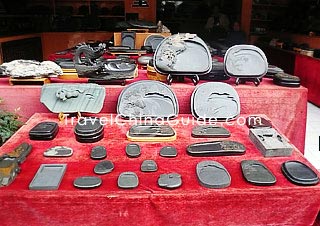
The ink slab is the reputed head of the 'four treasures', for its sobriety and elegance has endured the passage of time. Through ink slabs, people can sample the artistic charm of sculpting and the ink stone's natural tints. Nearly all Chinese calligraphy enthusiasts hold that the star of ink slab is the Duanyan, ink slab produced in Duanzhou of Guangdong Province. It has its base a purple hue and enjoys the poetic name 'purple clouds'. It was always a tribute to the royal families during the Tang Dynasty (618 - 907).

Chinese Brush Calligraphy: get your personalized Chinese calligraphy handwritten in ink by Chinese artists. Free translation!

Travelers' Voices on Chinese Calligraphy

1.

May. 8,2009 09:04 Reply

Mr.Nielsen(Denmark) said:

Is it possible to get my name written with chinese Calligraphy?

May. 9,2009 22:20
Ms.Evelyn(CN) replied:

Use the brush pen to write letters? Yes, you can do it. However, Chinese calligraphy always matches Chinese characters. Only when it's used to write Chinese characters, it seems more beautiful. This situation is more like a metaphor. Oriental ladies are more suitable for wearing Cheong-sam than western ladies.

Jul. 22,2009 02:11
Mr.joeyong(China) replied:

no problem email:joeyong@yahoo.cn

Oct. 18,2009 19:37
Ms.sitts(USA) replied:

i know it is so hard

2.

Jun. 18,2009 09:55 Reply

Ms.eranto(georgia) said:

i want to see the real callogriphy

Jul. 22,2009 02:10
Mr.joeyong(china) replied:

OK welcom to beijing

3.

Jul. 7,2009 08:03 Reply

Ms.ENAIRA(PHILIPPINES) said:

i know how to write chinese words but learning chinese calligraphy is hard.but in my old school our lao sher(teacher) always tries to teach us..

4.

Mar. 30,2009 12:36 Reply

Mr.Feng zhuo(Shandong, China) said:

Dear Sir or Madam:
Very glad to know you, I come from Qufu, China, the hometown of Confucius, my family has run a Chinese writing brush pen workshop for five generations, and we could offer you all kinds of Chinese brushes.
As a saying goes, the mechanic who wishes to do his work well, must first sharpen his tools. Finding a good brush is very important for you, if you want to study Chinese calligraphy well.
Lots of famous scholars and calligrapher have written title for our shop, such as Shen Peng (Chairman of Chinese Calligraphers Association), Kong demao (Confucius’77 lineal generation).
Liu yi, Kuang yaming, Jiang weisong, Wei tianchi, Mai huasan, Fan zeng, Lu yanshao, Chen gengqiao, Wang bomin.
Since the reform and open policy of our country, our workshop also walked up to the world. If you are interested in our brush, please contact me, my email and MSN: ideasforlife2008@yahoo.com.cn. I may list them on ebay and you could pay me via Paypal.
Two pictures of our brush workshop:
http://img.snpstudios.com.cn/upload/pics/9a1c291eccd9d86abb04d915b85fb3b1.JPG
http://img.snpstudios.com.cn/upload/pics/ce2a96ae2a10a1c1eca4002228ea98d9.jpg

5.

Feb. 10,2009 15:14 Reply

Ms.mdd(USA) said:

I love Calligraphy!!!!!!

6.

Jan. 13,2009 19:13 Reply

Mrs.Jonas(california) said:

this is really awesome its so jonas-tastic

7.

Jan. 12,2009 04:37 Reply

Ms.red(usa) said:

i'd want to know how chinese writes..

8.

Jan. 5,2009 13:57 Reply

Mr.Squarepants(Bikinibottom) said:

Chinese Calliagraphy is totally awsome~!

9.

Dec. 28,2008 15:55 Reply

Mrs.Judy(USA) said:

I have practiced calligraphy for many years and am just now learning about its origin. It is a fascinating and beautiful art.

10.

Nov. 29,2008 04:01 Reply

Ms.tere(philippines) said:

i'd like to learn chinese calligraphy...because i think this is really beautiful...

Nov. 30,2008 20:16
Ms.Chun Yuan(China) replied:

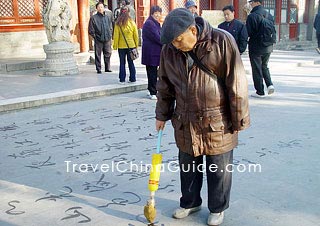
It's very difficult to master Chinese calligraphy. Most of Chinese people are not good at it. At Shu yuan men (in Xian City, Shaanxi Province), sometimes you could see calligraphers writing. Their masterpieces are extremely beautiful. Even you will think it's not only Chinese characters but a splendid painting. In China, especially the senior citizens love calligraphy, I think. Sometimes, one use mop as the brush pen, use water as ink, and use the ground as paper to do calligraph.

Comment Reply