 |
| Lovely Toys |
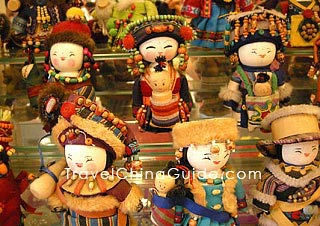
As an indispensable part of traditional folk art, toys are a unique expression of the long and uninterrupted Chinese history. Religious beliefs, world view, taste, classical works and local customs, especially festivals and the 'Four Great Classical Chinese Literatures', are all represented by the use of various techniques requiring an artisans' deepest wisdom and creativity. The advantage is that the greater majority of people can enjoy the pleasure of toys that are easier to make and more widely available than other artistic works such as jade or silver wares, as they tend to utilize common articles that are readily available, such as cloth, grass, straw, clay, paper, and so on. Even so, it should be noted that these toys are not of a coarse manufacture, but of rustic simplicity and vivacity.
Generally, the diverse variety of folk toys can act as decorations to be appreciated or as knickknacks to be played with. As such, the two categories are those for festival decoration and those for daily enjoyment.
Festival Toys
 |
| Chinese Folk Toys |
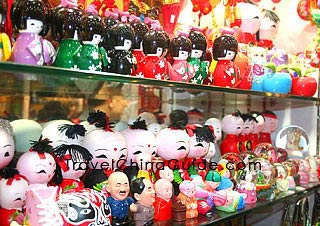
Those during festivals are quite flowery and customary. In the
Chinese New Year, people use firecrackers and fireworks; in the Lantern Festival, there are lanterns in the shape of lotus, monkeys, dragons, etc; in the Pure Brightness kites will be flown in the blue sky; and during the Dragon Boat Festival, people will take sachet with them. Old people's sachet looks like a peach, symbolizing longevity while children's sachets are of lovely patterns, with fragrant herbs inside to ward off evil spirits. In ancient times, they were also a token of love that a girl would give to her beloved.
For Appreciation
Those for appreciation and decoration stresses artistic conception. Carvings on root, stone and nut, painted eggshell, modeling with clay, porcelain and wax are all exquisite, especially those of figurines with their natural beauty.
Cloth paste pictures (collages) are interesting and distinctive. Most of its artisans are women who are good at needlecraft. Up until quite recently, almost every girl was able to make clothes and shoes out of cloth, with the off-cuts being used as convenient materials for collages. Choosing a large piece of cloth on which to sew or collage into the basic pattern, then adorn it with small pieces of lace. Utilizing color and texture and finished off with butterflies, tigers, children and real flowers are very appealing.
The Hairy Monkey was probably invented in Beijing during the Qing Dynasty (1644-1911). By sticking many shaggy magnolia flower buds color resembles a monkey's fur, the lively posture of a monkey can be presented. As these materials are not readily available, this folk art is a lot rarer.
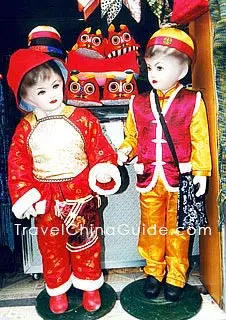 | | Festival Toys | | 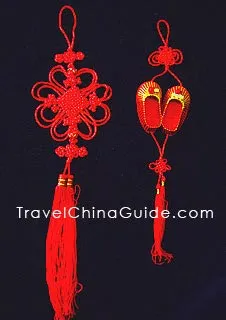 | | Chinese Knots | | 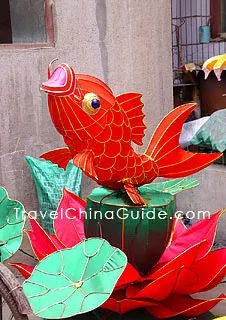 | | Goldfish-shaped Lantern | |
During the very early period of Chinese cultural development, the ancestors had worshiped the immortals. Rope, pronounced as 'Sheng', shared a similar pronunciation with the word for gods ('Shen' in Chinese), and when written, it looked like a dragon, an auspicious animal in Chinese culture; knots, in Chinese 'jie' means vigor, harmony, and unification, Therefore, this unique Chinese knots artwork has been a popular gift for thousands of years and embodies best wishes. People wore it in the beginning as a decorative addition to clothing, and later, used it to decorate their houses. Though the weaving techniques are complicated, ropes, in hands of a deft craftsman appear effortless moving the shuttle in between the rows of ropes. A Chinese knot is usually symmetrical in structure and colorful with jade or porcelain beads. This no doubt adds more jubilation to any festive atmosphere.
Euphonious Toys
Sounds can increase the amusement of toys. The main ones are whistles made of clay, porcelain, and bamboo. The simplest way is to blow directly along the edge of a leaf or blade of grass. Shadow puppets, displayed on the screen and steered by people behind, and the rattle-drum which can make the rattling sound by shaken are also favorites amongst children.
Play with Wisdom
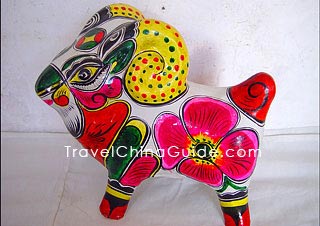 |
| Painted Clay Sculpture |
For Chinese who attach a great importance to the development of children's wisdom, jigsaw puzzle ('Qiqiaoban') might be the most ideal choice. Composed of 7 pieces in a certain shape, this toy requires one's brain exertion to join those pieces into a given pattern without leaving any gaps. The puzzle ring is another well-known game. It is said to originate from the Warring States Period (476–221 BC). Appearing to be one of the most incomprehensible games in the human history, it even aroused the attention of Western mathematicians. To separate the nine rings which are buckled together or to join separated nine rings together is quite intricate indeed.
Practical Toys
Besides being for play, they can also be of practical use, as part of finery, bedding and foodstuff. Children love animal-shaped pillows or hats. Today, the mascot of Olympic Games 2008 in Beijing is the lovely panda hat to numerous zealots. For the foodstuff, flour's plasticity helps people's imagination come true. In Shanxi Province, people are still experts at steaming flour figures. Suppose how pleasant they will be when seeing vivid edible flour rabbits and pigs!
- Last updated on Aug. 08, 2022 -
 Reply
Reply 1
1 4
4