Chinese Music
Development
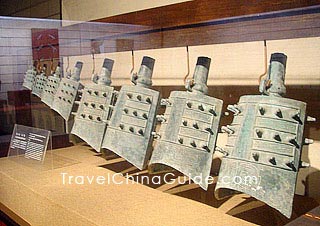 Chimes and Bells in the Xia,
Shang and Zhou Dynasties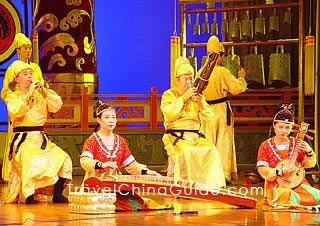 Tang Dynasty Music Show
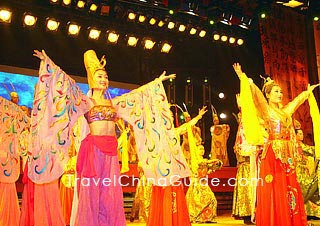 Tang Dynasty Dancing and Singing Show
Traditional Chinese music can be traced back 7,000 - 8,000 years based on the discovery of a bone flute made in the Neolithic Age. In the Xia, Shang and Zhou Dynasties, only royal families and dignitary officials enjoyed music, which was made on chimes and bells. During the Tang Dynasty, dancing and singing entered the mainstream, spreading from the royal court to the common people. With the introduction of foreign religions such as Buddhism and Islam, exotic and religious melodies were absorbed into Chinese music and were enjoyed by the Chinese people at fairs organized by religious temples.
In the Song Dynasty, original opera such as Zaju and Nanxi was performed in tearooms, theatres, and showplaces. Writers and artists liked it so much that Ci, a new type of literature resembling lyrics, thrived. During the Yuan Dynasty, qu, another type of literature based on music became popular. This was also a period when many traditional musical instruments were developed such as the pipa, the flute, and the zither.
During the Ming (1368 - 1644) and Qing Dynasties (1644 - 1911), the art of traditional opera developed rapidly and diversely in different regions. When these distinctive opera styles were performed at the capital (now called Beijing), artists combined the essence of the different styles and created Beijing opera, one of three cornerstones of Chinese culture (the other two being Chinese medicine and traditional Chinese painting) which continue to be appreciated even in modern times.
Besides these types, Chinese peasants were clever enough to compose folk songs, which also developed independently with local flavor. Folk songs described working and daily life such as fishing, farming, and herding and were very popular among the common people.
Traditional Musical Instruments
They can be divided into four categories: stringed instruments, percussion instruments, plucked instruments, and wind instruments. The following are just a few of them:
Horse-Headed Fiddle
The Horse-headed fiddle is a bowed stringed-instrument with a scroll carved like a horse's head. It is popular in Mongolian music. With a history of over 1,300 years, it even influenced European string music when Marco Polo brought one back from his travels through Asia. Its wide tonal range and deep, hazy tone color express the joy or pathos of a melody to its fullest.
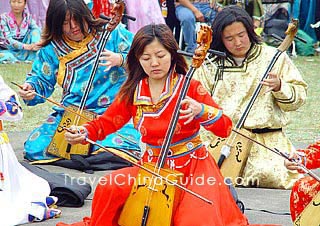
 Horse-Headed Fiddle
The Mongolian people bestowed upon their beloved horse-headed fiddle a fantastic legend: during horse-racing at the Nadam Fair -- their featured grand festival--a hero, Su He, and his white horse ran the fastest, which incurred the envy and wrath of the duke. The cruel duke shot the horse dead, and Su He grieved so much that he met his horse in a dream. In the dream, the horse told Su He to make a fiddle from wood and the hair of a horse's tail, and to carve the head of the fiddle in the shape of a horse's head. The lad followed the horse's advice and when he finished, the fiddle produced an extremely vivid sound. From then on, people loved this instrument and composed many songs for it.
Lute (Pipa)
Afterwards, the pipa underwent improvement in playing techniques and structure. Players then changed from holding the pipa transversely to holding it vertically, and from using a pick to using the fingers to pluck the strngs directly. In modern times, the volume and resonance has also been improved. The traditional work 'Spring Moonlight on the Flowers by the River', which has a history of over one hundred years, has brought harmony and a sense of beauty to untold numbers of people.
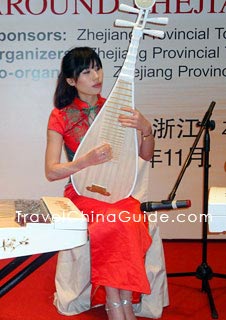 Lute (Pipa)
 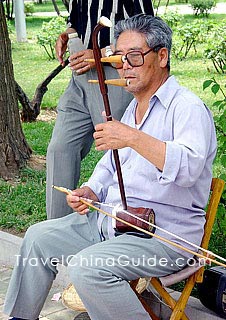 Erhu
Erhu 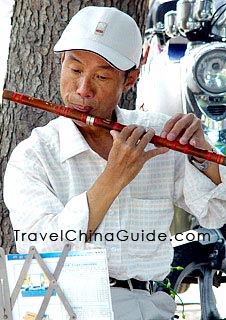 Flute
Flute
Erhu
When playing, the player usually stands the Erhu on his lap, and moves the bow across the vertical strings. The well-known music 'Two Springs Reflect the Moon' was created by the blind folk artist Liu Yanjun, also named A Bing by the people. Though he could not see anything of the world, he played his Erhu using his heart and imagination. This melody conjures up a poetic night scene under the moonlight and expresses the composer's desolation and hope.
