Chinese Shadow Puppetry
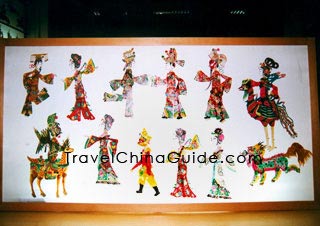
Shadow puppetry, or Shadow Play, was very popular during the Tang (618 - 907) and Song (960 - 1279) dynasties in many parts of China. Shadow puppets were first made of paper sculpture, later from the leather of donkeys or oxen. That's why their Chinese name is pi ying, which means shadows of leather.
 |
 Video of Shadow Puppet Show Video of Shadow Puppet Show |
History of Shadow Puppets
More than 2,000 years ago, a favorite concubine of Wu Emperor of the Han Dynasty died of illness; the emperor missed her so much that he lost his desire to reign. One day, a minister happened to see children playing with dolls where the shadows on the floor were vivid. Inspired by this scene, the smart minister hit upon an idea. He made a cotton puppet of the concubine and painted it. As night fell, he invited the emperor to watch a rear-illuminated puppet show behind a curtain. The emperor was delighted and took to it from then on. This story recorded in the official history book is believed to be the origin of shadow puppetry.
Shadow puppetry was related to politics. In Beijing, for example, during the reign of Emperor Kangxi, this folk art was so popular that there were eight generously paid puppeteers in one prince's mansion. When the Manchu rulers spread their rule to various parts of China, they brought the puppet show with them to make up for the fact that they could not appreciate local entertainment due to language barriers. From 1796 to 1800, the government forbade the public showing of puppet shows to prevent the spreading of peasant uprising at the time. It was not until 1821 that shadow puppet shows gained some vigor.
Today, the show faces extinction like other traditional art forms such as Nuo Drama.
Features of Shadow Puppet Show
Shadow puppetry wins the heart of an audience by its lingering music, exquisite sculpture, brisk color and lively performance.
One mouth tells stories of thousands of years; a pair of hands operates millions of soldiers. This is how the shadow puppeteer works. Nicknamed the business of the five, a shadow puppet troupe is made up of five people. One operates the puppets, one plays a horn, a suo-na horn, and a yu-kin, one plays banhu fiddle, one is in charge of percussion instruments, and one sings. This singer assumes all the roles in the puppet show, which of course is very difficult. That is not all; the singer also plays several of the over 20 kinds of musical instruments in a puppet show. These ancient musical instruments enhance this ancient folk art.
 The stage for the play is a white cloth screen on which the shadows of flat puppets are projected. Shadow puppet looks similar to paper-cut except that their joints are connected by thread so that they can be operated freely. The scene is simple and primitive; it is the consummate performance that attracts the audience. For example, a puppet can smoke and breathe out a smoke ring ¨C with operator help. In one drama, as a maid sits in front of a mirror, her reflection matches her actions. The operator plays five puppets at the same time, each of which has three threads. Ten fingers handle 15 threads. No wonder the operator is compared to the 1000-hand Kwan-yin.
To overcome the limit imposed when only the profile of puppets can be seen, shadow puppets use exaggeration and heavy dramatization. The faces and the costumes of puppets are vivid and humorous. The flowery color, the elegant sculpting and smooth lines make the puppets not only props but also artwork. A figure takes as many as 24 procedures and more than 3,000 cuts.
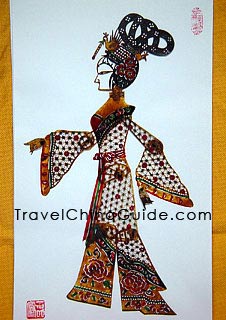
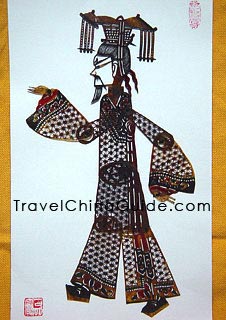
The figures all have a large head and a small body, which tapers down. A man has a big head and a square face, broad forehead and a tall strong body without being too masculine. A woman has a thin face, a small mouth and slim body without being too plump. Effeminacy and tenderness are the norm for Chinese beauty. Scholars wear long robes with an elegant demeanor, while generals in martial attire bring to mind bravery and prowess.
The design of the figures follows traditional moral evaluation and aesthetics. The audience can tell a figure's character by seeing his mask. Like the masks in Beijing Opera , a red mask represents uprightness, a black mask, fidelity, and a white one, treachery. The positive figure has long narrow eyes, a small mouth and a straight bridge of nose, while the negative one has small eyes, a protruding forehead and sagging mouth. The clown has a circle around his eyes, projecting a humorous and frivolous air even before he performs any act.
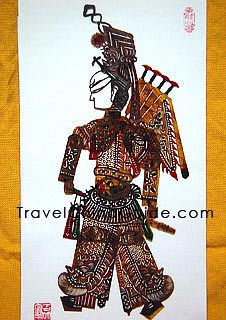 Lavish background pieces including architecture, furniture, vessels and auspicious patterns are featured in shadow play. Earthy art that it is, the play impresses audiences by their vividness and refinement. A framed puppet can be a novel and pleasant souvenir.
Shadow Puppet as Artwork
Shadow puppetry in Shaanxi is believed to be the most typical. The Academy Gate Cultural Street in Xian is an ideal place to choose shadow puppets as souvenirs. Here you can select from hundreds of figures in different sizes and poses, which reveal a special world with their different figures.