National Treasures in Stele Forest
 |
 Stele Forest Pictures Stele Forest Pictures |
The Stele Forest houses 11,000 relics among which nineteen groups are considered Chinese national treasures. These can be divided into two categories: the stone steles and the stone sculptures.
Stone Steles
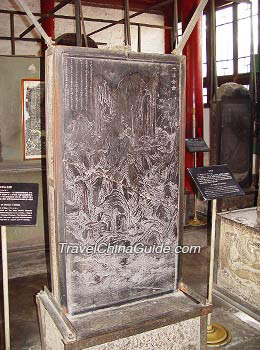
The engraving for the Kaicheng Classics, located in the first exhibition room, was completed in 837 (Tang dynasty) and took 7 years. The Kaicheng Classics is a group of stone tablets, which includes twelve intellectual, must-read books of the feudal society such as “The Analects” and “The Book of Changes”. These books were carved on the stones for future generations of students to study. These stones contain about 650,000 Chinese characters inscribed on 114 stone tablets. They are the only known collection of completely preserved stone books. This group of stone books was originally placed in the Imperial College during the Tang dynasty and was later moved into the museum during the Song Dynasty (960 - 1279). Later, during the Qing Dynasty (1644 - 1911), another stele inscribed with the writings of Mencius was added making a total of 13 classics.
The Stone Tablet of Cao Quan, an important and precious tablet engraved in the year 185 during the Eastern Han Dynasty (25 - 220), was unearthed towards the end of the Ming Dynasty (1368 – 1644). It was moved into the Stele Forest in Xi'an in 1956. The obverse and reverse of this rectangular tablet are carved with the life stories of Cao Quan, an upright and honest official in Heyang County who suppressed a rural uprising and helped the civilians during the the Eastern Han dynasty. The elegant characters on the tablet highlight this representative work of clerical script, an archaic style dominant in the Han dynasty. It is a real treat for fans of Chinese calligraphy.
|
|
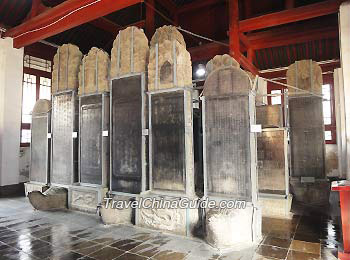
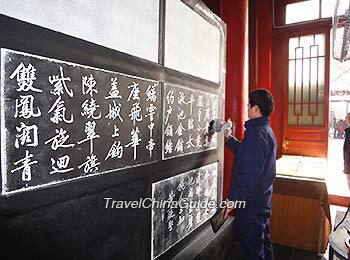
The Stone Tablet of Duobao Pagoda, written by Yan Zhenqing (a leading Chinese calligrapher of the Tang dynasty) in 752, is located in the second exhibition room. The stone stele was engraved with the history of the construction of Duobao Pagoda and is representative of Yan’s early works. It consists of thirty-four lines with each line containing sixty-six characters. The style of the writing is elegant and "fancifulness". The stele was originally at Qianfu Temple during the Tang dynasty and was moved into the museum during the Song dynasty.
The Nestorian Stele, in the second exhibition room, tells of the initial development of Nestorian Christianity and how Alopen Abraham did his missionary work in China during the Tang dynasty. The contents, carved in both Chinese and Syriac, reflect the international outlook of the Tang dynasty. Engraved in 781, the stele was unearthed in 1625 during the Ming dynasty and moved into the museum in 1907. It is now very important to the study of religions in China.
Many other precious stone steles are housed in the museum. The Huangfudan Stone Stele, one of Ou Yangxun’s works, was carved between 627 and 649 during the Tang dynasty. Yan Qinli Stele, written by Yan Zhenqing when he was 71 years old, tells Yan’s grandfather’s (Yan Qinli) life stories and provides information about his grandfather’s family members. Xuanmi Pagoda Stele was written and carved by Liu Gongquan, another eminent calligrapher of the Tang dynasty. The Huiyuan Taoism Temple Bell Tower Inscriptions, recording the history of the temple, was also created by Liu Gongquan in 836.
Stone Sculptures
 | 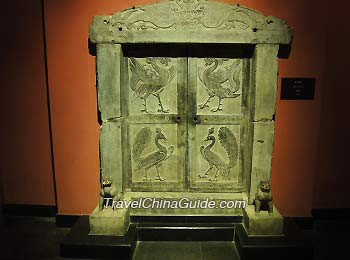 |
There are also many precious stone sculptures in the two stone sculpture galleries. The Six Steeds of Zhaoling Mausoleum are the must-see sculptures in the west gallery. These six steeds are six Tang dynasty reliefs of horses which were discovered in the Zhaoling Mausoleum, the tomb of Emperor Taizong of Tang dynasty. These six horses named Quanmaogua, Shifachi, Baitiwu, Telebiao, Qingzhui and Saluzi were precious war-horses of Emperor Taizong. Now only Shifachi, Baitiwu, Telebiao and Qingzhui are preserved in the museum. The other two horse are now stored in University of Pennsylvania Museum in the United States.
The only sculpture related to Taoism is the Statue of Laozi, which is also located in the west gallery. The 1.93 meters high white-marble statue was first placed in Huaqing Palace at Li Mountain in Lintong in northeast Xi'an. Sitting on a three-layer terrace, Laozi looks very kindly. The statue also gives historians valuable clues about how Taoism spread in the central Shaanxi Plain.
The epigraph of Li Shou (a general and brother of the first emperor of the Tang dynasty) was engraved on a stone tortoise with a mythical beast head. It is very rare and only one remains in China. Li Shou’s stone coffin shows the luxury of the imperial families’ daily lives, which give modern people an idea about ancient people’s attitude towards death and how imperial members lived their lives. Different images such as the four gods, dancing girls, attendants and musicians were carved outside as well as inside the stone coffin.
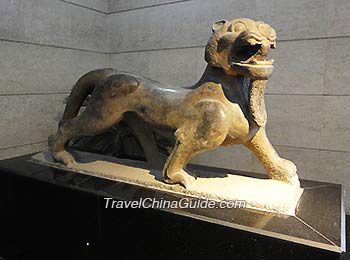
The Stone Rhinoceros of Xianling Mausoleum, which guarded the tomb of Li Yuan (the first emperor of Tang dynasty), is now stored in the west stone sculpture gallery. The stone rhinoceros was carved from a ten-ton bluestone and has a life-like expression on its face.
 Suggested Tour Itinerary:
Ancient City Tour: to Bell & Drum Tower, Great Mosque, the Stele Forest and City Wall
More Xi'an Tours Nearby Attractions: Xi'an City Wall Shuyuanmen Ancient Cultural Street
 Reply
Reply 0
0 1Reply
As for the city tour, please don't worry! Tour has no weekend. What kind of details do you want? A 2-day's tour? If so, I think you could refer to this web's ideas at: https://www.travelchinaguide.com/package/xian.htm