Liao Dynasty
Liao Dynasty was a regime founded by an ethnic minority called the Qidan (Khitan) who lived in the northeast areas of China. In 916, a Qidan man named Yelu Abaoji established the Qidan Kingdom. Initially, the kingdom was under the slavery system. Till 947, the title of the kingdom was officially changed into Liao, with Balin Left Banner (in current Inner Mongolia) as its capital city. Its territory mainly covered the northern part of China, with the estuary of the Amur River in the northeast, the middle part of Mongolia in the northwest, Tianjin and Hebei Province in the south.
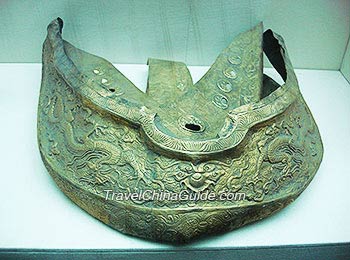 |
| Gold-plated Saddle, Liao Dynasty |
From the Five Dynasty and Ten States Period (907 - 960), they began to make business with the Latter Liang (907 - 923), the Latter Tang (923 - 936) and the Latter Jin (936 - 946). Through sea transportation, They also exchanged goods with the Northern Tang (937 - 975) and Wu Yue (907 - 978) in the southern areas. After the founding of Song Dnasty (960 - 1279), they mainly exchanged their horses, sheep and pearls for Song tea, silk fabric, porcelain and lacquer ware.
Politically, Liao had its own particular governing system and policies. On the one hand, different social systems were adopted in different regions. In the northern areas, which were the original living place of the Qidan people, the slavery system was adopted; in the eastern regions near the Bohai Sea and the southern 'Sixteen Prefectures of Yanyun', the feudal system was adopted. The so-called 'Sixteen Prefectures of Yanyun' area was the reward bestowed by Liao for helping Shi Jingtang (the founder of the Latter Jin) to defeat the Latter Tang in the Five Dynasties and Ten States period. On the other hand, a special management system in the court - the North and South Official System -- was established by Liao. The system regulated that officials in the north side in the court dealt with Qidan people's political affairs while officials in the southern side took charge of those of the Han people. In addition, different laws governed Qidan and Han people. 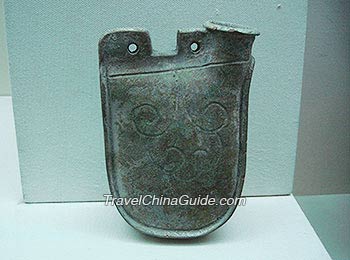
Stirrup-shaped Pot with
Engraved Pattern, Liao Dynasty
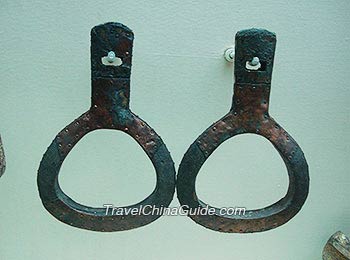 |
| Gilded Stirrup, Liao Dynasty |
The culture of the Qidan People was deeply affected by that of the Han people. Most rulers of the Liao adored Han culture. They liked to read the Analects of Confucius and Zhen Guan Zheng Yao written by Emperor Taizong of the Tang Dynasty (618 - 907). Especially, Yelv Abaoji, the first emperor of Liao worshiped Confucius and established an imperial academy called Guozijian to impart Confucianism. Under the enlightenment of Han culture, the Liao people created their unique characters - the Qidan language. In that period, the Qidan language and Chinese language were used as the official language. As for religion, Qidan people originally worshiped nature and primitive civilization. Since Emperor Taizu, Yelv Abaoji's reign, Chinese Buddhism gradually spread to Liao. Many Buddhist sutras were translated into the Qidan language and were carved on stone tablets. One of the four Buddhist holy mountains - Wutaishan Mountain (in current Shanxi Province), was a Buddhism teaching center of the Liao Dynasty.
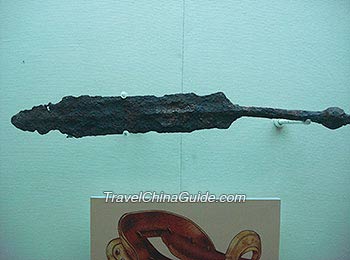 |
| Iron Spear, Liao Dynasty |
The Qidan were a warlike people. Rulers of Liao attacked the Northern Song many times, coveting Song territory in the central plain areas. However, due to the evenly matched military forces between Liao and Song, Liao did not finally realize its ambition. In 1005, Liao and Song signed the notable Tanyuan Treaty in Tanzhou (currently Puyang in Henan Province). After that, Liao kept a friendly relationship with Song for almost 120 years during which time the Liao society became more and more prosperous. Liao began to decline later because of the incompetence and tyranny of later rulers. In 1120, Song made an alliance with the newly founded Jin and attacked the Liao Regime. Finally in 1125, the last emperor of Liao, Emperor Tianzuo, was captured by the Jin army ending the Liao Dynasty.
Emperors
| Order | Name | Notes | Reign Time (years) |
|---|---|---|---|
| 1 | Liao Taizu (Yelu Abaoji) | He was originally elected as one of the leader of Qidan tribes. Later, he unified the Qidan Kingdom. In 916, he proclaimed himself emperor and established the Liao Dynasty. | 907 - 926 |
| 2 | Liao Taizong (Yelu Deguang) | The second son of Liao Taizu; He ascended to the throne instead of his elder brother. | 926 - 947 |
| 3 | Liao Shizong (Yelu Ruan) | Nephew of Liao Taizong; died in a coup launched by the generals | 947 - 951 |
| 4 | Liao Muzong (Yelu Jing) | Son of Liao Taizong; Rebellions broke out in his reign. He was killed by his servants. | 951 - 969 |
| 5 | Liao Jingzong (Yelu Xian) | He was adopted by Muzong. In his reign, he launched a series of battles with Song. | 969 - 982 |
| 6 | Liao Shengzong (Yelu Longxu) | He ascended to the throne at an early age. His reign was actually controlled by his mother - Empress Xiao. | 983 - 1031 |
| 7 | Liao Xingzong (Yelu Zongzhen) | The eldest son of Shengzong; The Liao Dynasty began to decline from his reign. | 1031 - 1055 |
| 8 | Liao Daozong (Yelu Hongzhen) | Son of Xingzong; In his reign, Liao's title was changed to 'Great Liao'. | 1055 - 1101 |
| 9 | Tianzuo Di (Yelu Yanxi) | The last emperor of Liao; He was captured by Jin army in 1125. | 1101 - 1125 |