Chinese Language
Mandarin
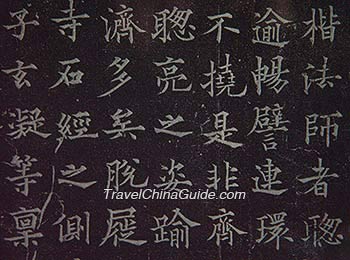 |
| Chinese Characters |
Putonghua is a parlance in mainland China. It is the common language of all modern Han nationality people. In Taiwan Province and Hong Kong, it is called 'Guoyu' while in Singapore and Malaysia, it is often called 'Huayu'.
Mandarin is shaped and based on the Beijing dialect and other dialects spoken in the northern areas of China. Students are often taught mandarin as 'Yuwen' in their schoolbooks. It is beyond all doubt that mandarin is used as a mother tongue by the most people accounting for about one fifth of the world's population. Chinese once had very great influence on some peripheral countries with their languages and characters, such as Japanese, Korean and Vietnamese.
English is a required course and universal education in China and has great popularity. Nowadays many Chinese people can speak basic English, especially the youth, students, and staff of service trades like hotels, restaurants, airlines, banks and post offices.
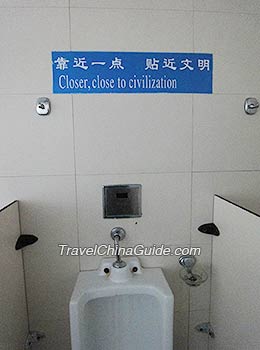 |
| Bilingual Sighboard in a Toilet |
The language barrier now is not a problem at all for those that wish to come to China. You can refer to the Basic Expressions in Chinese.
 Learn to Speak Chinese
Dialects
With a vast territory and huge population, China has many different dialects which are of great complexity. Divided into official and non-official dialects, they vary between different areas. The official dialects generally refer to the northern dialects, while the non-official dialects are often spoken in the southeast part of the country. Below is a table showing the dialects in detail:
| Categories | Dialects | Spoken in Areas |
|---|---|---|
| Official | North China | Beijing, Tianjin, Hebei Province, Henan Province, Shandong Province, Liaoning Province, Jilin Province, Heilongjiang Province, Part of Inner Mongolia |
| Northwest China | Shanxi Province, Shaanxi Province, Gansu Province, Part of Qinghai Province, Ningxia Province and Inner Mongolia | |
| Southwest China | Most areas of Hubei Province (southeastern and eastern parts excluded ), Yunnan Province, Guizhou Province, Sichuan Province, north sides of Hunan Province and Guangxi Province | |
| Yangtze-HuaiRiver | Areas along the northern and southern banks of Yangtze River in Anhui Province, Northern areas of Yangtze River in Jiangsu Province (Huizhou excluded), Southern areas of Yangtze River (northernmost to Nanjing and southernmost to Zhenjiang) | |
| Non-official | Wu | Southern part of Jiangsu Province; Zhejiang Province |
| Gan | JiangxiProvince | |
| Xiang | HunanProvince; northern part of Guangxi Province | |
| Yue | GuangdongProvince; Southeast part of Guangxi Province | |
| Min | FujianProvince; Taiwan Province; Guangdong Province (Chaozhou, Shantou), Hainan Province | |
| Hakka | Eastern and northern part of Guangdong Province; Western part of Fujian Province; Southern part of Jiangxi Province; Taiwan Province |
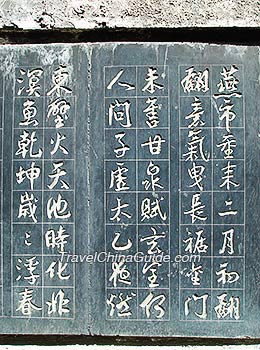 |
| Chinese Characters |
Characters
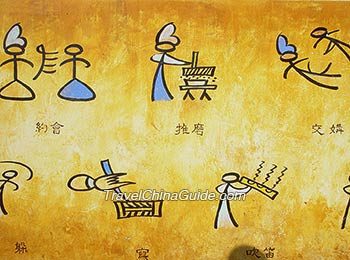
The Chinese character has more than 3,000 years of history. It is a kind of hieroglyphic which originated from carapace-bone-script in the Shang Dynasty (16th - 11th century BC). It then developed into different forms of calligraphic handwritings like large seal script, small seal script, official script, regular script, cursive script and running script.
There are altogether 80,000 Chinese words or so that originate from ancient times; however, only about 3,000 words for daily use are available to express over 99% of the information in written form because a word contains many different meanings. The character is now of two kinds – Simplified and Traditional. Simplified style are often used in mainland China, Singapore, and oversea Chinese communities in Southeast Asia, while the latter is often accepted in Taiwan Province, Hong Kong, Macau and oversea Chinese communities in North America.
Minorities
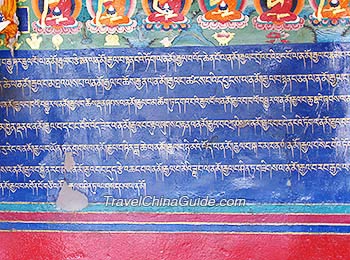
Actually the Mandarin and characters used by Han people are also the common language for other minorities. Among all the 55 ethnic minorities, the people of Hui and Man nationalities also use Mandarin and its characters. 29 ethnic minorities have their own traditional languages like Tibetan, Yi, Mongol, Uygur, Kazak, Lahu, Chaoxian and Kirgiz. Some minorities, like Dai nationality and Jingpo nationality, use even more than one kind of language and characters.
|
|
 Further Reading : Chinese Calligraphy