Memorial Hall to the Victims in the Nanjing Massacre
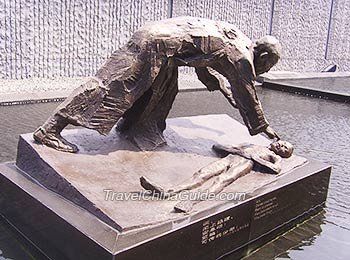 |
| Memorial Hall to the Victims in the Nanjing Massacre  More Nanjing Massacre Pictures More Nanjing Massacre Pictures |
Nanjing, a picturesque city lying by the Yangtze River, owes its fame to its favorable geographic position, galaxy of talents and profound historical background. Having served as the capital of ten dynasties in ancient China, its splendour has remained and even enlarged with an extended population up to 600,000 when the government of the Republic of China set up its capital there in 1927. However, an outrageous and well-prepared war of aggression was started by Japan on Sep 13, 1931. Receiving no resistance from the government of the Republic of China, the troops of the Japanese aggressor occupied the three provinces of northeast China within a period of five months. Marching southwards, they launched all-out offensives on Shanghai and Nanjing, the seat of government, thus starting a nightmarish holocaust that transformed the paradise into a hell on earth.
On Dec 13, 1937, the Japanese army occupied Nanjing and during the following six weeks bore witness to the inhumane disgrace and bloody massacre exerted on the city. No less than 300,000 innocent civilians and unarmed Chinese soldiers were brutally slaughtered in mass and individual beheadings, burying alive, burning, and killing races. More than 20,000 women were raped and many were then killed. A third of the architectures together with their contents were damaged by fire and countless shops, stores and residences were looted and sacked. Corpses were seen floating on rivers and littered the streets and lanes. Whether they were children or the aged, from residents to nuns, few could escape from the savage atrocity.
|
|
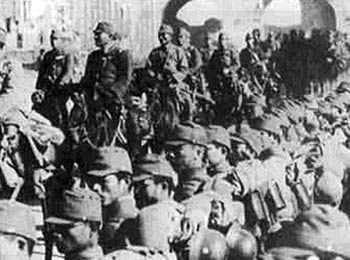
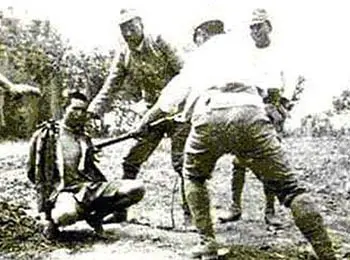
Solemn and imposing, the Memorial Hall to the Victims in the Nanjing Massacre consists of three parts: the outdoor exhibits, the remaining bones of the victims and the exhibition hall for historical documents.
The outdoor of Memorial Hall to the Victims in the Nanjing Massacre exhibits all vividly represent grief and indignation, life and death. Statues, group sculptures and relief carvings stand solemnly among green pines and cypresses, together with the monument upon which is engraved the dates of the tragic events '1937.12.13 - 1938.1' while two marble walls are engraved with the name of the hall and ' 300,000 Victims '. Three large groups of carved reliefs and seventeen small tablets upon which the major sites and historical facts of the massacre are carved, surrounded by withered trees and cobblestones, the wall upon which the names of the victims are listed and the atonement tablet, together form a permanent and moving record of the bloody tragedy.
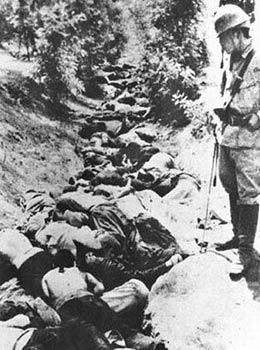 |
| Innocent civilians were brutally slaughtered in mass |
The remaining bones of victims in the massacre, which were excavated from Jiangdongmen in 1985, are exhibited in a coffin-shaped display hall of Memorial Hall to the Victims in the Nanjing Massacre. There were 208 more bones uncovered from this 'pits of tens of thousands bodies' in 1998. Another tomb-like exhibition hall, which is buried half underground, contains over 1000 items that illustrate the terrible tragedy. Paintings, sculptures and illuminated display cabinets and multi-media screens as well as documentary films all contribute to this reminder of the horrendous crimes perpetrated on the Chinese people.
Experiences of the past, if not forgotten, are a guide for the future. The attribution of blame for war and its consequences serves to sustain hatred. The Nanjing Massacre Memorial Hall was not built as a sign of indignation but a lasting memorial to the victims and a warning of history. The memorial hall and the historical materials it contains present themselves as iron proofs on the inhuman crimes the Japanese troops ever committed. Such behaviours as altering textbooks and fabricating lies to distort the history sound ridiculous and finally will be proved futile. The memorial hall presents not only to the Chinese but also to successive generations of the Japanese that only an acceptance and understanding of past wrongs can create a better future for mankind. See Also: Nanjing Facts & Nanjing History
How to get to Memorial Hall to the Victims in the Nanjing Massacre
1. Take metro line 2 and get off at Yunjin Road. Leave from exit 2 and walk westwards to get there.
2. Take bus 7, 37, 61, 63, 161, 166, 170, or 186 to Shuiximen Dajie Jiangdongmen.
3. Take bus G3 or G6 to Jiangdongmen Jinianguan.
Nanjing Bus / Metro Search
| Entrance Fee | Free |
|---|---|
| Opening Hours | 8:30 - 16:30; Closed on Monday except during holidays |

 Further Reading:
 Thought for the day 14 May 2005
 12 Best Places to Visit in Nanjing