Essential Knowledge of Beijing Olympics
The volunteers symbol of Beijing Olympics shows three people dancing surmounted by two interwoven red hearts, conveying a deep meaning.
The hearts represent the bond between the volunteers, the athletes, the family and guests, while the dancers symbolize a friendly attitude and a dedicated spirit. The Chinese calligraphy art form has been used to depict the dancers. They together set off the Emblem - Chinese Seal, Dancing Beijing to perfection.
Theme Slogan
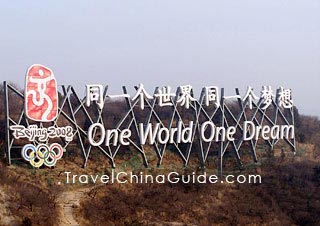 |
| Theme Slogan of 2008 Olympic Games |
Environmental Symbol
It depicts the 'Green Olympics' (one of the three concepts). It is of a green tree with a human figure below it.
Drawn with a single stroke, as a fluttering stripe of color, it resembles the canopy of a tree filled with vitality and hope. Together with the figure beneath, it looks like a big tree reaching for the sky and conveys a meaning of harmony between mankind and nature. As the man is drawn in the Chinese calligraphy art form, it contrasts the Emblem.
Mascot
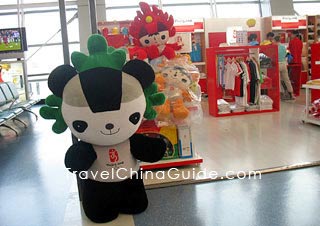 |
| Mascot Sold in Licensed Products Store |
Each of the five images has been given a nice name - Beibei, Jingjing, Huanhuan, Yingying and Nini. When these are read together thus 'Bei Jing Huan Ying Ni' it is actually Chinese for 'Welcome to Beijing'. Each image conveys different wishes and meanings: Beibei (the fish), symbolizes prosperity and harvest; Jingjing, a lovely panda represents the harmonious existence between human and nature; Huanhuan (the flame), regarded as the elder brother of the five, expresses the spirit, while Yingying, the Tibet antelope wishes everyone in the world good health and the swallow Nini brings happiness and good luck. As the five images are colored blue, black, red, yellow and green respectively, Fuwa matches the Five Rings.
The combination of the dancing people created by the Chinese seal and the words 'Beijing 2008' written in the Chinese calligraphy art form below it fully reflects Chinese culture. It also represents the vitality of China. Like the dancing people in the emblem, Beijing will welcome friends and guests from all parts of the world in its friendly embrace.
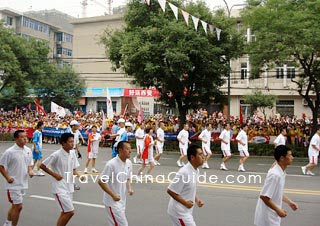 |
| Torch Relay in Xian |
The light aluminium alloy torch is well designed to have the ability to resist low temperatures, low pressure and variable wind directions and also easy to carry. Additionally, it is environmentally friendly as it is fuelled by propane gas. The torch was researched and devised exclusively by the Chinese and so is characteristically uniquely Chinese.
The medal is elegantly exceptional. Differing from past Medals, it is the first one that is not made totally of gold. Chinese Jade, the traditional craft standing for the dignity and virtue, was inlaid in the medal endowing it with unusual importance.
On the obverse, the traditional IOC design - goddess of victory Nike and the Panathinaikos Arena is adopted. On the reverse, the emblem is engraved in the jade which is inlaid in the medal. The medal's design is a good combination of Chinese and Western culture making it a significant piece of artwork in Olympic History.
Green Olympics: Protecting the environment and resource, and maintaining an ecological balance are the three main aims to realize. Beijing has already promised to spend US $ 6.6 billion to improve the environment. In the not too distant future, coal will be replaced by the clean natural and liquid natural gas, at the same time solar power will be more widely used. Waste and sewage systems will be improved to recycle resources. Many factories will be moved out of the city to help improve the environment. In addition, reforestation projects are being undertaken in both the mountains and plains surrounding the city will help to reduce the dust and sandstorms. The concept will not only be displayed through the change of environment, but also from the improvement of public awareness of the environment.
High-tech Olympics: High-tech is also a highlight. Broad Band, GPS technology and the mobile communications network will be greatly improved during the preparations. At that time, an integrated transport system will ensure the efficient movement of guests during the Games while Multi-lingual Translator Machines will provide an invaluable service for them. High-tech will also be used for weather forecasts and throughout the stadiums, etc.
People's Olympics: The spread of the Spirit as well as the unique Chinese culture are the main aim. Beijing has already set up a program for ensuring everyone uses correct manners and etiquette in schools, offices, venues and even in daily life of the public at large. More and more hotels, restaurants, museums, galleries, theaters and tea houses are making full preparations as they wait for guests to arrive from all over the world. Also, there is a focus on the protection of its ancient cultural relics, buildings, customs, arts and crafts etc. in order to make it a harmonious meeting of the West and China, together with an unrivaled service to both Olympians and journalists alike with comfortable accommodation, delicious food and efficient means of communication.
 Other Information onthe Olympic Games: