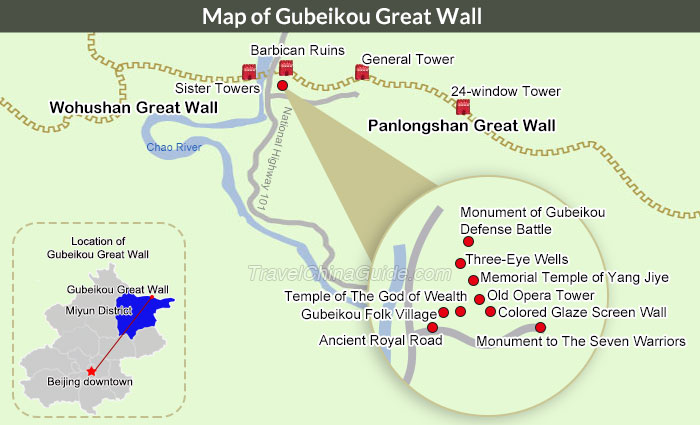
The Gubeikou Great Wall is about 140 kilometers (87 miles) from downtown Beijing, a three-hour drive away. It has never been renovated and is a wild section of the Great Wall. Even though it is now rather dilapidated, the meandering walls and sturdy watchtowers still evoke their former glory. Due to its preservation of the original appearance and the magnificent surrounding scenery with steep mountains, it is very popular among hikers.
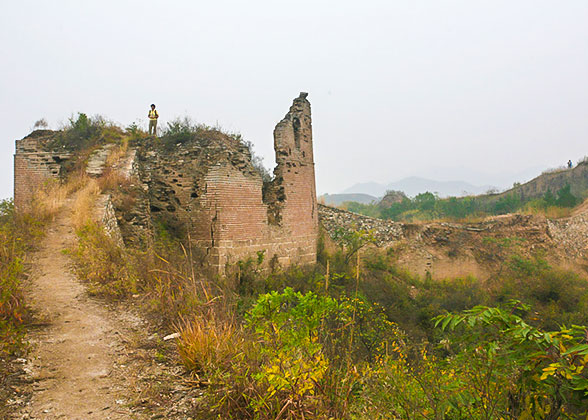 |
| Gubeikou Great Wall in Beijing |
Who and When Built It?
The Great Wall at Gubeikou is a rather unique “double-layered Great Wall” among the sections of the
Great Wall of China. This means that during the second construction, a new layer of wall was built parallel to the existing old Great Wall, thus forming a structure with two walls side by side.

Northern Qi Dynasty Line: Gubeikou was first built during the Northern Qi Dynasty (550-557). In the early
Ming Dynasty (1368 - 1644), General Xuda (1332 - 1385) was ordered to rebuild it. Its defensive capability was enhanced by adding more stones although only a few relics can be found today. The best-preserved is the Big Flower Watchtower (Dahualou), so-called due to its square shape with 12-arrowed windows, which resembles a blossoming flower when seen from afar.
Ming Dynasty Line: When Qi Jiguang (1528 - 1588) was appointed the chief commanding officer of the Ji Garrison (one of the
eleven garrisons during the Ming Dynasty), he ordered another layer of bricks to be laid standing side by side with the original one, forming the unique double-layered Great Wall.
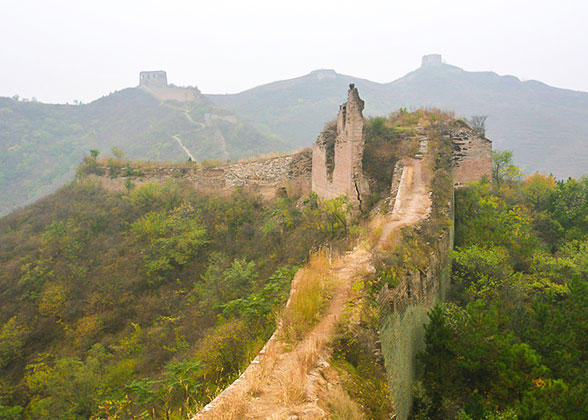 | | Gubeikou Great Wall | | 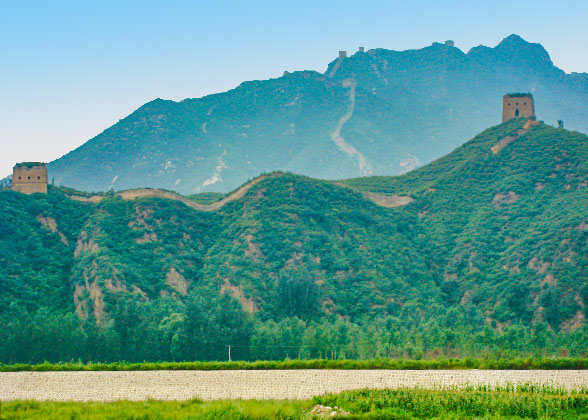 | | Gubeikou Great Wall | |
 More Gubeikou Great Wall Pictures
Basic Facts of Gubeikou Great Wall
This section was originally named "Beikou", which literally means "Northern Pass", during the Tang Dynasty (618-907) since it is the northern defensive line of Youzhou (today's Beijing). "Gu" (ancient) was only added by later generations.
Stretching for about 40 kilometers (25 miles), there are 172 watchtowers, 14 beacon towers, 16 passes, 3 water passes, 3 barbicans, and 6 fortresses along it.
In the broad sense, it is comprised of four sections: Wohushan, Panlongshan, Jinshanling, and Simatai. But in the narrow sense and to visitors, it is composed of Wohushan and Panlongshan.
“Wohushan”, literally meaning a mountain like a crouching tiger, gets its name from its shape resembling two tigers - one lying on its back and the other lying prone. The Wohushan section, situated on the west side, presents a complex terrain with steep steps. Its total length is 13.6 kilometers (8.5 miles), and the length accessible for hiking is 4.75 kilometers (2.95 miles).
“Panlongshan”, on the east side of Gubeikou Town, is named for its winding mountain shape that resembles a circling dragon. The terrain here is relatively flat, and the length available for hiking is 5 kilometers (3 miles) out of its total length of 25 kilometers (15.5 miles).
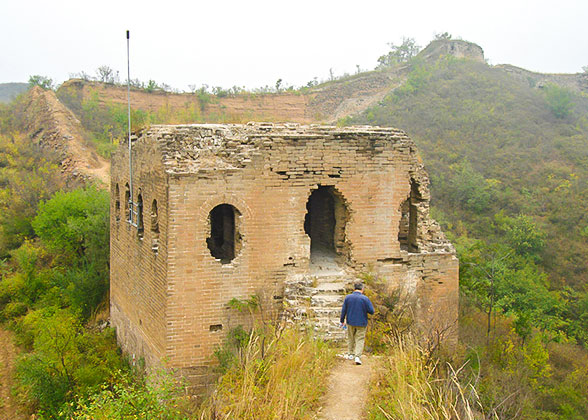 | | Beacon Tower on Panlongshan Great Wall | | 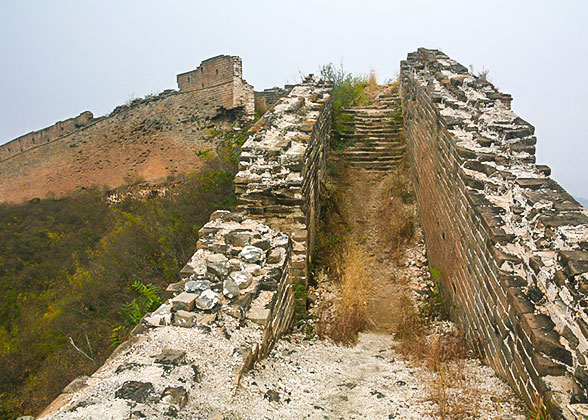 | | Great Wall at Wohushan | |
Highlights of the Gubeikou Great Wall
1. Sister Towers, Wohushan Section
The Wohushan Section features the unique “Sister Towers”. These two towers, one tall and one short, one large and one small, are constructed on the mountain overlooking the river. From afar, they appear as if two sisters holding hands. During the war, the sister tower served as a place for troops to be stationed and for storing weapons and food. The close proximity of the towers is quite rare.
2. General Tower, Panlongshan Section
The General Tower is the highest point of the Panlongshan section. From this vantage point, one can overlook the meandering Great Wall. Its square shape features a side length of approximately 10 meters (11 yards), with a door on each side. The south and north sides are equipped with 4 arrow windows, while the east and west sides have 3 arrow windows, exhibiting a high degree of symmetry. Once serving as a command post, however, the crenels on the top were severely damaged during the war, leaving the roof exposed ever since.
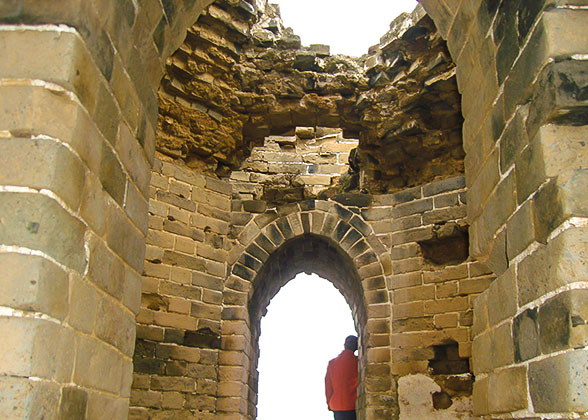 | | Inside a Watch Tower | | 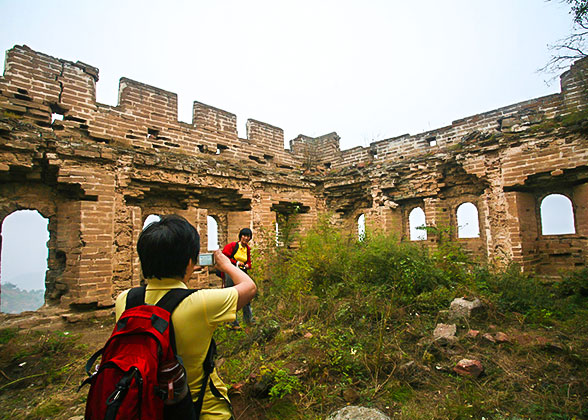 | | 24-window Tower | |
3. 24-window Tower, Panlongshan Section
The 24-window Tower is the last watchtower at the Panlongshan Section. True to its name, it features 24 closely-spaced observation windows, a rare characteristic among the watchtowers of the Great Wall. Its three-storey design is distinct. On the first and second storeys, each side has three windows, and the third storey is adorned with teeth-shaped crenels. The 24-window Tower worked in concert with the General Tower during the wartime. However, the northwestern side of the tower has now collapsed, leaving behind the eastern and southwestern walls standing firm and still.
How to Tour the Gubeikou Great Wall
When visiting the Gubeikou Great Wall, you can explore either the Panlongshan section or the Wohushan section alone, or combine it with a visit to the Jinshanling Great Wall. There are no cable car facilities at the Gubeikou Great Wall, and the only way to explore it is on foot. Here are several recommended hiking routes:
1. The most popular route: Panlongshan + Jinshanling; 15 kilometers (9.3 miles); 5 - 6 hours
Gubeikou Town → North Gate of the Panlongshan Great Wall → General Tower → 24-window Tower → Walk the mountain road to bypass the Military Area → West Entrance of Jinshanling Great Wall → Taochun Pass → Zhuanduokou Pass → Exit of Jinshanling Great Wall
 |
| Jinshanling Great Wall |
The hiking route from Gubeikou to Jinshanling Great Wall is a classic one among outdoor adventurers and is very popular. It stretches from the ancient and dilapidated Gubeikou Great Wall to the restored Jinshanling Great Wall. Some say this route is like a museum of the Great Wall because it has the densest distribution of watchtowers among all sections. The path from Gubeikou to Jinshanling winds through mountains and jungles, offering breathtaking views.
2. The simplest route: Panlongshan section; 10 kilometers (6.2 miles); 3 - 4 hours
North Gate → General Tower → 24-window Tower → Convenient Downhill Path
 | | Road to the General Tower | | 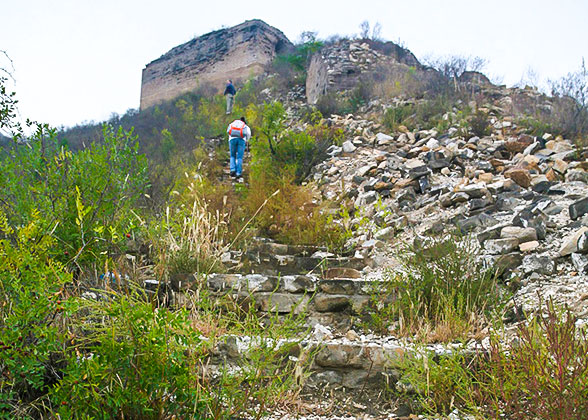 | | Broken Bricks on the Wall | |
Enter from the North gate and walk for about 20 minutes to reach the Panlongshan Great Wall. Then climb up to the General Tower, continue towards the 24-window Tower, and finally walk downhill along the mountain trail. The Panlongshan section has only been minimally restored, allowing visitors to witness its authentic and original architectural structure. The route is relatively flat, making the hike easy. It's suitable for elderly people and children with certain physical strength.
3. The most challenging route: Wohushan section; 14 kilometers (8.7 miles); 5 - 6 hours
 |
| Hiking on the Gubeikou Great Wall |
Gubeikou Railway Station → Wohushan section → Convenient Downhill Path → Gubeikou Railway Station
Starting from Gubeikou Railway Station, walk for about 30 minutes along the mountain road to reach the Wohushan Great Wall. Then climb along the Great Wall to the top of the wall and return to Gubeikou Railway Station along the downhill path. The Wohushan Great Wall is completely in its original, unrestored state, known for its majestic beauty. It provides a more challenging and rugged hiking experience. This section of the Great Wall is suitable for tourists with hiking experience, and it's best to avoid bringing the elderly and children.
When is the Best Time for a Visit?
The best time to visit the Gubeikou Great Wall would be April, May, September, and October when the temperature is favorable and the scenery is delightful.
| Admission Fee: | CNY 33 |
| Opening Hours: | 08:30 - 16:30 |
How to Get to Gubeikou Great Wall from Beijing
1. Beijing - Gubeikou Train
Firstly, take a train from
Beijing North Railway Station or
Qinghe Railway Station to Gubeikou Railway Station.
| Train No. | Beijing North Departure | Qinghe Departure | Gubeikou Arrival |
| S501 | 06:58 | 07:12 | 09:23 |
| S503 | 14:20 | 14:34 | 16:50 |
After getting out of the high-speed railway station, walk south for about 300 meters (330 yards) to the Gubeikou Railway Station Bus Stop and take the bus Mi25 to Gubeikou Erzhan Bus Stop. Then walk about 500 meters (550 yards) further to reach the entrance of the scenic area. Alternatively, you can take a taxi from Gubeikou Railway Station and it will take about 10 minutes to arrive.
Train Schedule for Return Trip:
| Train No. | Gubeikou Departure | Qinghe Arrival | Beijing North Arrival |
| S502 | 10:00 | 12:13 | 12:28 |
| S504 | 17:20 | 19:37 | 19:52 |
2. Bus No. 980 Express
Hop onto bus line 980 Express from Dongzhimen bus station to Miyun Xidaqiao station. Then, cross the road and transfer to bus Mi25 at the Miyun Xidaqiao Gas Station bus stop. Finally, get off at Suidaokou station to arrive. The overall duration is about 3.5 - 4 hours.
| Bus No. | Onward Trip | Return Trip | Fare |
| 980 Express | 06:00 - 20:00 | 04:30 - 18:30 | CNY 17 |
| Mi 25 | 06:00 - 17:30 | 05:00 - 16:30 | CNY 11 |
Note: This is a viable yet not ideal option for travelers. The long journey can be quite tiring, and there's no guarantee that everyone will get a seat.
Tips for Visiting the Gubeikou Great Wall
1. Check the weather in advance and wear windproof jackets and hiking shoes.
2. Bring along some food and drinks with you as there is no vendor up the Gubeikou Great Wall.
3. It is recommended to bring a flashlight and a power bank in case of emergency.
Further Reading:
15 Wonderful Places to See Snow in Beijing- Last updated on Jul. 16, 2026 by Sherry Xia -