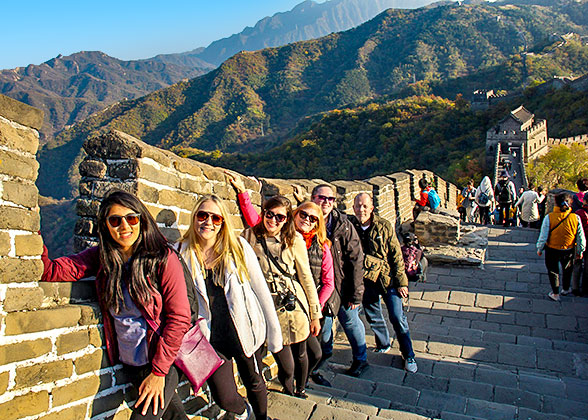
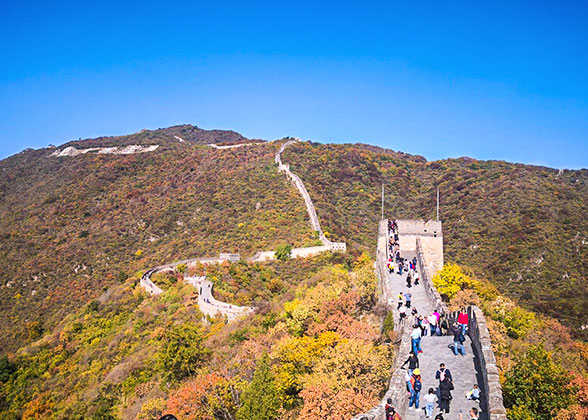
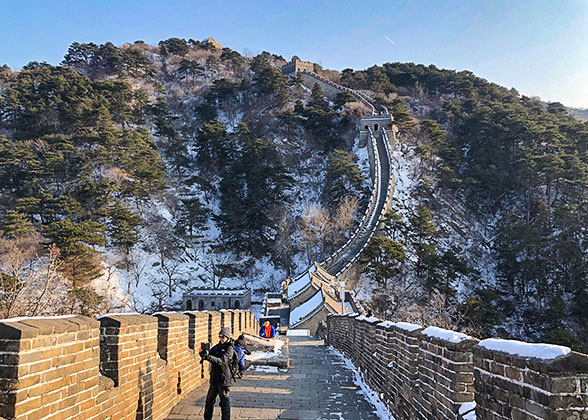
The Mutianyu Great Wall is an integral segment of the world’s preeminent defensive structure: the Great Wall of China. Nestled in Yanqing District, Beijing, it lies approximately 65 kilometers (40 miles) from the city center, with a 1.5-hour drive. Renowned as one of the best-preserved and most celebrated stretches of the Great Wall, it stands as a testament to ancient Chinese engineering prowess.
Visiting Mutianyu Great Wall
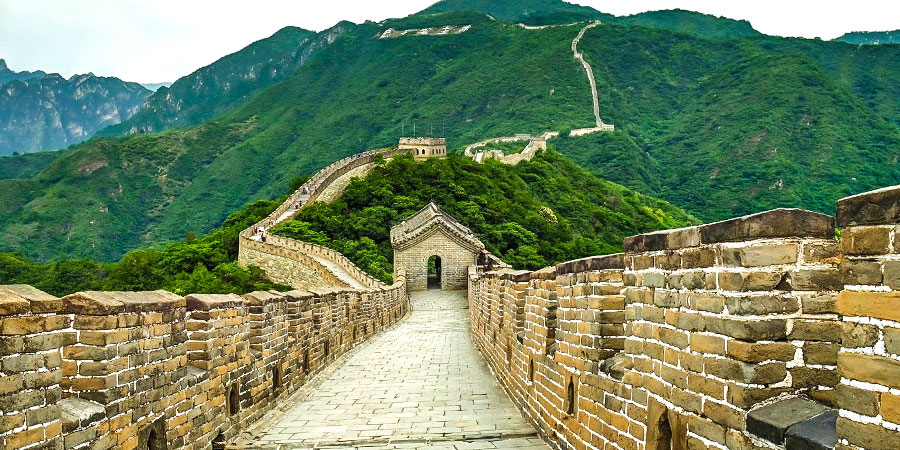
First constructed between 550 AD and 557 AD, the Mutianyu Great Wall that greets visitors today was reconstructed during the Ming Dynasty (1368 - 1644 AD), boasting a history spanning over 600 years. Having withstood countless attacks by northern nomadic tribes, it served as a crucial stronghold safeguarding the imperial capital during the Ming Dynasty. Built primarily from bluish-gray granite, the wall rises 7 to 8 meters (23 to 26 feet) high and spans 4 to 5 meters (13 to 16 feet) wide. Its top edges are lined with serrated crenellations on both sides, while strategically positioned watchtowers form a comprehensive and impenetrable defense system. Stretching 5,400 meters (5,900 yards) as it winds along the mountain ridges, around 3,000 meters (3,300 yards) are now open to tourists, dotted with 20 imposing watchtowers. Among these, Zhengguan Terrace, a unique architectural marvel composed of three interconnected watchtowers, stands out as a one-of-a-kind feature on the entire Great Wall.
At present, Mutianyu Great Wall, as a well-equipped, multi-faceted and most highly praised tourist attraction among the Great Wall sites, welcomes millions of visitors every year.
Mutianyu Great Wall distinguishes itself with unparalleled design features. Unlike most sections of the Great Wall, which have crenellations on only one side, Mutianyu’s walls are fortified with battlements on both flanks, enabling soldiers to engage enemies from either direction. What’s more, the wall is equipped with branch ramparts - secondary barriers extending outward from the main structure - to bolster defensive capabilities. These unique traits underscore Mutianyu’s pivotal geographical and strategic significance throughout history.
2. Dense and Diverse Watchtowers
The watchtowers at the Mutianyu Great Wall are distributed particularly densely, with one tower standing roughly every 100 meters (110 yards) on average. Boasting a rich variety of architectural styles, they allow visitors to admire a diverse array of tower designs within a relatively short distance. Several landmarks are absolute must-sees:
-Zhengguan Terrace (No. 4 Watchtower): This iconic structure comprises three adjacent two-story watchtowers, forming a central main tower flanked by two auxiliary towers. The ground floor functioned as a grain storage depot and soldier rest area, capable of accommodating up to 200 troops, while the upper floor served as the commanding officer’s quarters and battle command center.
Zhengguan Terrace
Crenellations and ancient cannon
-The Big Corner Tower (No. 1 Watchtower): This tower stands at the intersection of three distinct sections of the Great Wall, granting it a unique vantage point from which a corner of the watchtower can be seen from each direction.
-No. 20 Watchtower: The highest vantage point of Mutianyu Great Wall, it is linked to the precipitous Hero Slope - a stretch with an incline exceeding 60 degrees. Standing in front of this tower, visitors can feast their eyes on the full expanse of the winding Mutianyu Great Wall.
-No. 15 Watchtower: A two-story tower with an internal staircase, it is the only watchtower in the area where tourists can climb to the top floor.
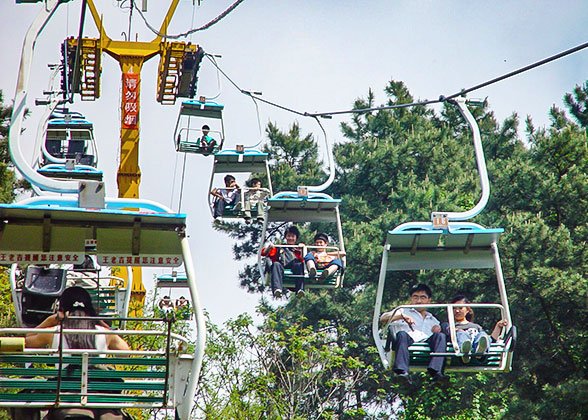
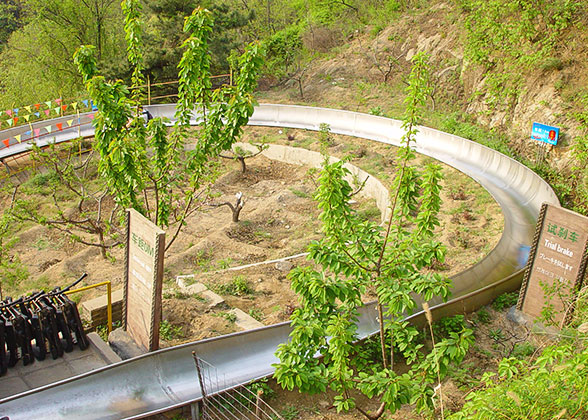
Beyond the historical allure of the wall itself, the Mutianyu Scenic Area offers a host of recreational activities. From cable cars and chairlifts that provide bird’s-eye views of the wall, to exhilarating downhill toboggan and a graffiti wall where visitors can leave their personal marks, all of these add an extra layer of fun to any Great Wall adventure.
Toboggan, Mutianyu Great Wall
Graffiti Wall, Mutianyu
4. Scenic Beauty
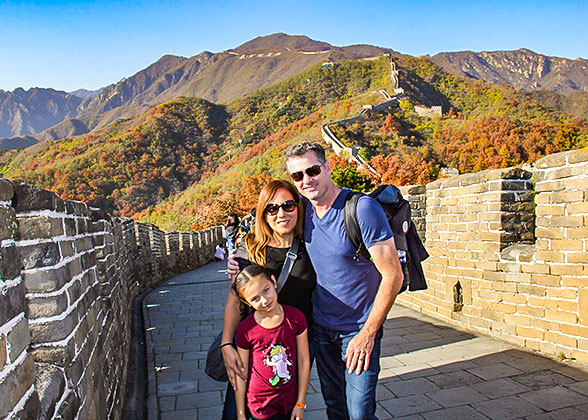
Another standout feature of Mutianyu Great Wall is its breathtaking natural scenery. The surrounding area boasts a vegetation coverage rate of over 95%. In spring, the landscape is blanketed in delicate pink peach blossoms, while autumn transforms the hillsides into a vibrant tapestry of fiery red leaves, making these two seasons the most picturesque times to visit. Meandering through this idyllic setting, the Great Wall resembles a colossal dragon soaring through a landscape painting, delivering a truly awe-inspiring visual experience.
1.Usually, there are fewer tourists, affording visitors a tranquil and immersive journey away from the hustle and bustle.
2.Mutianyu Great Wall is the only section of the Great Wall that offers a toboggan ride, providing a more thrilling and enjoyable experience.
3.Its diverse terrain, featuring both flat and steep sections, along with its well-developed facilities, caters to visitors of all fitness levels, making it an ideal destination for families.
How to Tour the Mutianyu Great Wall?
When you arrive at the Mutianyu Great Wall area, passing through the ticket checkpoint doesn't mean you have already reached the Mutianyu Great Wall. You still need to make your way from the foot of the Great Wall to the top. Usually, there are three primary ways to ascend: hiking along the mountain trails, taking an enclosed cable car, or riding an open-air chairlift. For the descent, four options are available, with the thrilling toboggan ride added to the three ascent methods.
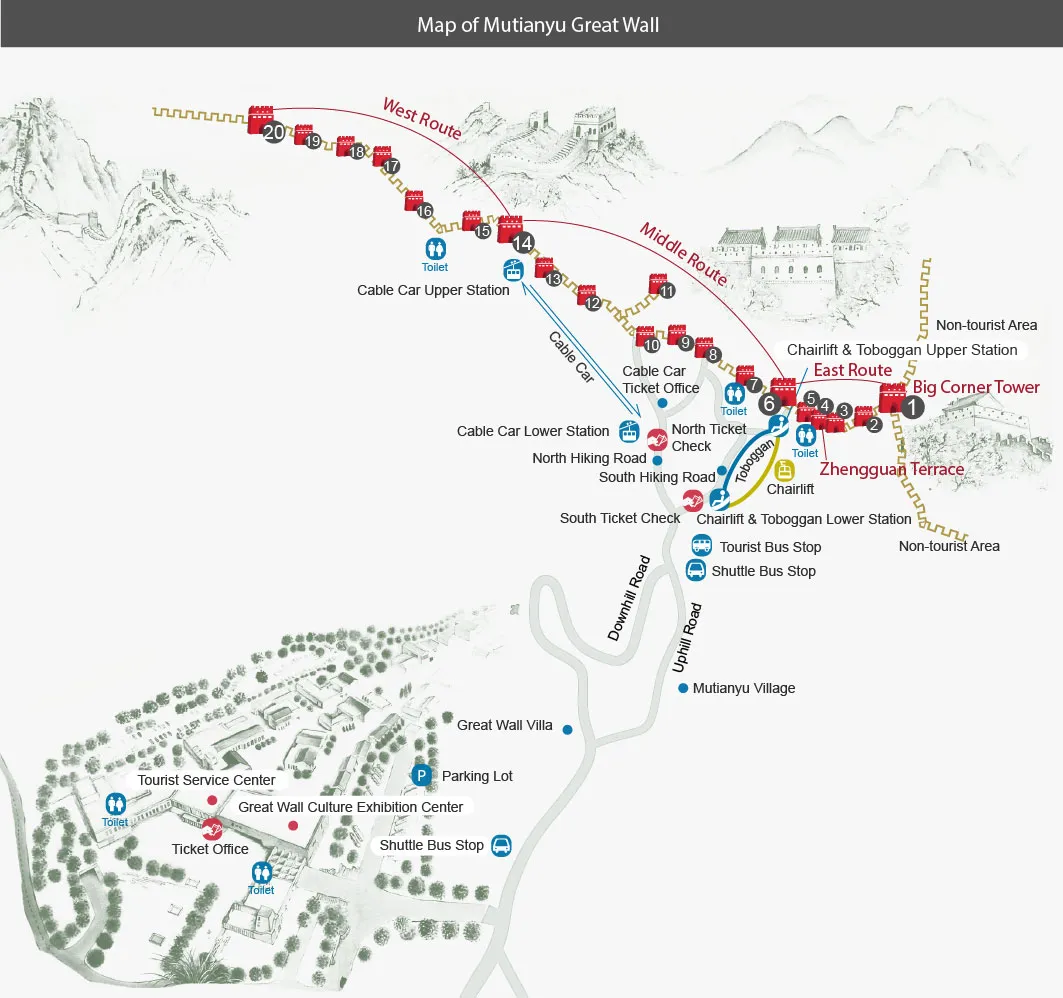
The Mutianyu Great Wall is generally divided into three sections: the West Section, the East Section, and the Middle Section.
West Section: Spanning from Watchtower No. 14 to No. 20, this area is highlighted by the graffiti wall and Hero Slope. It is accessible via cable car.
East Section: Covering the stretch from Watchtower No. 6 to No. 1, its key attractions include the toboggan ride, Zhengguan Terrace, and the Big Corner Tower. Chairlifts provide access to this section.
Middle Section: Extending from Watchtower No. 14 to No. 6, this part is prized for its stunning scenery, flat terrain, and fewer visitors. It can be reached by either cable car or chairlift.
Below are recommended touring routes and ticketing options:
1. The Most Popular Route: East Route; 800 meters (880 yards)
Chairlift or hiking (South Entrance) ↑ → No. 6 Watchtower → hiking about 1 hour to No. 1 Watchtower → another 1 hour back to No. 6 Watchtower → Hiking/Chairlift/Toboggan↓
This route is the most popular among tourists because it offers the opportunity to enjoy a relaxing ride in an open-air chairlift up and thrilling toboggans down. This section of the Great Wall forms a “V” shape, descending from No. 6 to No. 4 Watchtower, and then ascending steeply from No. 4 to No. 1 Watchtower. Due to the complex terrain, this section is suitable for those with good physical fitness. Those seeking a more laid-back experience can enjoy the views near No. 6 Watchtower.
2. To the Highest Point: West Route; 950 meters (1,040 yards)
Hero Slope, Mutianyu
Cable car↑ → No. 14 Watchtower → hiking about 1.5 hours to No. 20 Watchtower → another 1.5 hours back to No. 14 Watchtower → Cable car↓
This route leads to the Hero Slope and No. 20 Watchtower, as well as the highest point of the Mutianyu Great Wall. The climb from No. 14 Watchtower to No. 19 Watchtower is relatively easy. The most challenging part is the Hero Slope between No. 19 and No. 20 Watchtower, which requires courage and endurance to conquer. Accessible by cable car for both ascent and descent, this is the only route at Mutianyu suitable for wheelchair users.
Ticket purchase plan: Admission ticket + round-trip cable car ticket
Cable car↑ → No. 14 Watchtower → touring about 2 hours to No. 6 Watchtower → Hiking/Chairlift/Toboggan↓
This relatively flat route offers a less strenuous journey with fewer crowds compared to the East and West Routes, making it a prime spot for photography and savoring the natural scenery.
4. The Most Challenging Route: Hiking the Entire Length
For travelers eager to experience the authentic thrill of hiking the Great Wall, you can start from the South Ticket Gate and hike up to Watchtower No. 6 or No. 8 via the mountain trails, or begin at the North Ticket Gate and trek to Watchtower No. 8 or No. 10. This journey takes approximately 30 to 40 minutes. Then, you can choose any section of the wall to explore based on your interests, before descending via the mountain trails.
Mutianyu Great Wall Hiking Trail
For the ultimate challenge, energetic visitors can hike the entire length of Mutianyu Great Wall. The recommended route is to start from the South Ticket Gate, hike to Watchtower No. 6, head east to Watchtower No. 1, then trek west all the way to Watchtower No. 20. Finally, return to Watchtower No. 10 and descend the mountain via the hiking trails. The entire journey takes approximately 5 to 6 hours.
Ticket purchase plan: Only admission ticket
If time and energy allow, you can extend your journey by adding more sections to any of the above routes.
March 16 - November 15: 07:30 - 18:00; extended to 18:30 on Saturdays and Sundays.
Night Time: Open from July to August
17:30 - 21:00, last admission at 20:30
Lighting time: 19:30 - 21:00
Notes:
1. Ticket sales stop one hour before closing and entry stops half an hour before closing.
2. The service hours of the cable cars, chairlifts and toboggan are the same as that of the Mutianyu Great Wall.
Tickets
Day Tour:
Entrance ticket
Adult: CNY40 6 - 18 and 60+: CNY20 Under 6: Free of charge
Shuttle bus (round trip)
CNY 15 (round trip)
Cable car/Chairlift/Toboggan (single-way)
CNY 100
Cable car/Chairlift (round trip), or Chairlift (single-way) + Toboggan (single-way)
CNY 140
Cable car (single-way) + Toboggan/Chairlift (single-way)
CNY 200
Notes:
1. Cable Car/Chairlift/Toboggan: Free for children under 1.2 meters (3.9 feet).
2. If you buy an entrance ticket attached with a postcard of Mutianyu, you need to pay CNY5 more and pick it up at the manual ticket window or self-service ticket machine.
3. If you choose to take the cable car to ascend the Great Wall and then take the chairlift or the toboggan to descend, you need to purchase two one-way tickets separately, as these two facilities are operated by independent operators.
4. The entrance to the scenic area is about 6 kilometers (4 miles) away from the ticket checkpoint. Therefore, if you're arriving by public transportation, you'll need to transfer to a shuttle bus; if you're taking a tour bus or joining a guided tour, you can go directly to the checkpoint without needing a shuttle.
CNY 200, including entrance ticket, shuttle bus ticket and cable car ticket. Children under 1.2m (3.9ft) are free of charge.
How to buy the tickets
1. You can buy tickets on site, but it is generally not recommended as the tickets may be sold out. We recommend that you purchase your tickets online in advance, as early as possible.
2. Tickets can be booked 30 days in advance on the Mutianyu website.
When is the Best Time for a Visit?
Although it is suitable for a visit all year round, the best time is April, May, September, and October, when the temperature is favorable, neither too cold nor too hot. But try to avoid the May Day Holiday (from May 1st to 5th), the National Day Holiday (from October 1st to 7th) and the summer vacation (July - August), during which visitor numbers surge significantly.
Option 1: Qianmen Tourist Bus Line Departure: 08:00 - 10:00 from Qianmen; 13:00 - 16:00 from Mutianyu Duration: 1.5 - 2 hours Interval: set off when all seats are taken Ticket: CNY80 for a round trip
Option 2: Dongzhimen Tourist Bus Line Departure: 9:10 at Dongzhimen Public Transport Hub; 13:00 - 16:00 from Mutianyu Duration: 1.5 - 2 hours Interval: one departure per day Ticket: CNY80 for a round trip
Option 3: Bus line 916 Express to Huairou North Avenue + h23, h24, h35, or h36 to Mutianyu Roundabout Station Departure: 916 Express: 05:50 - 20:00 from Dongzhimen; 04:30 - 18:50 from Huairou North Avenue Duration: 2 - 2.5 hours Interval: 916 Express: 10 - 30 minutes; the H buses are many. Ticket: CNY16
Option 4: Taxi/Didi/Car Rental This is the most time-efficient option, though it comes at a higher cost. The journey typically takes between 1 and 1.5 hours. A one-way trip costs approximately CNY 300 to 400, while a round-trip arrangement with a hired vehicle ranges from CNY 800 to 1,200.
If you have ample time or a basic grasp of Chinese, the public transportation options listed above are feasible. On the contrary, if you don't understand Chinese very well, you may encounter communication hurdles when using public transport. Additionally, public transit can be time-consuming, potentially consuming an entire day just for one attraction. For a seamless experience, joining a small-group tour with English-speaking guides is an excellent choice. It eliminates the hassle of planning transportation and purchasing tickets, allowing you to explore more attractions in one day.
Where to Eat
Within the Mutianyu Scenic Area, you'll find a selection of dining venues. Fast food chains like Burger King, Subway, and Pizza Hut are good choices, with an average consumption of about CNY 50. For those craving authentic flavors, some traditional Chinese restaurants are worth exploring, with average prices ranging from CNY50 to 70 per person.
Tips for Visiting Mutianyu Great Wall
1. It is recommended to wear comfortable sports shoes and choose clothes of appropriate thickness according to the weather.
2. Essential items include sunscreen, sunglasses, a raincoat, and a hiking stick.
3. Bring enough food and water to replenish your energy.
4. Clean restrooms are available on the wall, but please bring your own tissues.
Cute cat on the Mutianyu Great Wall
5. Mutianyu is home to many friendly stray cats. You can bring some cat treats to feed them.
6. If you plan to take the toboggan, pay extra attention to the weather. As long as it's raining, even a light drizzle, the slide will be closed.
7. For easier climbing, rent “AI Legs” at the South Ticket Gate - an innovative device that reduces climbing effort by 50%, providing robust support on steep steps and long slopes. Rental fee: CNY100 for 3 hours, with an additional CNY20 per extra hour.
They are the two most visited sections in consideration of the scenery, equipment, and transportation. If you plan a visit on normal days, both of them are okay. When you plan a visit during peak travel season, Mutianyu is recommended, for Badaling may be overcrowded on some big holidays and you probably cannot enjoy the scenery to the full.





 West Section: Spanning from Watchtower No. 14 to No. 20, this area is highlighted by the graffiti wall and Hero Slope. It is accessible via cable car.