Chinese Greetings
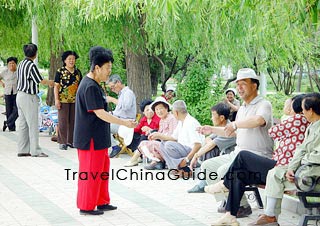 |
| Chinese people greets each other in a park |
Form of Address:
A form of address is to some extent a reflection of social climate. In China, various forms of address are used according to circumstances. Choosing the appropriate and correct form shows your wit and high respect to others. Generally, for Chinese people it should be in accord with convention and care much about the personal favor of the people being addressed. There are four main categories:
| Chinese Pinyin | Chinese | The same meaning in English |
|---|---|---|
| Hu Zhu Xi | 胡主席 | President Hu |
| Zhang Jing Li | 张经理 | Manager Zhang |
| Liu Zhu Ren | 刘主任 | Director Liu |
To address based on professional qualifications, which expresses respect to those being addressed:
| Pinyin | Chinese | The same meaning in English |
|---|---|---|
| Li Jiao Shou | 李教授 | Professor Li |
| Wang Lu Shi | 王律师 | Lawyer Wang |
| Zhao Gong Cheng Shi | 赵工程师 | Engineer Zhao |
An address based on educational qualifications is helpful to emphasize the academic authority of the people being addressed:
| Pinyin | Chinese | The same meaning in English |
|---|---|---|
| Yang Bo Shi | 杨博士 | Dr. Yang |
| Gao Shuo Shi | 高硕士 | Master Gao |
| Ma Xue Shi | 马学士 | Bachelor Ma |
To address based on professions:
| Pinyin | Chinese | The same meaning in English |
|---|---|---|
| Wang Lao Shi | 王老师 | Teacher Wang |
| Zhang Yi Sheng | 张医生 | Docotor Zhang |
| Liu Jing Guan | 刘警官 | Officer Liu |
Generally, you can call others by their family name or full name by putting the Mr. or Ms. in front. This is the general address most widely used in company, hotels, stores, restaurants, karaoke, bars and other places.
You can use a person's full name or family name when addressing acquaintances, good friends and colleagues, or only the surname proceeded by an informal title which indicates his age:
| Pinyin | Chinese | Meaning in English | Note |
|---|---|---|---|
| Lao Li | 老李 | Elder Li | A person older than yourself |
| Xiao Wang | 小王 | Younger Wang | A person younger than yourself |
Phatic Communion
Different conditions require different styles in which conversational greetings may be exchanged. When you meet someone for the first time, the most commonly-used words are:
| Chinese Pinyin | Chinese | The same meaning in English |
|---|---|---|
| Ni Hao | 你好 | Hello/Hi |
| Hen Gao Xing Ren Shi Ni | 很高兴认识你 | Glad to see you. / Nice to meet you. |
| Xing Hui (more formal ) | 幸会 | How do you do? |
For greeting acquaintances, the words will be more informal and friendly like the following:
| Pinyin | Chinese | Meaning in English |
|---|---|---|
| Hao Jiu Bu Jian | 好久不见 | Long time no see! |
| Ni Qi Se Bu Cuo | 你气色不错 | You look very well today! |
| Chi Le Ma | 吃了吗 | Have you had your meal? |
| Mang Shen Me Ne | 忙什么呢? | What are you busying doing these days? |
| Zui Jin Ru He | 最近如何? | How are you doing recently? |
| Shen Ti Zen Me Yang | 身体怎么样? | How are you feeling? / How are you? |
| Jia Ren Dou Hao Ba | 家人都好吧? | How is your family? |
| Qu Na'er | 去那儿啊? | Where are you going? |
| Shang Ban Qu Ma | 上班去吗? | You are going to work? |
| Jin Tian Feng Hen Da | 今天风很大 | The wind is so strong today. |
| Ni Nu Er Zhen Ke Ai | 您女儿真可爱 | Your daughter is so lovely! |
This phatic communion is a salutation without expectation of a response, the question being rhetorical. However, it should be compact, friendly and respectful. It is improper to ask about the personal affairs of other people, for delving into another's privacy is considered to be discourteous. Remember always to be active, passionate, natural and attentive when greeting others. Further Reading : Chinese Names