Chinese Table Manners
 |
| Dining in a Chinese restaurant |
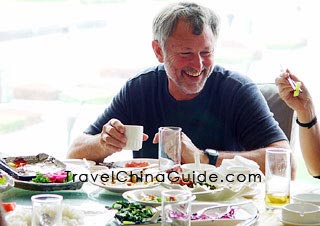
a. A round dining table is more popular than a rectangular or square one. As many people who can be seated comfortably around it conveniently face one another. The guest of honor is always seated to the right of the host; the next in line will sit on his left. Guests should be seated after the host's invitation, and it is discourteous to seat guests at the place where the dishes are served.
b. Dining may only begin once the host and all his guests are seated. The host should actively take care of all his guests, inviting them to enjoy their meal.
c. On a typical Chinese dining table there are always a cup, a bowl on a small dish, together with the chopsticks and spoons. Dishes are always presented in the center of the table.
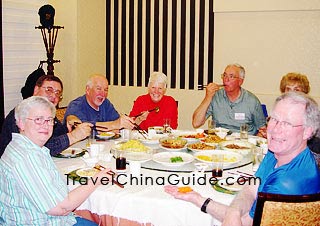 |
| Our guests enjoy delicious Chinese food |
d. Apart from soup, all dishes should be eaten with chopsticks. The Chinese are particular about the use of chopsticks. There are many no-no's such as twiddling with chopsticks, licking chopsticks, or using them to stir up the food, gesture with them or point them at others. Never stick chopsticks in the center of rice, as this is the way to sacrifice and is therefore considered to be inauspicious.
e. Keep your dining pace accorded with other people. Never smoke when dining.
f. A formal dining is always accompanied by tea, beer or distilled spirit. The one who sit closest to the teapot or wine bottle should pour them for others from the senior and superior to the junior and inferior. And when other people fill your cup or glass, you should express your thanks. Guests can not pour tea or wine themselves.
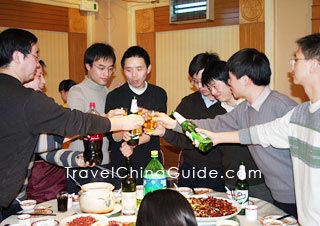 |
| Cheers when dining together in China |
g. A toast to others is a characteristic Chinese dining. When all people are seated and all cups are filled, the host should toast others first, together with some simple prologue to let the dining start. During the dining after the senior's toast, you can toast anyone from superior to inferior at their convenience. When someone toasts you, you should immediately stop eating and drinking to accept and toast in response. If you are far from someone you want to toast, then you can use your cup or glass to rap on the table to attract attention rather than raise your voice. However, it is impolite to urge others to drink.
h. Conventionally, if you are invited to a formal banquet, all the dishes should not be eaten up completely, or you will give the host the impression that he has not provided a good banquets and the food was insufficient. After dining, guests should leave once the host has left the table. Further Reading: Food and Drink