Bai Nationality
The main distribution of the Bai people is in the Dali Bai Autonomous County of Yunnan Province, together with Lijiang, Kunming, Yuanjiang, Guizhou and so on. According to the census taken in 2000, there were some 1,858,063 individuals.
 Language:
Their language language derives from the Zang-Mian Austronesian family of Sino-Tibetan Phylum but with the character set of the Han people as their written form of language.
|
|
 Arts and Crafts:
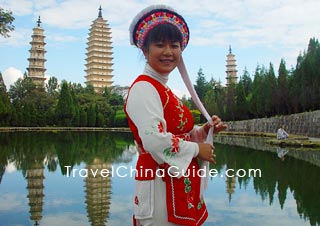
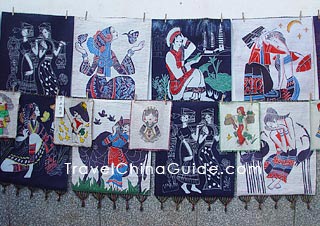
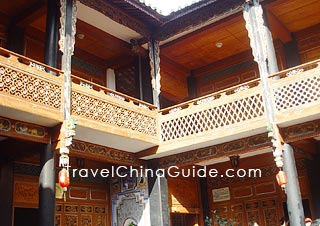
 The Bai people are masters of artistic creativity including architecture, sculpture, painting, music, and other craft techniques such as lacquer work. The great Three Pagodas in Dali, having stood since the Tang Dynasty (618-907), and resembling the Small Wild Goose Pagoda in Xian are excellent examples of Bai creativity and skill. Contemporarily, their dance and music spread among the Han people after becoming accepted as part of the court entertainment. In the Yuan (1271-1368) and Ming (1368–1644) Dynasties, the majority of the skilled lacquer artisans were selected from Yunnan Province.
Food:
For the diet, they prefer sharp, cold and spicy flavor, so they prefer cured ham or fish eaten with rice or flour; though some people in the mountains eat corn as a staple food.
Clothes:
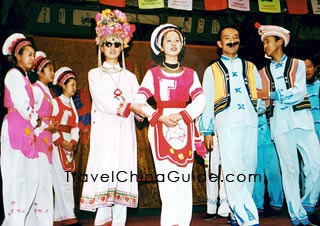
The Bai people favor white clothes and decorations. White in Chinese is pronounced 'Bai', so maybe this is where their name derives from. Women in Dali traditionally wear a white coat trimmed with a black or purple collar, blue loose trousers; embroider shoes, silver bracelets and ear rings.
|
|
 Religion:
Although the Bai people believe in Buddhism, they also respectively worship their village god ('Benzhu'), Nature god, the Prince of the Nanzhao regime, or even a hero of folklore.
Festivals:
The grandest festival of the Bai people is the March Fair, held annually at the foot of Mt. Cangshan in Dali between the fifteenth and the twentieth day of the third lunar month. Originally it was religious activity to rally and pay homage, but it gradually evolved into a fair including performances of traditional sports and dance, as well as the trade of merchandise from different regions. Another important festival is the Torch Festival, held on the 25th day of the sixth lunar month to wish both health and a good harvest. On that evening, the countryside will be decorated with banners with auspicious words written upon them. Villagers will then light torches in front of their gates, then walk around the fields while holding yet more torches in order to catch pests. Recommended Video Clip: Bai Minority People Dance More Ethnic Groups in Yunnan and Guizhou Area:
Yi Hani Dai Zhuang Miao Bouyei Dong Yao Further Reading:
Yunnan People