 |
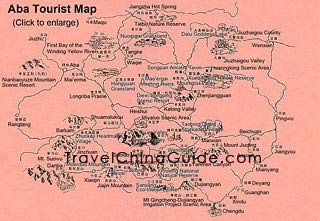
| Aba Tourist Map (Click to enlarge) |
Aba Facts
Chinese Name: 阿坝藏族羌族自治州 (ā bà zàng zú qiāng zú zì zhì zhōu)
Population: 946,000
Area: 84,242 square kilometers (32,526 square miles)
Location: in the northwest of Sichuan Province, southwest China
Administrative Division: 12 counties (Wenchuan, Lixian, Maoxian, Songpan, Jiuzhaigou, Jinchuan, Xiaojin, Heishui, Zamtang, Aba, Zoige, Hongyuan); 1 county-level city (Barkam)
Area Code: 0837
Zip Code: 0624000
GDP (2019): CNY 39.008 billion (USD 5.654 billion)
Nationalities: Tibetan, Qiang, Han
Famous for China's Star Attraction – Jiuzhaigou
Aba (Ngawa) Tibetan and Qiang Autonomous Prefecture is situated in northwestern Sichuan Province, the eastern end of the Qinghai-Tibet Plateau. It neighbors Qinghai and Gansu provinces to the north. Aba is regarded as the best destination of ecotourism by world tourism experts. It retains the animal and plant resources that have been extinct in other parts of the world, such as giant pandas and dove trees. The vast grasslands, towering snow mountains and crisscross rivers constitute Aba's diverse and magnificent natural scenery.
All the tourists who have visited the Jiuzhaigou Valley are hard not to admire the dreamlike scenery presented by the mountain lakes, waterfalls, colorful forests, snow peaks, and Tibetan customs. The colorful calcified pool and rare karst landform in Huanglong Scenic Area are also unique. At the same time, the multi-ethnic people have created brilliant ethnical cultures here. Many monasteries and traditional ethnic buildings, such as Tusi official village, and ethnic festivals have been preserved. Tibetan New Year in February and March and Qiang New Year in lunar October are the two biggest festivals in the region. At that time, people will dress up, sacrifice, sing and dance to celebrate the coming of a new year.
Aba Attractions - Things to Do
 Jiuzhaigou Valley Scenic and Historic Interest Area
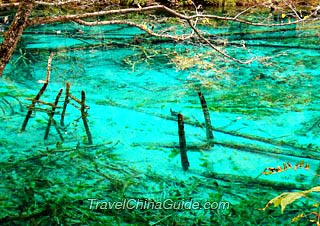
: Jiuzhaigou is named after the nine Tibetan villages in the valley. It is widely known as a wonderland with dreamlike sceneries and unique folk customs. Located in northwestern of Jiuzhaigou County, Jiuzhaigou has opened a 60-kilometer-long (37-mile-long) scenic line dotted by several scenic zones where visitors can admire the breathtaking landscape of lakes, waterfalls, springs and alpine valleys.
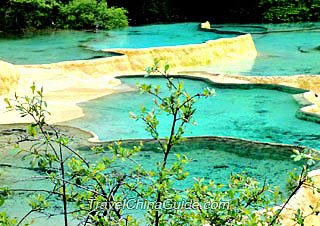
Huanglong Scenic and Historic Interest Area: Located in the Huanglong Town of Songpan County, 100 kilometers (62 miles) from Jiuzhaigou, this scenic area is famous for the layered calcium carbonated deposit, colorful lakes, snow clad mountains and virgin dorest.
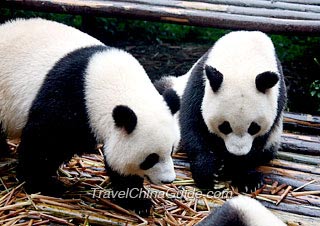
: Wolong is situated in the southwest of the Wenchuan County, 130 kilometers (81 miles) from Chengdu. It is well known as the home of the giant pandas. Apart from the great number of rare animals and plants, this natural reserve also boasts enthralling sceneries combining with mountains, waters, forests, caves.
Four Maiden's Mountain: Composed of four sister snowy peaks, the mountain has three valleys with majority of the scenic spots collected in the Changping Valley. Some people call it 'the alps in China', and it is preferred by a multitude of climbers.
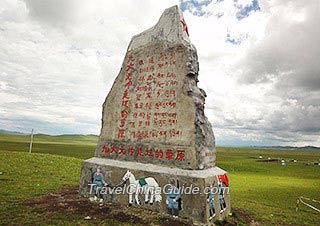
Ruoergai Grassland: Located in the northwest of Sichuan Province, Ruoergai Grassland is the vast home of Zang (Tibetan) People who mainly live on stock farming.
Flower Lake: It is a wetland in the vast Ruoergai Grassland. Its name comes from the small but beautiful flowers in the lake. This is also the origin of its name.
Wenchuan Special Tourism Zone: On May 12, 2008, a most damaging earthquake occurred in Wenchuan county. It was the 21st deadliest earthquake of all time and caused great loss of lives and property. The Chinese government did the best to help people to overcome the difficulties. Many foreign nations, international and domestic organizations as well as common people also offered quick assistance to the victims. After the earthquake, Wenchuan Special Tourism Zone was established to commemorate the victims of the earthquake, create more employment opportunities for the survivors and make more people learn of the culture of the Qiang and Tibetan ethnic minorities.
 |
How to Get to Aba
1. Aba Hongyuan Airport is 48 kilometers (30 miles) away from the Hongyuan County. There is no airport shuttle bus, so taxi is a good choice to travel between the airport and surrounding areas. The airport opens direct flights from/ to Chengdu, Wenzhou and Lhasa.
2. Jiuhuang (Jiuzhaigou-Huanglong) Airport is 12 kilometers (7 miles) north of the Chuanzhusi Town, Songpan County. The airport is 88 kilometers (55 miles) from Jiuzhaigou Scenic Area, and 43 kilometers (27 miles) from Huanglong. Air distance from Jiuhuang Airport to Chengdu Shuangliu International Airport is about 240 kilometers (149 miles) for about 40 minutes' ride. There are dozens of flights daily from Jiuzhaigou to Chengdu, but much fewer in winter.
3. If visitors don't want to miss the natural beauty on the way, the best way is taking buses. Chengdu has two bus stations operating lines to Jiuzhaigou, Barkam, Zoige, Songpan, Zamtang and the Four Maiden's Mountain.
4. Visiting Aba, including Jiuzhaigou and Huanglong, spring or autumn clothing is necessary in summer for the temperature varies greatly during a day.
Weather
-
Climate of the prefecture is complex and varied for the complicated geography and landform. The northwestern tableland area has a continental plateau climate with long and chilly winter and cool humid summer. The annual average temperature is 0.8-4.3 C (33 -40F). The Aba weather of the southeastern alpine valleys ranges from the temperate to the frigid climatic types with annual average temperature of 1-5C (34-41F).
Some people say that paradise is distributed everywhere in Aba. The fact is that different sceneries here show their best in different seasons although visitors can visit this wonderland at any time. For instance, the best time to Huanglong is from April to November, to Jiuzhaigou is from September to October and to the Four Maiden's Mountain is in July and August.
Aba Travel Tips
 History: For thousands of years, a multitude of Chinese ancient ethnic minorities, including Qiang, Sienpi (Xianbei), Tubo and Hui, had worked collaboratively on the development of Aba, leaving the land abundant culture accumulations of ethnic minorities. The prefecture was changed into Aba Tibetan Autonomous Prefecture in 1955 and Aba Tibetan and Qiang Autonomous Prefecture in 1987.
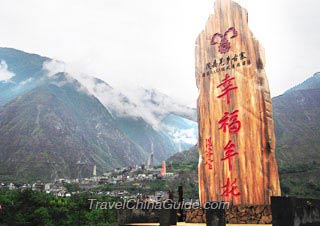 |
| Mutuo Qiang Stockaded Village in Maoxian |
Physical Features: Tableland and alpine valleys make up the main landform of the prefecture. Parts of the Qinghai-Tibetan Plateau and the Hengduan Mountains extend to its territory. Alpine valleys are mainly distributed in the southeastern part, while its northwestern land is plateau region. Minjiang River and Dadu River, tributaries of the upper Yangtze River, flow across this area which is the only place in Sichuan Province having the Yellow River flow through.
Local Highlights: Festivals and folk customs of the Tibetan and the Qiang constitute the highlights of the prefecture. In addition, the International Panda Festival will be held in every September.
Special Local Products: verbal medicine, Tibetan knives, embroidery of the Qiang ethnic minority
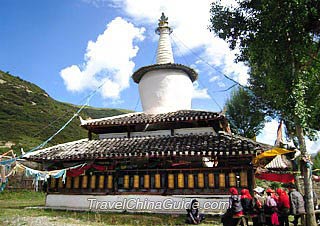 |
| Shangniba Temple in Songpan |
- Last updated on May. 08, 2026 by Demi Li -