Military Formation of Terracotta Army
 |
 Terra Cotta Warriors & Horses Pictures Terra Cotta Warriors & Horses Pictures |
Victory or defeat on a battlefield depends on a well-organized military formation together with a well thought out strategy. Ancient military strategists advocated an agile vanguard preceding a formidable main echelon, which consists of chariots, infantrymen and cavalrymen. The formation was adaptable to changing conditions on the field.
The terra cotta warriors armed with different weapons played supportive roles in a variety of scenarios so that the combined strength of the army was brought into full play. The soldiers are divided into infantry armed with swords and spears, archers, crossbow archers, cavalry, chariot drivers and officers. Among the infantrymen there are some with armor and others without. Chariots are respectively designed for commanders, aide officers as well as for a squad of three or four soldiers. In the Art of War, it illustrates that more horses rather than chariots should be used when the battle is going to be a difficult one and vice versa. When the danger is at its greatest archers should be deployed.
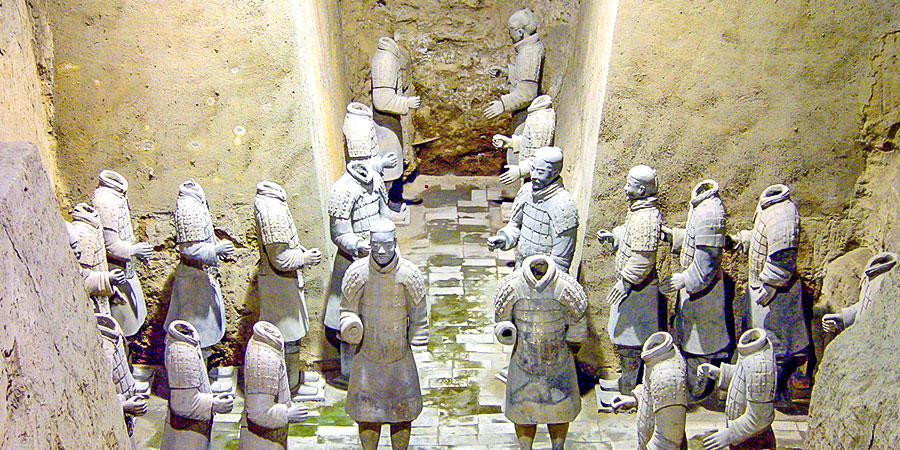 |
| Many Terracotta Warriors have lost heads. |
Excavations indicate that the cavalry functioned as an independent force in battle, with chariots playing a vital strategic role. It oppugned the opinion that use of chariots in battle had ceased with the end of the Warring States Period. During the Battle of Changping between the Qin and Zhao states in 260 BC, this well-designed military disposition enabled the Qin defeat the enemy troops and thereby slaughtered 400,000 Zhao soldiers. Extract from the Art of War
Military tactics are like unto water; for water in its natural course runs away from high places and hastens downwards. So in war, the way is to avoid what is strong and to strike at what is weak. The soldier works out his victory in relation to the foe that he is facing. Therefore, just as water retains no constant shape, so in warfare there are no constant conditions.
Water shapes its course according to the nature of the ground over which it flows; He, who can modify his tactics in relation to his opponent and thereby succeed in winning, may be called a heaven-born captain.
 Recommended Tours including the visit to Terra Cotta Warriors and Horses:
Terracotta Warriors Tour: One-day to visit Terracotta Warriors and Horses and more
More Xi'an Tours
 Next:
Next: