General Introduction
The history of Chinese garden architecture can be traced back to the Shang and Zhou dynasties (16th century BC - 221 BC). During that period, Chinese kings and nobilities began the practice of developing forests and woods for the specific purpose of hunting. In some instances these areas of forests and woods, called 'You' in Chinese covered dozens of square kilometers or even hundreds of square kilometers. Somewhere between 206 BC and 220 BC, the Han Dynasty advanced the concept of these 'Natural Gardens' by adding living quarters and adding animals that were raised and considered to be the rudiment of Chinese garden architecture.
Traditional Chinese Garden architecture in the real sense first appeared in the Tang Dynasty somewhere between 618 AD and 907 AD. During this era, the construction of beautiful architecture evolved into what would include man-made hills, pools and fountains. As time went on, and craftsman became more accomplished, this man-made beauty was able to successfully blend in well with the beauty of the natural environment.
The Ming Dynasty (1368 AD - 1644 AD) followed by the Qing Dynasty (1644 AD - 1911 AD) saw the heyday of Chinese garden architecture. Especially in the Qing Dynasty, emperors collected skillful craftsmen from all over the country to create even more elaborate gardens. Gardens in this period were no longer merely places for fun, but also served as areas where more formal ceremonies could take place such as holding court, hosting banquets, pursuing studies, producing theatrical activities, and to provide a setting where people could worship.
Classification
Depending on their geographical locations, Chinese gardens can vary. Generally speaking, they can be divided into two groups, the Imperial Garden Architecture in north China and the Private Garden Architecture in south China. Imperial gardens are noteworthy for their grand dimensions, luxurious buildings, and exquisite decorations.
Northern Imperial Garden
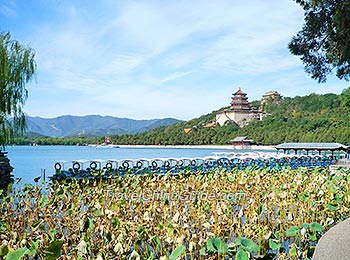
With material resources and generous financial support combined with supreme power, emperors were able to construct Imperial Gardens with almost unlimited extravagance. Designers placed emphasis on the harmonious unity of architecture with nature which contributed to the decision to construct many gardens in scenic mountain areas. In northern China, Beijing is one of the better known areas for these beautiful gardens.
Summer Palace and
Old Summer Palace (Ruins of Yuanmingyuan) are typical
examples of this period. Gentle babbling brooks meander through delicate palaces, pavilions, platforms, and bridges. Large lakes shimmering in the early morning or late afternoon sun, where fish swim delightfully in and out of duckweeds add to the incredible beauty of the pleasant surroundings. When one is confronted with all of this fine architecture, it is easy to appreciate the high level craftsmanship that went into the construction of these magnificent gardens.
Southern Private Garden
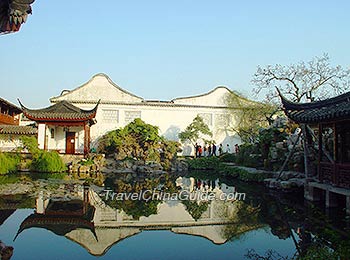
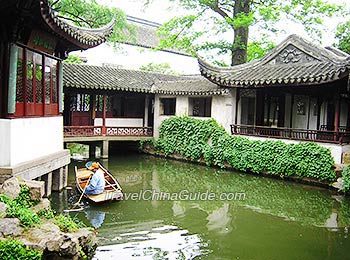
The gardens in the south are smaller but no less exquisite. The area in South China although rich in water resources is somewhat limited in the land area that could be used for private gardens. As a result of these phenomena, the owners were put in the position where they skillfully and cleverly constructed their private gardens according to their own personal tastes. Southern gardens are simpler and more elegant, like a shy girl waiting for you to take away her veiling. Designers were also good at selecting colors such as dark grey tiles to cover the house roofs, while walls were painted white. Wooden pillars were colored dark brown or greenish black that blended with the bridges, pavilions and corridors that were made of natural stone. The whole scenery presents a peaceful and pleasant atmosphere. Famous gardens belonging to this type are popular in Jiangsu Province. Some of the more noteworthy would be
Garden of the Master of Nets,
Li Garden,
Blue Wave Pavilion,
Lion Grove,
Garden for Lingering, and
Humble Administrator's Garden.
Other kinds of garden architecture contain monastic gardens which are located in temples, symbolizing a sort of spiritual peace and harmony. An example of this would be the
Mountain Resort of Chengde (Bishu Shanzhuang) that is built on a large scale and blends in well with the mountain scenery.
- Last updated on Aug. 07, 2025 by Gabby Li -
 Forbidden City Pictures
 Forbidden City Video