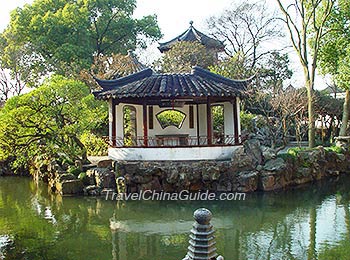
The beautiful waterside City of Suzhou in Jiangsu Province in South China is most famous for its elegant
classical gardens. Among these, the Humble Administrator's Garden, covering about 52,000 sq. meters (12.85 acres), is the largest and most renowned. Due to its unique designs and ethereal beauty, the garden has garnered many special honors. It is listed as a World Cultural Heritage site and has also been designated as one of the Cultural Relics of National Importance under the Protection of the State as well as a Special Tourist Attraction of China. Along with the
Summer Palace in Beijing, the
Mountain Resort of Chengde in Hebei Province and the
Lingering Garden in Suzhou, it is considered as one of China's four most famous gardens. No other classic garden in the country has been honored more than this one.
The Humble Administrator's Garden was originally built in 1509 during the Ming Dynasty (1368-1644). It was initially a private garden of a former government servant named Wang Xianchen. It was said that Wang was frustrated in his official career, so he intended to build a garden after retire and just do some gardening work like planting trees and cultivating vegetables there. He thought that was a simple life led by a humble man like him, hence the name of the garden. The garden was created upon the old relics of a residence and a Taoist temple. Water feature is the main background and its natural landscape includes small forests, hills and rock formations. It also has man-made pavilions, halls and parlors. Unlike the Grand View Garden and other famous gardens in Beijing, it is a representative work of the Ming Dynasty building style.
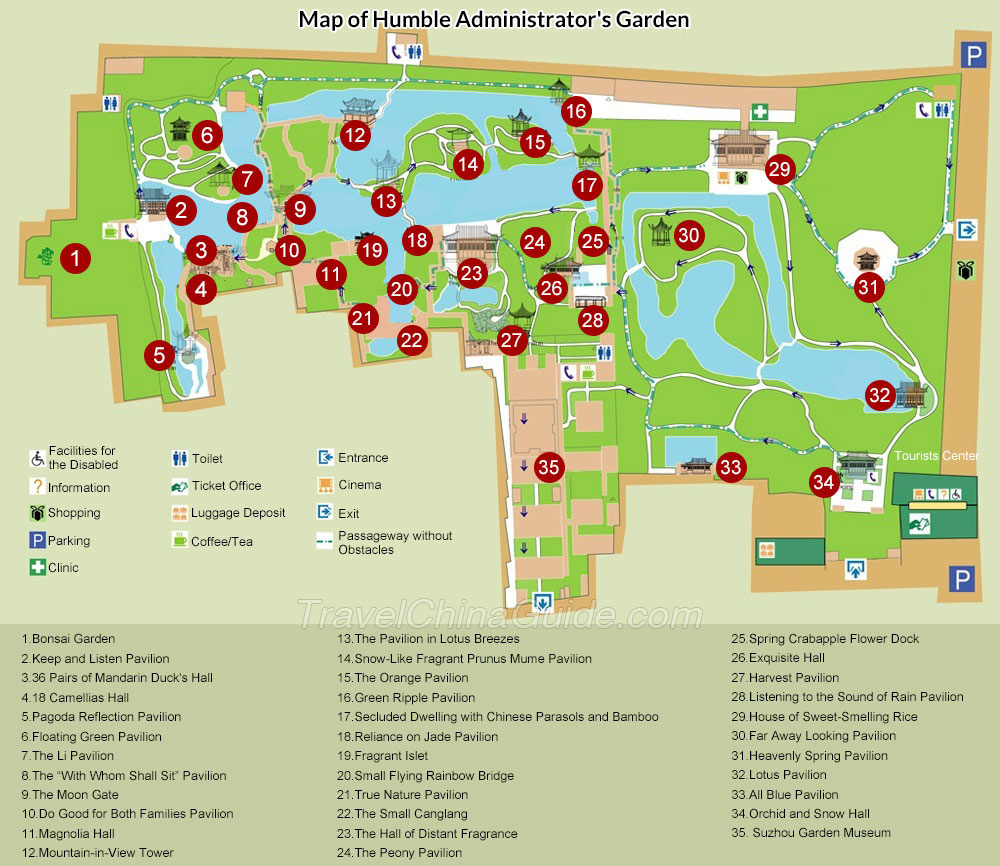
The garden consists of Eastern, Central and Western sections as well as some residences of the former owners. The residential houses are of typical style of Suzhou Local Residences, whose feature can be seen in the famous water township Zhouzhuang not far from Suzhou City. The site of the residences has been rebuilt as the Garden Museum now. 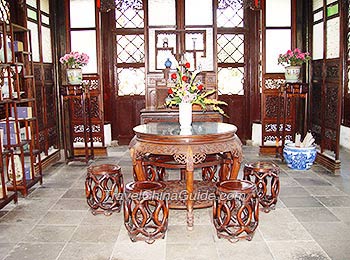 | | Golden Ginkgo in the Garden | |  | | Red Maple in the Garden | |
Eastern Section
The Eastern Section is dotted with sheer hills, green grasses, dense bamboo and pine forests and winding streams. The main building is the Orchid and Snow Hall (Lanxue Tang), whose south wall has a panoramic map of the entire garden. Besides, there is a Lotus Pavilion (Furong Xie) in the garden. Half built above water while half built on a terrace, the pavilion is an excellent place to admire lotuses in summer. Another impressive structure is the Heavenly Spring Pavilion (Tianquan Ting), which gets its name after an ancient well whose water tastes very sweet.
Central Section
The Central Section is the truly elite part of the garden, with one-third of its area covered by water. It is lined with exuberant trees and elegant parlors. Pavilions and courtyards are clustered throughout. The Hall of Distant Fragrance (Yuanxiang Tang) is the main building that is named after a lotus pool nearby. When the summer comes the pool is filled with lotuses and the heady fragrance wafts into the building. The hall is designed with oversized glass windows on all sides for easy viewing. Nearby is the Small Flying Rainbow Bridge (Xiaofeihong), a rare type of bridge and the only one in the garden you can walk across.
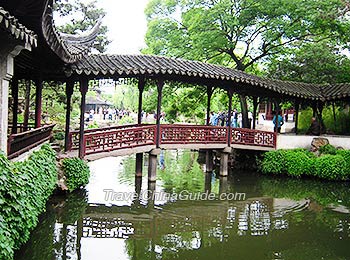 |
| Small Flying Rainbow Bridge |
Western Section
The main building in the Western Section is a stately and ornate hall which is divided into two by a massive screen. The south part is 18 Camellias Hall (Shiba Mantuoluohua Guan) and the north part is the 36 Pairs of Mandarin Duck's Hall (Saliu Yuanyang Guan). In a nearby pool where the ducks were fed, stands an octagonal Pagoda Reflection Pavilion (Taying Ting); there is an optical illusion here - it appears as if a pagoda was lifting when all we actually see is the reflection of the pavilion.
In recent years, the Humble Administrator's Garden has been the site of many floral exhibitions. Every spring and summer, the Azalea Festival and the Lotus Festival are held here. There are bonsai shows in the aptly named Bonsai Garden (Penjing Yuan) in the Western Section while precious Chinese stones are shown in the Elegant Stone House (Yashi Zhai) in the Central Section.
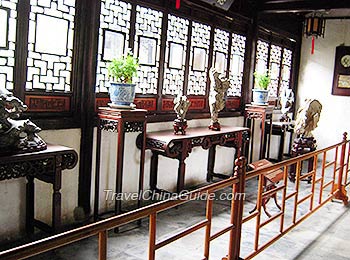 | | Elegant Furnishings | |  | | Bonsais | |
How to Get to the Humble Administrator's Garden
1. Take bus no. 40 or 313 and get off at Baijiaxiang, then walk westward for about 250m (273yd) to get there.
2. Take bus Gusu tourist line 4 or 5, and then get off at Suzhou Museum Station.
Suzhou Bus Search Humble Administrator's Garden Opening Hours & Entrance Fee
| Admission Fee | April, May, July, August, September and October: CNY 80
January, February, March, June, November and December: CNY 70
Note:
Children below 4.6 feet (1.4 meters) or under 6 or seniors over 70 can enter for free.
Half ticket for minors aged 6-18 and seniors aged 60-70. |
| Opening Hours | March 1 to October 31: 07:30 to 17:30
November 1 to the end of February of next year: 07:30 to 17:00
On Qingming Festival, the Labor Day, Mid-Autumn Festival and National Holiday: 07:30 - 18:00
Ticket selling stops 30min before the close time. |
Recommended Nearby Attractions
Next to the the Humble Administrator's Garden is the Garden Museum. It is the first museum themed on Chinese classic gardens, covering an area of 0.79 acre (3,205 square kilometers). The museum consists of five exhibition halls, including a preface hall and other four halls which respectively present the history, art, culture, and inheritance of Suzhou gardens. It demonstrates the traditional garden-building techniques and conveys the artistic charm of Suzhou Gardens to a large degree. After you wander around the Humble Administrator's Garden, it’s a place you can't miss.
Then, you may want to visit the nearby
Suzhou Museum, a popular local museum famous for its abundant and rare cultural relics of Ming and Qing dynasties. Besides,
Lion Grove Garden is a famous classical garden of a different style within walking distance.
Pingjiang Road is a featured ancient block where you can taste authentic Suzhou snacks and feel the watertown culture.
 Top 10 Things to Do in Suzhou 12 Best Places to Visit in Suzhou
- Last updated on Aug. 12, 2025 by Demi Li -
 Humble Administrator's Garden Photos