Zhouzhuang Water Town
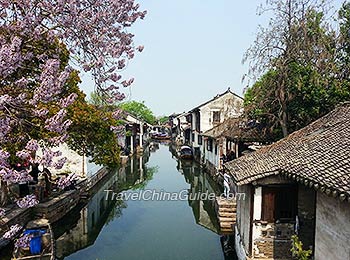
Zhouzhuang, one of the most famous water townships in China, is situated in Kunshan City which is only 18 miles (30 kilometers) southeast of Suzhou. It is noted for its profound cultural background, the well-preserved ancient residential houses, the elegant watery views and the strong local colored traditions and customs. During the Spring and Autumn Period (770-476 BC), the small town was a part of the fief Yaocheng and called Zhenfengli. After being donated to Full Fortune (Quanfu) Temple by Zhou Digong, a very devout Buddhist, in 1086 during the Northern Song Dynasty (960-1127), it got its present name as a memorial of the donor.
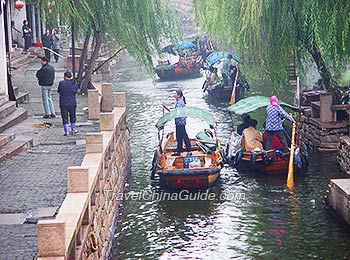
In an area of 124 acres (half a square kilometer), 60 percent of the existing structures here were built during the Ming and Qing Dynasties, which is from 1368 to 1911. Taking the most convenient form of transport here, a gondola, we will admire some of the breathtaking sights one by one.
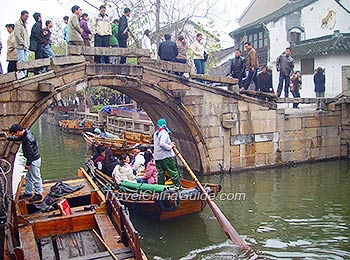
Zhouzhuang Water Town is surrounded and divided by lakes and rivers. 14 stone bridges cross the rivers, showing distinctive views of the water town. Twin Bridges which comprise Shide Bridge and Yong'an Bridge are the most famous and considered the symbol of the peaceful town. Built in Wanli era (1573-1619) of the Ming Dynasty, Twin Bridges is in the northeast of the town. Shide Bridge is east-west and has a curving arch, while Yong'an Bridge is north-south and the bridge beam is straight. Crossing the two crisscross rivers (Yinzi Creek and Nanbeishi River) and connecting at the middle, Twin Bridges look like an old-style Chinese key. In 1984, 38 canvases of the notable painter, Chen Yifei, were exhibited in a New York gallery named after Armand Hammer, chairman of Occidental Petroleum Corporation. 'Memory of Hometown' which depicts Twin Bridges was one of the items on display and has gained the world's attention for Zhouzhuang Water Village. The painting was chosen to be the first-day cover of the United Nations' postage stamp in 1985.
Located at the eastern end of Zhongshijie Street, Fu'an Bridge was built in 1355 during the Yuan Dynasty (1271-1368). The unique trait of Fu'an Bridge is the consummate combination of the single-arch bridge and the bridge towers which have no inside stairs to link the ground floor and the second floor. People have to make a detour and go up to the second floor via the bridge stairs. The towers are used as tearooms, restaurants and stores, providing good places to appreciate the views while taking a rest.
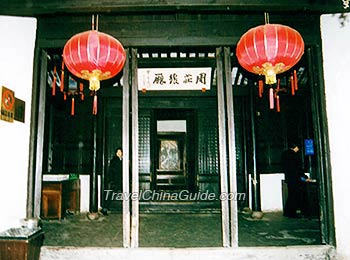
Built in 1742 and located at the southeast side of Fu'an Bridge, Shen House was the private property of the descendant of Shen Wansan, the richest man in Jiangnan (South of Yangtze River) in the early Ming Dynasty. The whole architectural complex is of the Ming's style and occupies an area of more than 0.7 acre (2,900 square meters). Over 100 rooms are divided into three sections connected by arcades and aisles. The first is the water gate and the wharf, where Shen's family moored boats and washed clothes. The middle part includes the gate tower, the tearoom and the main hall. Bricky gate tower carved with lively and ingenious figures which tell the historic stories or show the good wishes, make it a rare artwork. Tearoom and main hall are places for serving guests, and the furnishings here are all very elegant. The last section is the two-storied dwelling which consists of several buildings which are quite different from the main hall, more comfortable and refined in pattern and atmosphere. Datang Tower was where the womenfolk in the family lived. In Xiaotang Tower stands a painted sculpture of legendary Shen Wansan. Cultural relics including ancient folk instruments are exhibited in this tower and Back Hall.
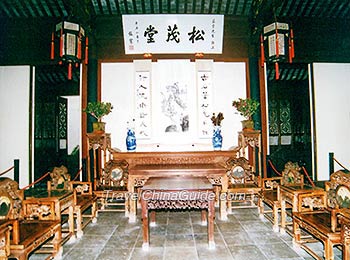
The house was built by Xu's family in the Zhengtong era (1436-1449) of the Ming Dynasty and bought by Zhang's family in the early Qing Dynasty. Located to the south of the Twin Bridges, Zhang House has more than 60 rooms and takes up about 0.44 acre (1,800 square meters). With Zhujing River flowing through, Zhang House is a dapper and graceful residential house with a tranquil courtyard and pond. Deep halls all indicate the secluded life of the quondam owner.
Once called the De's Tavern, Milou Tower perches next to Zhenfeng Bridge which is at the southwest corner of Zhouzhuang Ancient Town. It is famous for being a rallying place of the literators in old times. Numerous poets, songs and stories about Milou Tower are wide spread and make it more charming.
Standing on Zhongshi Street which is opposite to Puqing Bridge, Chengxu Taoist Temple was built during 1086 - 1093 of the Song Dynasty and also known as Sanctity Hall (Shengtang Hall). After several periods of expansion, it is one of the most famous Taoist temples in Wuzhong District. Covering an area of 1,800 square yards (1,500 square meters), simple but majestic Shengdi and Doumu halls, Yuhuang, Wenchang and Shengdi pavilions are really elaborate works and masterpieces of Taoist architctures.
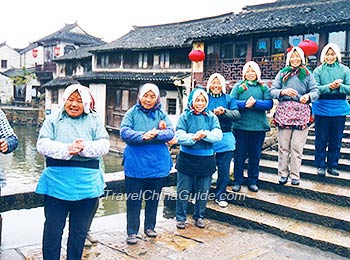
The preceding sight-seeing sites are just a little part of the pretty attractions of this water town. Besides these historic sights, the local folklore, traditions and legends of this water township, such as the dragon boat race, the granny tea or the Wansan home-style banquet which are formed from the immemorial civilization and history are also the indispensable elements for an unforgettable tour.
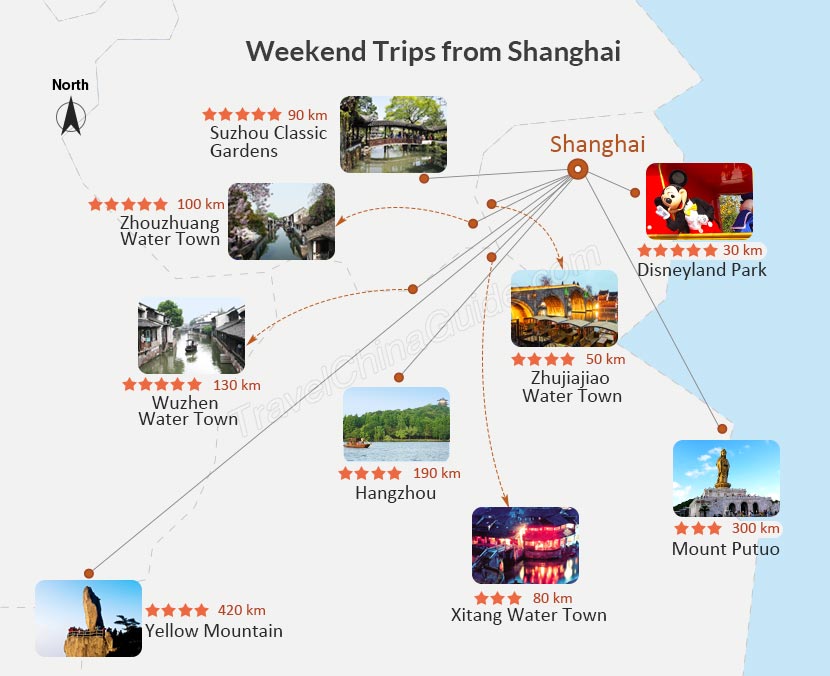
Take a bullet train from Shanghai to Suzhou Railway Station, then take a direct bus at the North Square of the train station to Zhouzhuang at a cost of CNY18.
Or take Shanghai metro line 11 to Huaqiao, then transfer to the bus Kunshan 106 to Zhouzhuang Bus Station, get off and change to Kunshan 261 to Zhouzhuang Xinpaikou.
 |
 More Pictures More Pictures |
In an area of 124 acres (half a square kilometer), 60 percent of the existing structures here were built during the Ming and Qing Dynasties, which is from 1368 to 1911. Taking the most convenient form of transport here, a gondola, we will admire some of the breathtaking sights one by one.
Twin Bridges (Shuang qiao)
|
|
Fu'an Bridge
Shen House
|
|
Zhang House
Milou Tower
Chengxu Taoist Temple
The preceding sight-seeing sites are just a little part of the pretty attractions of this water town. Besides these historic sights, the local folklore, traditions and legends of this water township, such as the dragon boat race, the granny tea or the Wansan home-style banquet which are formed from the immemorial civilization and history are also the indispensable elements for an unforgettable tour.
How to get to Zhouzhuang Water Town from Shanghai
Or take Shanghai metro line 11 to Huaqiao, then transfer to the bus Kunshan 106 to Zhouzhuang Bus Station, get off and change to Kunshan 261 to Zhouzhuang Xinpaikou.
How to get to Zhouzhuang Water Town from Suzhou
Take a Suzhou to Zhouzhuang bus from the north square of Suzhou Railway Station. The bus departs about every 30 to 40 minutes from 6:50 to 17:50, at a fare of CNY 18.
Or take metro line 4 to Tongli, take Exit 2 to catch bus no. Kunshan C10 and get off at Daqiao Rd. Yunting Rd., then walk southward along Diannan Rd. for Yunhai Rd. for about 1.2km to the water town.
Suzhou Bus Search
How to get to Zhouzhuang Water Town from Hangzhou
Take a bullet train from Hangzhou to North Square of Suzhou Railway Station and then take a direct bus there to Zhouzhuang.
Admission Fee & Opening Hours
| Opening Hours | 07:30 - 21:00 The scenic spots inside are open from 8:00 to 16:30, except Zhang House, Shen House and Zhouzhuang Musuem are open from 08:00 - 20:00. |
|---|---|
| Admission Fee | CNY 100 (for entry to the town and seeing 15 scenic spots) Children below 4.6 feet (1.4 meters) or under 6 or seniors over 70 can enter for free. Half ticket for minors aged 6-18 and seniors aged 60-70. |
| Tourist Boat | CNY 220 Operating Hours: 08:30 - 21:00 A boat allows six people at most and a cruise takes about half an hour. |
 Furthur Reading:
 Guangfu Ancient Town Mudu Ancient Town Tongli Town Luzhi Town Shaxi Ancient Town Top 8 Suzhou Water Towns 12 Best Places to Visit in Suzhou 8 Best Water Towns near Shanghai A Complete Guide to 15 Shanghai Old Towns Top 10 Water Towns in China 15 Most Beautiful Places in China
You May Like

- Last updated on Aug. 12, 2025 by Demi Li -