Tiger Hill
A famous Song Dynasty (960-1279) poet, Su Shi said, 'It is a lifelong pity if having visited Suzhou you did not visit Tiger Hill.' This epitomises the general opinion of those who have seen this local beauty spot with its many attractions that we shall endeavour to describe for you.
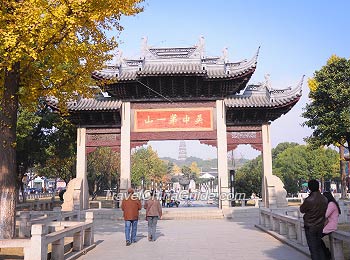
Tiger Hill, known also as Surging Sea Hill, is a large hillock covering about 3.5 acres (14,100 square metres) and only 118 feet (36 metres) in height. Climbing it, you will find a number of historical sites some of which can be traced back over 2,500 years to the founding of Suzhou. Although the hill is relatively small it has rich history. These are just some of the highlights of what to be found there.
Tiger Hill, known also as Surging Sea Hill, is a large hillock covering about 3.5 acres (14,100 square metres) and only 118 feet (36 metres) in height. Climbing it, you will find a number of historical sites some of which can be traced back over 2,500 years to the founding of Suzhou. Although the hill is relatively small it has rich history. These are just some of the highlights of what to be found there.
 |
 Tiger Hill Photos Tiger Hill Photos |
 |
| Tiger Hill Pagoda |
The Tomb of King He Lu
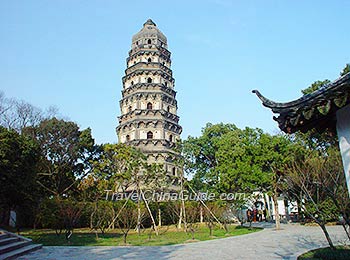
Tiger Hill Pagoda (Huqiu Tower)
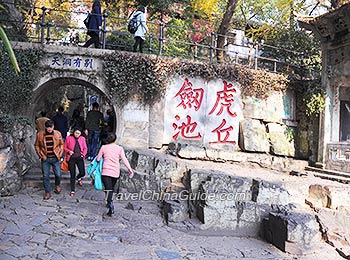
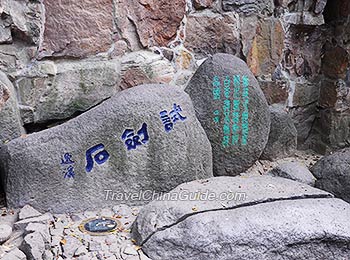
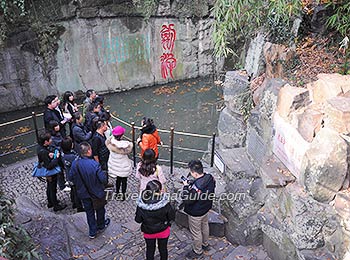
Sword Testing Stone and Sword Pool
|
|

Lu Yu Well
Verdant Mountain Villa (Yongcui Shanzhuang)
 |
| Verdant Mountain Villa |
Wanjing Villa
 |
| Bonsais |
There can be little doubt that Tiger Hill is a wonderful sight with its leaning pagoda, waterfalls and landscaped paths. It is hard to believe that it was man made to be the cemetery of king but this is yet another part of the wonder in China, a land that will never cease to amaze and enthral the visitor with its heritage.
Transportation
2. Take Gusu Tourist Bus Line 3 and get off at Huqiu Beimen Parking Lot Station.
Admission Fee & Opening Hours
| Opening Time | Nov. 1 - April 30: 07:30 - 17:30 May. 1 - Oct. 31: 07:30 - 18:00 |
|---|---|
| Admission Fee | April, May, July, August, September and October: CNY 70 January, February, March, June, November and December: CNY 60 * Note: 1. Children below 4.6 feet (1.4 meters) or under 6 and seniors over 70 can enter for free. 2. Minors aged 6-18 and seniors aged 60-70 enjoy half price. |
 Tiger Hill Ticket Booking
You May Like:
Shantang Street (Seven-Li Shantang) Lingering Garden (Liu Yuan) West Garden Temple Top 8 Classical Gardens of Suzhou Top 10 Things to Do in Suzhou 12 Best Places to Visit in Suzhou- Last updated on Jul. 24, 2026 by Sherry Xia -