Chinese Taoist Architecture
Taoist architecture greatly reflects many Taoist ideas and thoughts. Taoism is a religion native to China. Laozi, (also spelled Lao-Tse, Lao Tsu, Lao Tzu, etc.) a famous thinker living in 6th Century BC, established this philosophy and came to be regarded as the father of Taoism. It formed mainly during Eastern Han Dynasty (25-220).
Taoism pursues the harmonious unity of humans and nature. Taoists skillfully built temples that conformed to the contours of the land. Starting with inherited Chinese traditional ideas of construction, they added their own concepts. Splendorous symmetric architectural complexes are composed of many ordinary yards spreading orderly along a central axis. In every single yard, there are neatly located attached architectural structures. The whole layout reflects Taoists' emphasis on order and equability.
Taoist architecture includes temples, palaces, nunneries, altars and huts where religious activities are performed and the power that envelopes and flows through all things, living and non-living, is worshipped. Similar to Buddhist architecture, it can be divided into holy halls for sacrifice, altars to pray at, houses to live in, rooms to chant scriptures in according to their use. But the difference is that Taoist architectural style is closer to that of worldly buildings. For example, Taoist statues and wall paintings are more familiar to common people.
Another constructional style follows Taoist theory of five elements and eight diagrams. A furnace - a stove to refine pills of immortality which are believed to lengthen one's life - is laid in the center around which other constructions are distributed according to eight diagrams. All structures are in line forming a strict constructional system which reflects Taoist thought of the inter-relationship of Essence, Energy and Spirit.
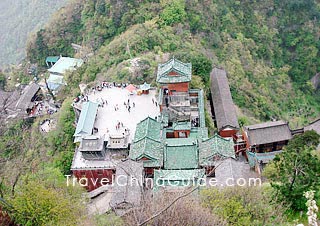
Taoist architecture is developed from the early palaces, altars and temples in ancient China. Most Taoist temples are wooden-framed and have garden structures. Some garden sights are man-made pavilions, towers, walkways and terraces. And others are mainly based on natural scenery. Quiet and beautiful mountains provide an unblemished environment in which Taoists can cultivate their inner selves.
Taoist architecture provides us an opportunity to experience genuine Taoism. It has important artistic and historic values in lucubrating Taoist philosophy and thought of ancient China.
Famous Taoist Holy Mountains in China include Mt. Wudang, Mt. Longhushan, Mt. Qingcheng and Mt. Laoshan. And Famous Taoist Holy Temples are Qingyang Temple, Temple of the Eight Immortals (Ba Xian An) and Wong Tai Sin Temple.
Related Link: Taoist Temples, Hall of Imperial Peace (Qin’andian) in Forbidden City
Taoism pursues the harmonious unity of humans and nature. Taoists skillfully built temples that conformed to the contours of the land. Starting with inherited Chinese traditional ideas of construction, they added their own concepts. Splendorous symmetric architectural complexes are composed of many ordinary yards spreading orderly along a central axis. In every single yard, there are neatly located attached architectural structures. The whole layout reflects Taoists' emphasis on order and equability.
|
|
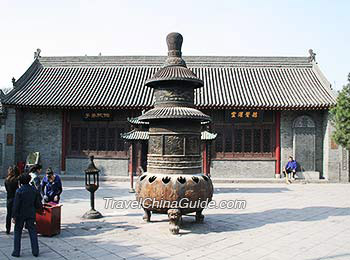
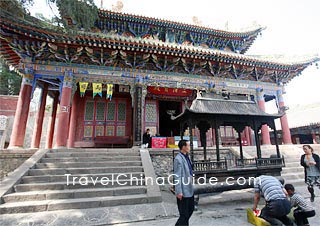
Taoist architecture includes temples, palaces, nunneries, altars and huts where religious activities are performed and the power that envelopes and flows through all things, living and non-living, is worshipped. Similar to Buddhist architecture, it can be divided into holy halls for sacrifice, altars to pray at, houses to live in, rooms to chant scriptures in according to their use. But the difference is that Taoist architectural style is closer to that of worldly buildings. For example, Taoist statues and wall paintings are more familiar to common people.
Another constructional style follows Taoist theory of five elements and eight diagrams. A furnace - a stove to refine pills of immortality which are believed to lengthen one's life - is laid in the center around which other constructions are distributed according to eight diagrams. All structures are in line forming a strict constructional system which reflects Taoist thought of the inter-relationship of Essence, Energy and Spirit.
|
|
 Introduction to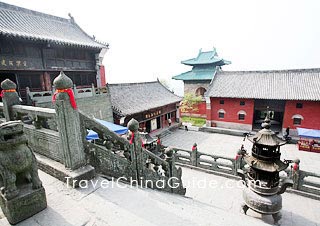

Taoist architecture is developed from the early palaces, altars and temples in ancient China. Most Taoist temples are wooden-framed and have garden structures. Some garden sights are man-made pavilions, towers, walkways and terraces. And others are mainly based on natural scenery. Quiet and beautiful mountains provide an unblemished environment in which Taoists can cultivate their inner selves.
Taoist architecture provides us an opportunity to experience genuine Taoism. It has important artistic and historic values in lucubrating Taoist philosophy and thought of ancient China.
Famous Taoist Holy Mountains in China include Mt. Wudang, Mt. Longhushan, Mt. Qingcheng and Mt. Laoshan. And Famous Taoist Holy Temples are Qingyang Temple, Temple of the Eight Immortals (Ba Xian An) and Wong Tai Sin Temple.
Related Link: Taoist Temples, Hall of Imperial Peace (Qin’andian) in Forbidden City
- Last updated on May. 28, 2026 by Sule Su -