Eastern Qing Tombs
 |
 Eastern Qing Tombs Pictures Eastern Qing Tombs Pictures |
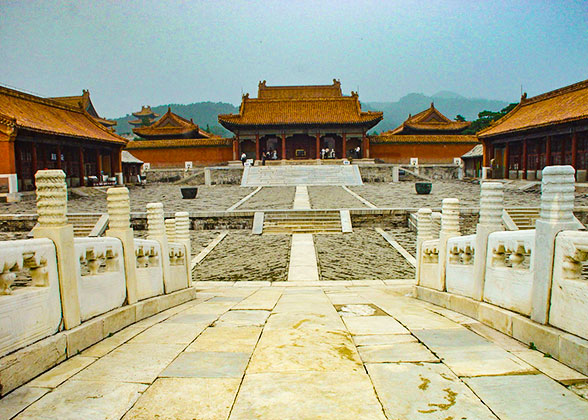
Among the finest, best-preserved and largest of the extant tomb complexes in China, the Eastern Qing Tombs are located along Changrui Mountain in the west of Malanyu Town, Zunhua County, Hebei Province. Along the south side of Changrui Mountain, the tombs of five emperors, four empresses, five imperial concubines, and one princess are arrayed based on the traditional concept of placing the most senior and most distinguished in the center.
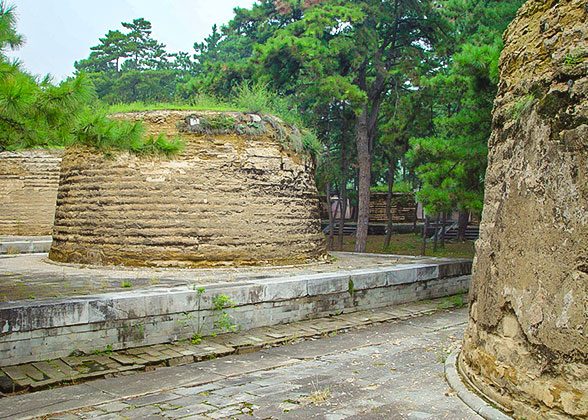
Xiaoling, the tomb of Emperor Shunzhi (1638-1661, the first Qing emperor to rule China), is aligned with the axis of the main apex of Changrui Mountain, which indicates that the person buried there is the most exalted in the group. Other emperors' tombs lie on both sides of Xiaoling in a fan pattern from east to west according to the position each person occupied in the family hierarchy. The tombs of empresses and concubines are placed alongside those of their husbands, clearly showing the master-subject relationship that they had in life. Sacred ways connect the tombs of the women with those of their husbands, and the sacred ways of the tombs of the other emperors connect with that of Xiaoling. Thus a branch-like system is formed, showing clearly the relationship of the rulers to their heirs.
Of all, Xiaoling is the biggest and most elaborate, standing as the focal point of the entire Eastern Qing Tombs. The grandeur of this tomb may be attributed to its having been the first sepulcher constructed for a member of the royal family of the Qing Dynasty, so the builders hoped to set the tone for a prosperous future. Crossing through the Great Red Gate, you can see buildings of different sizes, all with roofs of yellow glazed tile, connected by the brick paths or 'sacred ways' that converge in the area of Xiaoling.
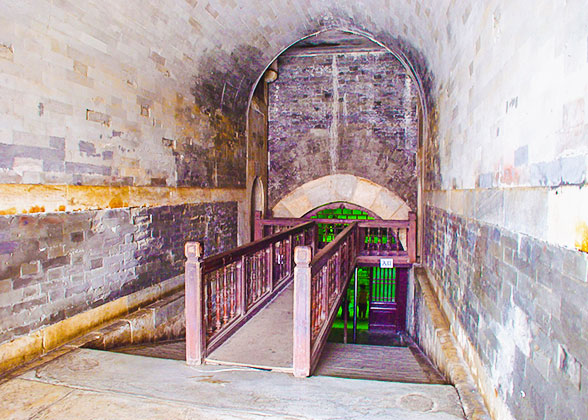
An example of the most exquisite architecture of Eastern Qing Tombs is Dingdongling, the tomb of Empress Dowager Cixi. Although she handled affairs of state for more than 45 years, she never ascended the throne. Elaborate and highly refined decorations and carvings inside Dingdongling make it unique among those of the Qing Dynasty. The main material used in the tomb, which took six years to build, was gold, the symbol of royal family.
Around the Gate of Eminent Favor (Long'enmen) of Dingdongling, elaborate carvings of dragons and phoenixes, drifting water and flowing clouds adorn the white marble balustrades. In front of the hall, on a colorful stone, we find examples of extraordinary techniques and unconventional design in additional intricate images of lively dragons and phoenixes.
Many of the minor tombs are also worth visiting. You can learn about Chinese culture while enjoying the beauty of the area.
|
|
How to Get to Eastern Qing Tombs:
From Beijing:
From Tangshan:
From Tianjin
| Apr. - Oct. | Nov. - Mar. | |
|---|---|---|
| Admission Fee | Combo Ticket: CNY 108 Yuling (Tombs of Qianlong the Emperor): CNY60 Dingdongling (Tombs of Cixi): CNY60 | Combo Ticket: CNY 80 Yuling (Tombs of Qianlong the Emperor): CNY40 Dingdongling (Tombs of Cixi): CNY40 |
| Free for children under 1.2 meters (3.9 feet) and the old over 70 | ||
| Sightseeing Battery Car | CNY 30 | |
| Blessing Ceremony | CNY 30 from Apr. to Oct. Time: 10:00, 11:00, 14:00, 15:00 (stop on Mondays) | |
| Opening Hours | 08:30-17:00 | |
| Recommended Time for a Visit | It may take 2-3 hours or so on the way from downtown Beijing, single way. So prepare one day for the whole place. | |
