Dujiangyan Irrigation System is honored as the 'Treasure of Sichuan', which still plays a crucial role in draining off floodwater, irrigating farms and providing water resources for more than 50 cities in the province.
In China, Chengdu is always praised as the Tian Fu Zhi Guo, which means 'Nature's Storehouse'. Over 2,200 years ago, the city was threatened by the frequent floods caused by flooding of the Minjiang River (a tributary of the
Yangtze River). Li Bing, a local official of Sichuan Province at that time, together with his son, decided to construct an irrigation system on the Minjiang River to prevent flooding. After a lengthy study and a lot of hard work by the local people, the great Dujiangyan Irrigation System was completed. Since then, the Chengdu Plain has been free of flooding and the people have been living peacefully and affluently.
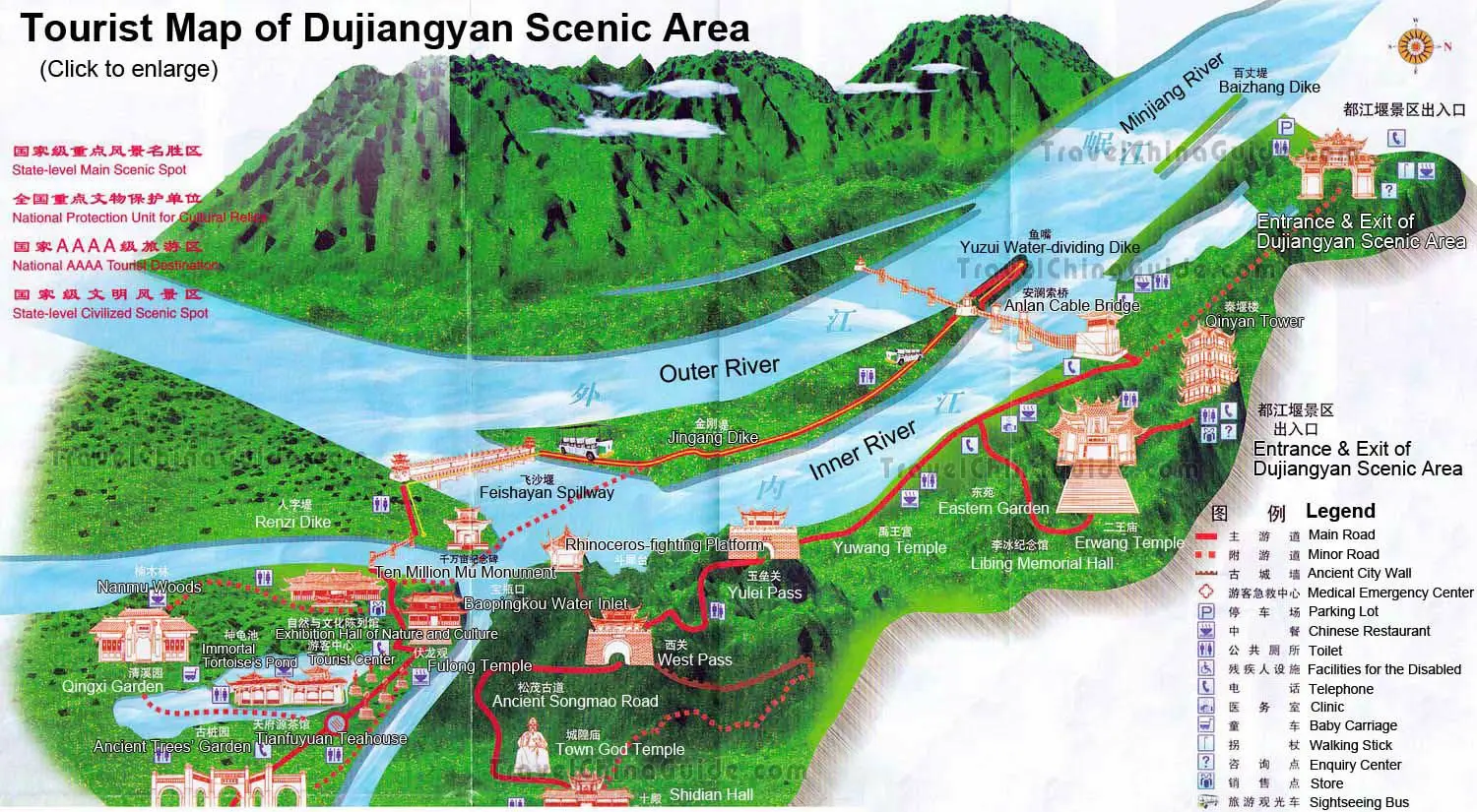
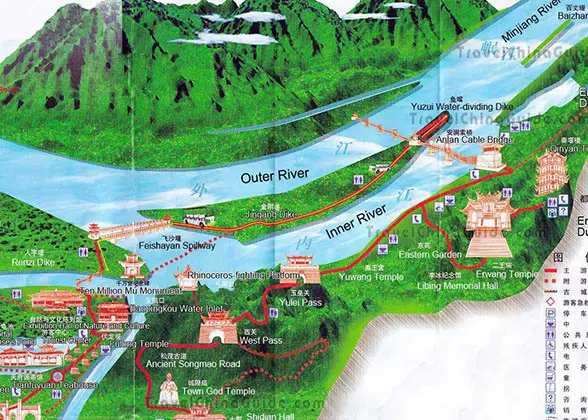 | Map of Dujiangyan Scenic Area ( ) ) | | 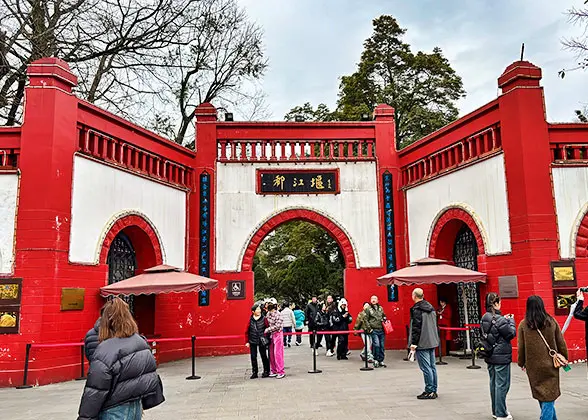 | | Entrance to Dujiangyan Scenic Area | |
Dujiangyan is the oldest and only surviving no-dam irrigation system in the world; and a wonder in the development of Chinese science. The project consists of three important parts, namely Yuzui, Feishayan and Baopingkou scientifically designed to automatically control the water flow of the rivers from the mountains to the plains throughout the year.
Yuzui, like a big fish lying in the Minjiang River, is a watershed dividing the river into two parts: inner river and outside river. Feisha Yan is a spillway that diverts the sand and stones of the inner river into the outer river. Baoping Kou, like a neck of a bottle, is used to bring water into the inner river from Minjiang. At the same time, Baoping Kou controls the amount of the intake water due to its reasonable location. These three parts interact with each other perfectly to form an effective water conservancy project. During the low-water season, 60% of the Minjiang water is brought into the inner river for irrigation while 40% of the water is drawn into the outside river. The situation is reversed in the flood season ensuring the water supply for irrigation and protection from flooding on the Chengdu Plain.
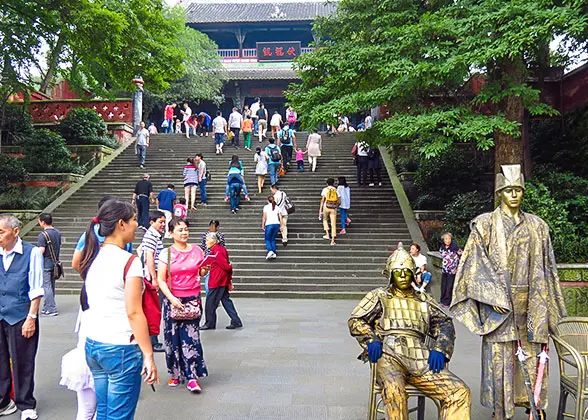 | | Fulong Temple | | 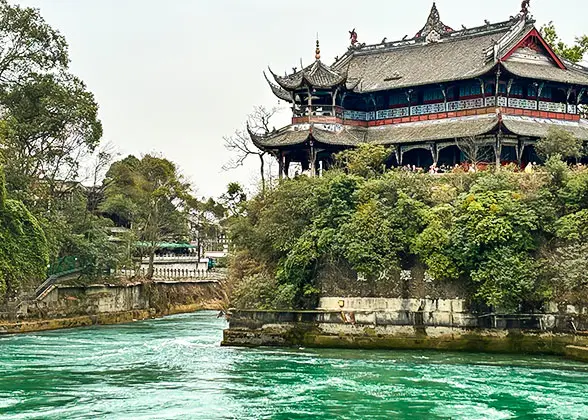 | | Bottle-Neck Channel (Baopingkou) | |
There is a magnificent bridge called the Anlan Cable Bridge crossing the Minjiang River above Yuzui, which is the most scenic place of the whole project. The construction of the bridge originally commenced before the Song Dynasty (960-1279). At that time, the body of the bridge was constructed with wooden blocks and the handrails were made of bamboo. Recently the wood and bamboo were replaced with steel and reinforced concrete to ensure the security of the visitors. Seen from afar, the bridge looks like a rainbow hanging over the river. From the bridge, you can clearly see the entire layout of the Dujiangyan Irrigation System.
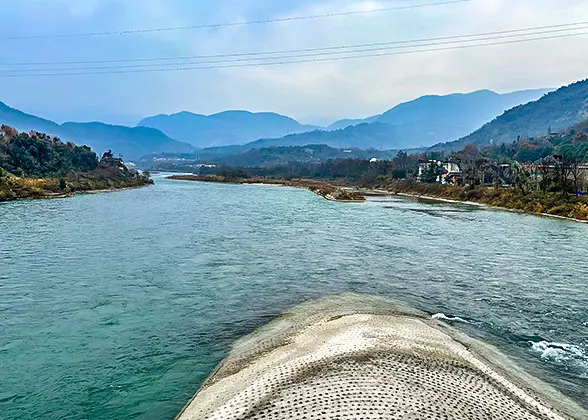 | | Fish Mouth Levee (Yuzui) | | 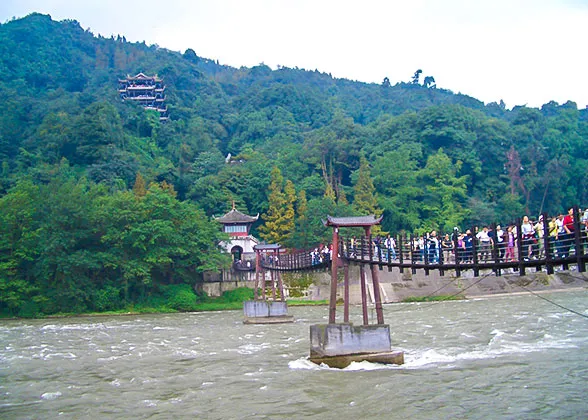 | | Anlan Suspension Bridge | |
There are also historical sites here. Fulong Temple is said to be the place where Li Bing subjugated the evil dragon during the construction process. The stone statue of Li Bing caved in the
Eastern Han Dynasty (25-220) is displayed in the front courtyard of the temple; is the earliest round sculptured stone statue in China. In the back courtyard of the temple, you can see the working principles of Dujiangyan Irrigation System replicated in an electric model of the irrigation system.
Erwang Temple is located on the mountain by the right side bank of the Minjiang River. It was built to commemorate Li Bing and his son by the ancient people. The temple retains the architectural style of the
Qing Dynasty (1644-1911) and the whole environment here is quite serene and beautiful. Many Chinese characters depicting experiences of water control are engraved on the stone walls of the temple. In the Grand Hall, you can see the vivid statues of Li and his son, who are worshiped by the local people every day. Incense has never ceased to burn in the temple. For over twenty two hundred years, the people have held memorial ceremonies for Li and his son. Today the main activities are the Temple Fair held from June 24th to June 26th in Chinese lunar calendar and the Releasing Water Festival on Tomb Sweeping Day.
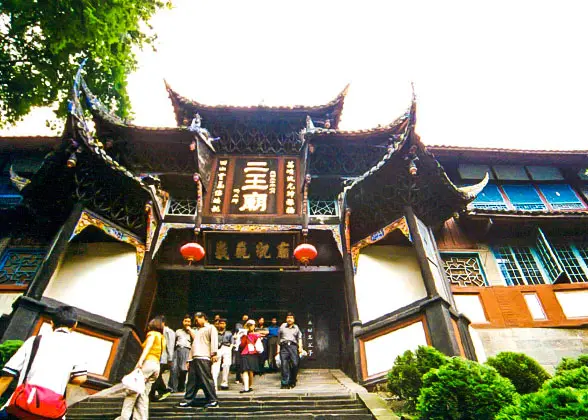 | | Erwang Temple | | 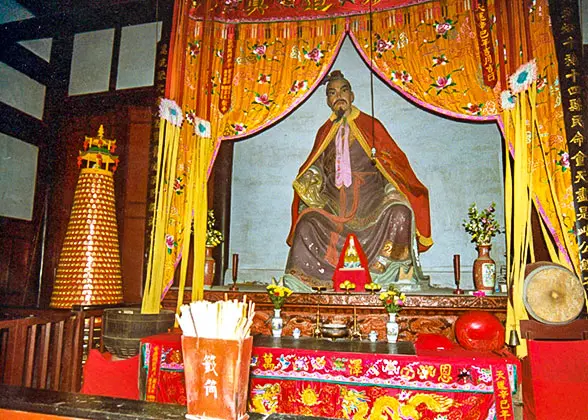 | | Statue of Li Bing in Erwang Temple | |
How to get to Dujiangyan Irrigation System
1. Get to Xipu Railway Station first and take the bullet trains to Lidui Park Railway Station, only taking 20-30 minutes and CNY10. Then take the bus Dujiangyan Line 4, 5, 7 or 17 to the Dujiangyan Scenic Area directly, taking about 15 minutes and CNY2; or walk westward along Gongyuan Road to the entrance, taking about 10 minutes.
Chengdu - Dujiangyan Train2. Take a direct tourist bus from
Wide and Narrow Alley,
Chengdu Research Base of Giant Panda,
Wuhou Temple or Chunxi Road to the scenic spot directly, taking CNY58 and 2.5 hours.
Chengdu Sightseeing Bus | Entrance Fee | Entrance ticket: CNY 80 (free for children under 6 or under 1.2 meters (3.9 feet)
Sight-seeing bus: CNY 15 (round-trip) and CNY 10 (single trip) |
| Opening Hours | March 2 to November 30: 08:00 - 18:00
December 1 to next March 1: 08:00 - 17:30 |
Recommended
Time for a Visit | One and a half hours |
- Last updated on Nov. 27, 2025 by Gabby Li -