Great Wall of Jin Dynasty (1115 - 1234)
The Great Wall of the Jin Dynasty (1115-1234), also known as Jin Jiehao, was erected to defend against the northern nomadic tribes. Once spanning 1,550 miles (2,500 kilometers), it passed Heilongjiang and Inner Mongolia in northeast China, and extended to the west part of today's Mongolia and Russia, with a total length of 4,660 miles (7,500 kilometers). The major relics are from the Mingchang Wall and Da'an Wall.
History of Jin Dynasty Great Wall
The Jin Dynasty, established by Jurchen people, defeated the Liao Dynasty (907-1125) and Northern Song Dynasty (960-1127) step by step. After occupying north China, it came to a confrontation with the Southern Song Dynasty (1127-1279) based in south China. The two reigns were well-matched in strength, but Jin was harassed by the continuous attacks from the northern tribes, especially the rising Mongols. The Jin Great Wall was constructed at the circumstance. Although it finally failed in blocking the Mongolian troops led by Genghis Khan, it to some extent hindered other small nomadic powers and sustained Jin Dynasty for some years. However, the huge financial and labor cost on building the wall heavily burdened Jin and later contributed to its collapse.
Jin Jiehao – Special Structure of Jin Dynasty Great Wall
The special defensive system of Jin Jiehao is made up of walls, trenches, watchtowers, beacon towers, forts, and passes. The trench was dug to stop attacks from horseback. Inside the trench was the wall. At the important places, double trenches and walls were designed. The outer subsidiary trench was to divert floods, while the outer subsidiary wall was used to prevent floods and fires. The inner main trench was about 98 - 197 feet (30 - 60 meters) wide, while the inner main wall was about 16 - 20 feet (5 - 6 meters) high. A watchtower was erected every 200 - 260 feet (61 - 79 meters) of the main wall. A fort or pass was constructed every 3 - 6 miles (5 - 10 kilometers). Such a complete defensive system was easy to defend and hard to attack. Now the remaining wall is about 5 - 8 feet (1.5 - 2.5 meters) high.
|
|
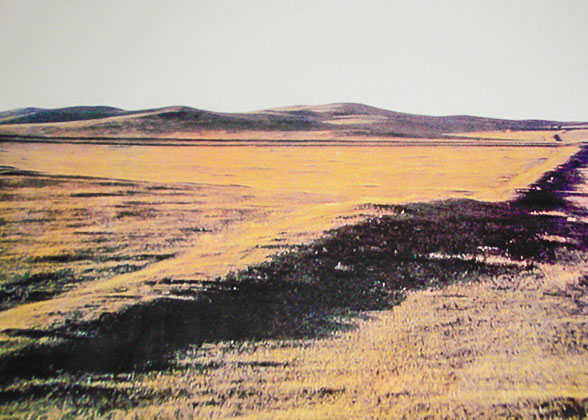
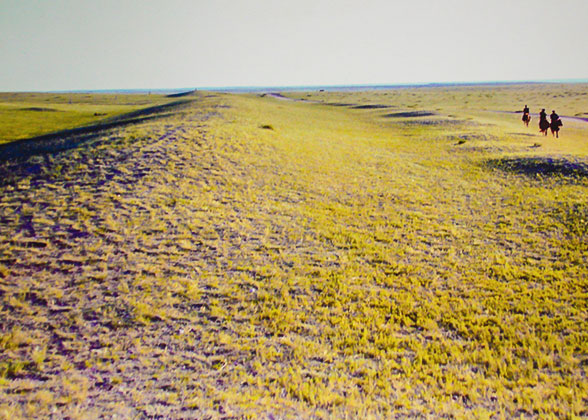

Mingchang Great Wall
Built from 1194 to 1201, the Mingchang Wall was used to resist continuous aggressions from the northern nomadic tribes like Tatar and Khongirad. Spanning over 1,025 miles (1,650 kilometers) from northeast to southwest, it started from the eastern bank of Nenjiang River in Morin Dawa Daur Autonomous Banner in northeast Inner Mongolia, and ended at Shangmiaogou in Wuchuan County of Hohhot. Most sections were in Inner Mongolia, and today 149 sites of forts and passes are found.
Da'an Great Wall
Da'an Wall, also known as Wushabao Great Wall, was built from 1210 to 1211 so as to thwart the invasions by Mongols. The wall extended about 171 miles (276 kilometers). It started from Caoyuan Town in Fengning County of Hebei Province, via Duolun County, Xulun Hoh Banner, and Taibus Banner in Inner Mongolia, Kangbao County in Hebei, and Huade County in Inner Mongolia, and ended at Shangdu County. The Wushabao Wall was built on the foundation of the walls of early Jin Dynasty, raising the wall and adding some fortifications, such as watchtowers, beacon towers, and forts.
|
|
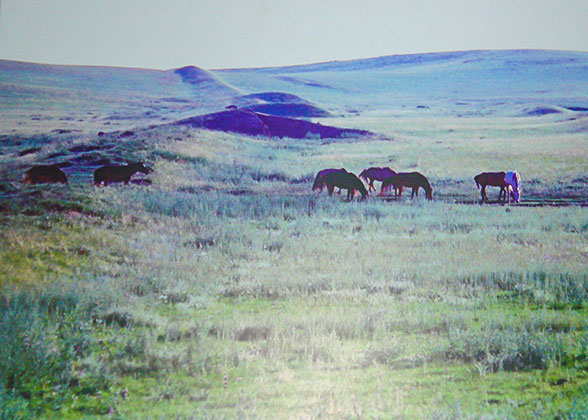
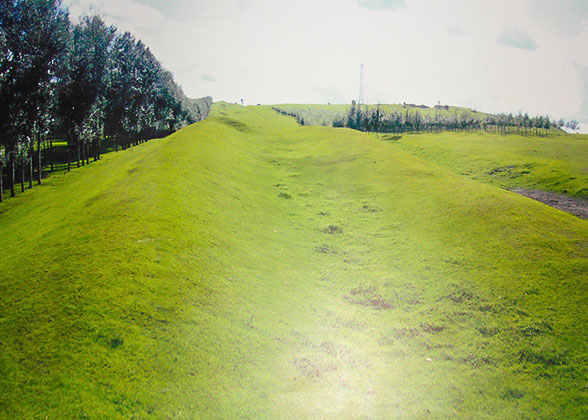
Relics of China Jin Dynasty Great Wall
The Great Wall of the Jin Dynasty has suffered greatly from storms, floods, and engulfment by deserts. In addition, the human activity accelerates its disappearance because many sections have been torn down for fields, houses, and roads. Fortunately, there are still some relics in Inner Mongolia. Relics of Mingchang Wall: The best-preserved section is on the western slope of Greater Khingan Range in Heshigten Banner. The ruins of walls are about 10 - 13 feet (3 - 4 meters) high, and the trench is about 33 feet (10 meters) wide. The beacon towers sites were found atop hills or on walls. For instance, a large beacon tower was found on the wall in Linxi County, Inner Mongolia. It is about 66 feet (20 meters) long, 46 feet (14 meters) wide, and 20 feet (6 meters) high. Relics of Da'an Wall: The well-preserved section was in Baotou Village, Duolun County. The remaining wall is about 12 miles (20 kilometers) long, 26 - 33 feet (8 - 10 meters) wide, and 3 - 7 feet (1 - 2 meters) high. The trench is 20 feet (6 meters) wide at the bottom. The watchtowers are 890 - 950 feet (270 - 290 meters) apart from one another. Additionally, 21 sites of forts have been found along the wall, such as Wusha Fort and Wuyue Barrack.
 Further Reading: Great Wall History: from Zhou Dynasty to Qing Dynasty