Han Dynasty Great Wall
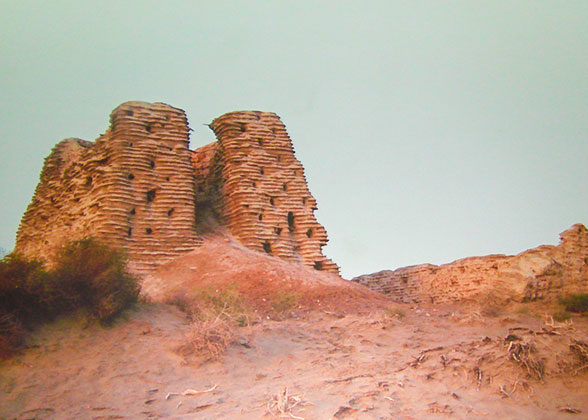 |
| Ruins of a Beacon Tower in Han Dynasty, Lop Nur, Xinjiang  Photos Map Photos Map |
Distinctive Features of Han Dynasty Great Wall
 The wall was built at several periods of time, and varies in its pattern. In general, beacon towers and fortresses were built first. Then, the defensive wall was added when necessary. In some places, only beacon towers and forts could be found.
 The wall was made of local materials. The sandy soil, reeds, and branches of rose willows and Euphrates poplars were placed layer upon layer, making the wall solid and sound. A trench was formed outside the wall after the sandy soil was removed. The trench was then filled with fine sand in order to be able to check the footprints of those who passed the fortifications.
The Great Wall of the Han Dynasty (202BC-220AD), the longest one in history, once spanned over 6,214 miles (10,000 kilometers) across deserts, grasslands, mountains, rivers, and plains in north China. It consisted of an outer wall and an inner wall. Today, relics have been found in Yumen and Dunhuang in Gansu Province, Hohhot, Baotou, and Bayannur in Inner Mongolia, Chengde in Hebei Province, and Fuxin in Liaoning Province.
Han Dynasty Great Wall History: Built over Four Periods of Time
After the demise of the Qin Dynasty (221BC-207BC), the Han Dynasty was established. It was a unified regime, but was still threatened by the northern Huns. In the early years, the emperors made peace with the Huns through marriage, because of their weak economy and military power. When the national economy prospered, Emperor Wu of Han ordered generals Wei Qing and Huo Qubing to fight against the Huns, and reconquered the lost territory.
See more about Wei Qing and Huo Qubing Beat Back the Huns.
At the same time, the Great Wall was erected along the northern borders over four periods of time.
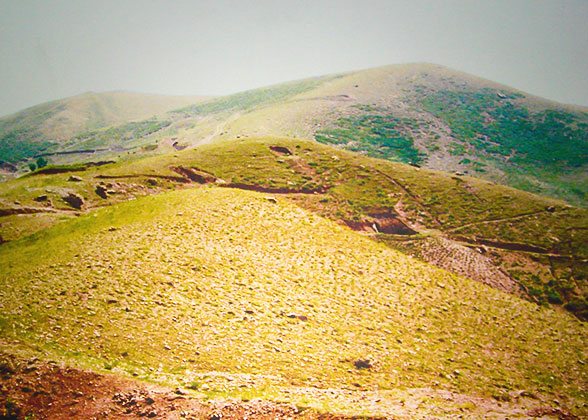 |
| Ruins of Great Wall of Han Dynasty, Daqing Mountain, Inner Mongolia |
In 127 BC, Shuofang City was constructed at Hetao Area, and the previous Qin Dynasty Great Wall was renovated.
In 121 BC, the Han troops regained the Hexi Corridor. Thereafter, the wall was built between Lingju (today's Yongdeng County) and Jiuquan in Gansu Province.
From 111 BC to 110BC, the wall was extended from Jiuquan to Yumenguan.
From 104BC to 100BC, the defense stretched from Yumenguan to Lop Nur in Xinjiang.
After two decades of construction, the Great Wall of the Han Dynasty was finally completed, running from Liaoning in the east and ending at Lop Nur, Xinjiang in the west. The Hexi Corridor section was the most important because it protected the ancient Silk Road. Hence, many beacon towers, fortresses, and passes were erected. See more about the Relation Between Great Wall & Silk Road
Relics of China Great Wall of Han Dynasty
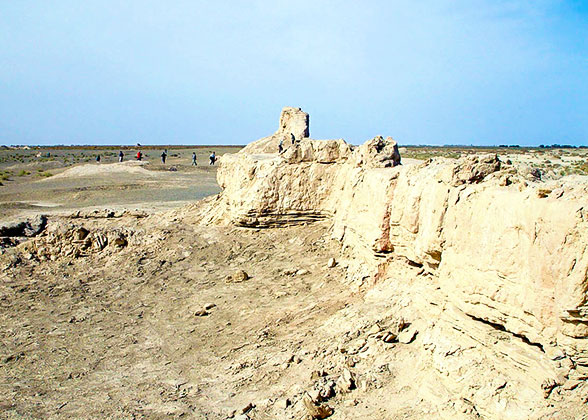
Relics in Gansu: The section in Dunhuang runs along the southern bank of Shule River. It starts from Guazhou County in the east, and ends at Yushuquan Basin in the west. The total length is around 85 miles (136 kilometers). The Danggusui part is the best-preserved. It is about 984 feet (300 meters) long, 10 feet (2.95 meters) high, and 2 feet (0.65 meter) wide at the top. Along the wall are ruins of beacon towers, which are 23 feet (7 meters) to 33 feet (10 meters) high. See Dunhuang Great Wall of Han DynastyThe part in Yumen has a total length of 43 miles (70 kilometers). The comparatively well-preserved part is about 12 miles (20 kilometers). It is 1 foot (0.3 meter) to 7.5 feet (2.3 meters) high. It was mainly made of gravel, loess, and rose willow branches. The important passes are Yumenguan, Yangguan, and Juyan Fortress.
|
|
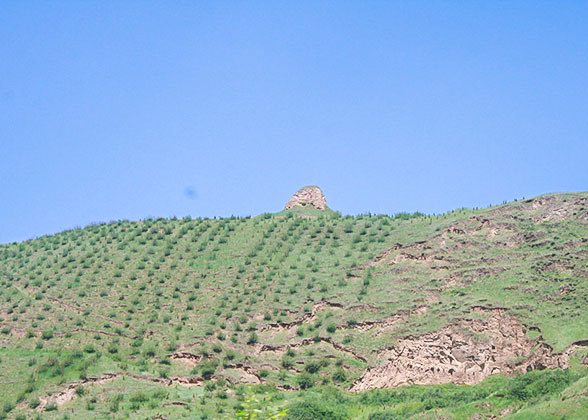 Relics in Inner Mongolia: The wall in Inner Mongolia was built in 102BC, and consists of two lines. The northern line is about 327 miles (527 kilometers) long, 10 feet (3 meters) to 20 feet (6 meters) wide, and 2 feet (0.5 meter) to 10 feet (3 meters) high. It was made of rammed earth and stone. Potsherds were excavated from the nearby forts.
The southern line is about 309 miles (498 kilometers) long, 10 feet (3 meters) to 13 feet (4 meters) wide, and 2 feet (0.5 meter) to 10 feet (3 meters) high. It was made of local materials. In Wuchuan County, Hohhot, the wall was made of sandy soil, and is relatively well-preserved. In Darhan Muminggan United Banner and Guyang County, Baotou, the wall was made of earth, so it is poorly preserved. In Urat Front Banner and Urat Rear Banner, Bayannur, the wall was mostly made of earth and stone.
Relics in Chengde, Hebei: The wall runs across Fengning, Longhua, Luanping and Chengde Counties. The beacon towers and fortresses were built, forming a complete military defense. Relics in Fuxin, Liaoning: The Gaolintai Fortress is located in Gaolintai Village, Fuxin County, Liaoning Province. It was made of rammed earth, and is about 16 feet (5 meters) high. The military system is quite complete, with forts, cities, watchtowers, and beacon towers.