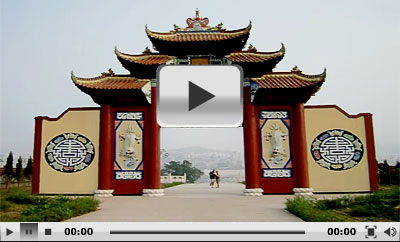
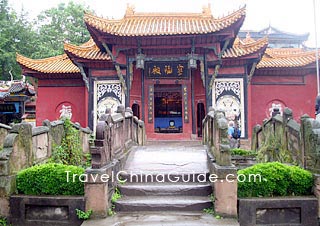
Located on the Ming Mountain on the northern bank of the Yangtze River, Fengdu County is known to most Chinese as the 'Ghost City'. Having nearly two thousand years' history, the Ghost City combines the cultures of Confucianism, Taoism and Buddhism with the mystique of ghosts. Many famous literary works like Journey to the West, Apotheosis of Heroes and Strange Tales of a Lonely Studio contain vivid references to Fengdu.
Fengdu got its name as the Ghost City in the
Eastern Han Dynasty. Two officials from the imperial court Yin Changsheng and Wang Fangping decided to come to Ming Mountain to practice Taoist teachings. Through self-cultivation they became immortals. Combining their surnames produces the term "Yinwang" meaning the "king of hell." Later, during the
Tang Dynasty, a stupendous temple was erected on Ming Mountain depicting life in hell. It displays demonic images and torture devices and reflects the notion that good people will be treated well in the afterlife and that bad people will be punished by going to hell.
In the Chinese vision of the afterlife, the dead must undergo three major tests to enter the netherworld. These tests are taken at three locations -
Nothing-To-Be-Done-Bridge;
Ghost Torturing Pass and the
Tianzi (son of heaven) Palace. These three locations are among many attractions in this scenic area.
 | | Ghost Torturing Pass | |  | | Hell of Skinning | |
Nothing-To-Be-Done-Bridge
Built during the
Ming Dynasty, the bridge connects the nether world with the real world and is a testing point for good and evil. According to legend, the Nothing-To-Be-Done-Bridge is composed on three identical stone arches. The middle arch is used for testing people. There are different protocols for crossing the bridge depending on your gender, age and marital status. Below the bridge are square-shaped pools of water. Virtuous people will pass over the bridge without obstacle; villainous people will fall into the pools below. The other two arches are called the golden and silver bridges respectively. When preparing to leave, visitors are encouraged to pass these two bridges because according to local superstition this will bring them good fortune.
 | | Nothing-To-Be-Done Bridge | | 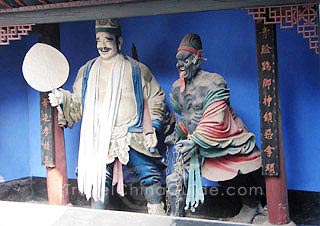 | | Statues of Black and White Impermanents | |
Ghost Torturing Pass
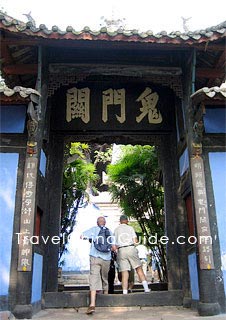
It is the second test before entry into the nether world. It is said that this is the place where the dead report to the Yama, the King of Hell, for judgment. In front of the structure there are eighteen sculptures depicting ferocious demons. Each of these devils is quite lifelike creating a feeling of true eerieness.
 |
| Statues of Ghosts in Fengdu |
Tianzi Palace
Having over three hundred years' history the palace covers an area of nearly 2,908 square yards. It is composed of a temple gate (paifang) and the palace itself. The gate is an archway made of wood and stone rising to height of nearly 33 feet. The palace is the nerve center of this scenic area and is the oldest and largest temple on Ming Mountain.
The third test to evade hell takes place at a large stone in front of the gate. The ghost must stand on the stone on one foot for three minutes. A good person will be able to do this while an evil one can not and will be sent to hell.
 |
| Tianzi Palace |
One other ghostly attraction in Fengdu worth mentioning is the Last-Glance at Home Tower. This structure was built in 1985 and commemorates the site where spirits consigned to hell could take one last look at their families.
Visitors coming here will marvel at the artisanship of ancient craftsman, the unique styles of architecture and the culture of the ghost. Whatever your beliefs, you are constantly reminded the "Good will be rewarded with good, and evil with evil." A major highlight here is the annual temple fair every March 3 - 5 featuring all kinds of folk activities and performances.
- Last updated on Jan. 16, 2026 by Gabby Li -