Fengjie is a county with a dense history. Since the
Xia Dynasty (21st - 16th BC), people have been living in this place. The county was named during the
Tang Dynasty (618 - 907) in honor of Zhuge Liang who answered the call to take care of the son of Emperor Liu Bei during the
Three Kingdoms Period (220 - 280).
Located in the hinterland of Three Gorges Reservoir Area, Fengjie County is the east gate of
Chongqing, adjacent to
Hubei in the south and
Yunyang County in the west. Its natural beauty drew a great number of notable poets, who subsequently eulogized the area in their poems.
The area is home to the magnificent Kui Gate, which is the gate to the
Qutang Gorge. Baidi City (White Emperor City) or Baidi Temple is the most attractive temple in Fengjie. One can also view historic relics such as the Tuogu Tang (Entrusting Son's Hall) and Observing Stars Pavilion (Guanxing Ting) while cruising along the Yangtze River. The Eight Elements Battle Formation (Ba Zhen Tu) is a spot favored by the lovers in the classical Chinese novel Romance of Three Kingdoms. Xige Thatched House where Du Fu (a renowned poem of Tang Dynasty) lived for two years is also situated in this area.
 | | Qutang Gorge | |  | | Observing Stars Pavilion | |
Other attractions like Xiaozhai Tiankeng, the world's first giant karst pit, Tianjing Gorge Difeng (deep karst fissure), and the underground river, Longqiao River (Dragon Bridge River) are all worth a visit.
Fengjie County was submerged by rising water caused by the
Three Gorges Dam Project. A new area has been built in Fengjie, with a length of 15 miles stretching from Baidi City in the east to Sanma Mountain in the west. The county is now developing quickly and people live comfortably in the new territory.
(Baidi City)
Located 8 kilometers (5 miles) east of Fengjie County of Chongqing and on the northern back of the Yangtze River, the White Emperor City (Baidi City) originally named Ziyang City was first built during the Western Han Dynasty (206BC - 24AD). The city is now the best place for appreciating the beauty of the Kui Gate of Qutang Gorge.
 | | White Emperor City | | 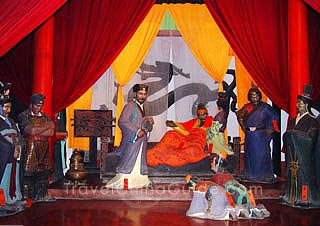 | | The statue of Liu Bei Entrusting His Sons to Zhuge Liang | |
Eight Elements Battle Formation
(Ba Zhen Tu)
The people who have read the Romance of Three Kingdoms (one of the four great classical Chinese novels) must be familiar with the Eight Elements Battle Formation (Ba Zhen Tu). It is said that
Zhuge Liang (the great statesman, ideologist and militarist of
Shu Kingdom during the
Three Kingdoms Period) has set the Eight Elements Battle Formation in four places in history. They are in Mian County of Shaanxi, Xindu City of Sichuan, eastern Fengjie of Chongqing, and northeastern Baidi City of Chongqing separately.
Among the four Eight Elements Battle Formations, the one in eastern Fengjie is the most well-known. It is located at the dam 1,640 yards long, 656 yards wide with a creek passing through on the northern bank of the Yangtze River. It is said that Zhuge Liang once ordered his soldiers to assemble stones to built 64 bases with eight in length and eight in breadth. The bases are composed of eight battle arrays - sky, earth, rain, cloud, dragon, tiger, bird, and snake.
 |
| Statue of Zhuge Liang, Baidi City |
According to the
Romance of Three Kingdoms, a militarist of the
Wu Kingdom once chased the Shu Kingdom's army and arrived at the Eight Elements Battle Formation. He retreated at last because he was frightened by the elemental strength of the formation.
In the history, many celebrities like Li Bai, Du Fu (great poets of the Tang Dynasty) and Lu You (great poet of the Southern Song Dynasty) have visited the place and left some famous poems. However, since the water level rose due to the
Three Gorges Dam Project, the Eight Elements Battle Formation has been submerged in the river. The one in northeastern White Emperor City will become the one favored by some
Romance of Three Kingdoms lovers.
- Last updated on Jan. 16, 2026 by Gabby Li -
 More Fengjie Photos