Shaanxi History Museum
 1. Starting March 15, 2026, the Shaanxi History Museum will be open seven days a week, ending its Monday closures. The museum will extend its daily closing time by one hour to 19:00, with last entry at 18:00.
2. From March 15 to April 30, 2026, the museum will offer 10,000 tickets per day for reservation.
3. Due to ongoing facility upgrades, Exhibition Hall 4 and the Exhibition Hall for Murals Treasures of Tang Dynasty will be temporarily closed to visitors.
As one of China’s top five most popular museums, the Shaanxi History Museum has been recognized as a world-class museum by UNESCO, celebrated for its high-grade, diverse, invaluable and chronologically comprehensive collection of cultural relics. Xi’an, home to the museum, served as the imperial capital for thirteen dynasties in Chinese history, including the most glorious Qin, Han and Tang Empires. To date, nearly 80 imperial mausoleums have been discovered in Shaanxi Province, including that of Qin Shi Huang, the first emperor of a unified China. Even the construction of Xi’an’s metro system alone has unearthed thousands of ancient tombs, yielding an incalculable number of precious cultural relics.
 |
Shaanxi History Museum  Pictures Pictures  Video Video |
The museum houses more than 1.7 million sets of exceptional collections, ranging from stone tools used by early humans, bronze swords and Terracotta Army figures of the Qin Empire, to exquisite gold and silver wares, jade artifacts and murals of the prosperous Tang Dynasty. It also features a rich array of daily utensils, currencies and textiles that bear witness to the evolution of ancient China’s science, technology and economy. Spanning over a million years, the collection covers nearly the entire course of Chinese history, with 18 national treasures among its holdings. Below are the museum’s five must-see iconic treasures.
Highlights of the Collection
1. Agate Cup with Animal Head - No.4 Exhibition Hall
This cup was a drinking vessel used by the nobility in the Tang Dynasty. It is shaped like the head of a takin, with its two horns serving as handles and its elongated neck forming the body of the cup. This shape design is very similar to the rhyton of ancient West Asia and the Mediterranean region. When people drank from a rhyton, they had to hold it high above their heads, as it was considered a sacred object to pay homage to the god of wine.
Crafted from a single piece of banded agate, a material not produced in ancient China, it was likely brought to China via the Silk Road as a diplomatic gift from West Asian states, or created by Tang artisans who integrated Western craftsmanship. It stands as a vivid testament to the Tang Dynasty’s openness and inclusivity, as the capital Chang’an became a gathering place for merchants and craftsmen from all over the world.
|
|

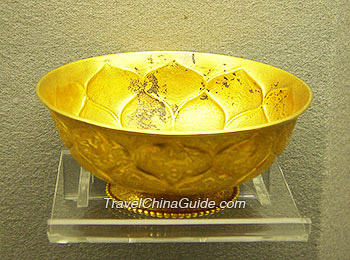
2. Gold Bowls with Mandarin Ducks and Lotus Petals - No.4 Exhibition Hall
- Tang Dynasty (618 - 907)
This pair of gold bowls forms a complete set, adorned with intricately carved lotus petals that symbolize longevity. Each petal is further engraved with patterns of mandarin ducks and parrots, all conveying auspicious and graceful blessings. In the Tang Dynasty, these gold bowls were a symbol of noble status, reserved exclusively for the imperial family and aristocracy. This pair of golden bowls is extremely exquisite and might have been ornamental pieces for display in noble households.
The bowls were made using the repoussé forging technique. Compared with casting, this process greatly conserves precious gold and silver materials, producing thin, lightweight vessels that better highlight the metal’s texture and luster. Originating from the ancient Persian Empire rather than traditional Chinese craftsmanship, this technique was merged with Chinese aesthetics by Tang artisans, creating a uniquely Tang-style vessel.
3. The Empress’ Jade Seal - No.2 Exhibition Hall
- Han Dynasty (206 BC - 220 AD)
This is the highest-ranking surviving jade seal from the Han Dynasty, belonging to Lv Zhi, the first woman in Chinese history to wield real ruling power. This jade seal is exquisitely crafted, perfectly matching the noble status of its owner. The seal body is square; the top is carved in the shape of a crouching tiger; and the bottom is engraved with the four Chinese characters “Huang Hou Zhi Xi,” which translates as “Queen's Seal.” Seals were usually used on official documents such as edicts and letters. The existence of this seal also confirms the fact that Lv Zhi had the authority to manage state affairs.
|
|

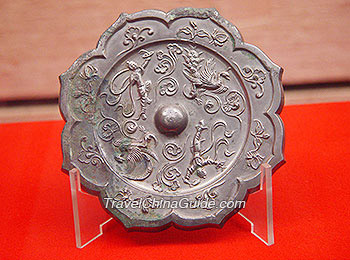
4. “Fifth-Year” Tripod (Ding) of Wei; Cauldron - No.1 Exhibition Hall
Though unadorned with elaborate patterns and modest in size and weight compared to other bronzes, this tripod stands out as a national treasure for the 207 characters inscribed on its inner wall. The text records the entire process of a land dispute lawsuit in the Western Zhou Dynasty, from filing and court interrogation to deliberation, judgment and enforcement. It clearly demonstrates that as early as three thousand years ago, the Western Zhou Dynasty already embraced the rule of law, resolving disputes through judicial means, restricting power by law, and enforcing judicial rulings.
5. Tri-Color Camel Carrying a Musical Band - No.3 Exhibition Hall
- Tang Dynasty (618 - 907)
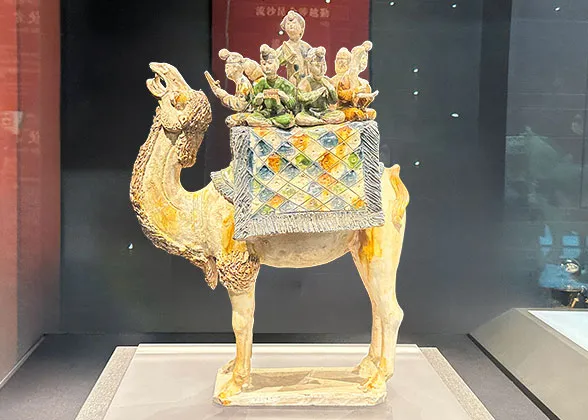 |
| Tri-Color Camel Carrying a Musical Band |
Permanent Exhibition Halls
The permanent exhibition is arranged in chronological order and is divided into three exhibition halls.
No.1 Exhibition Hall - 1F
Prehistoric Period (c. 1.63 million years ago - 21st century BC) - The Qin Dynasty (221 BC - 207 BC)
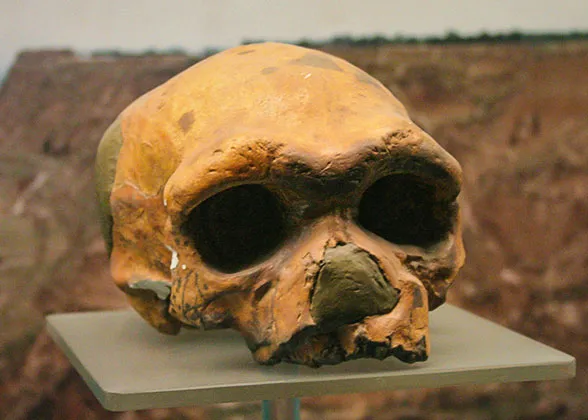
Stepping into No.1 exhibition hall, it feels as if one has traveled back to the ancient times. It displays fossilized skulls of early humans alongside their daily utensils and tools, including pottery and simple stone tools. Though rudimentary in craftsmanship, these tools prove that humans mastered basic tool-making and usage skills over a million years ago.
Further on, a wide variety of bronze artifacts showcases the Western Zhou Dynasty, an era known as the “Bronze Age”. Bronzes were widely used and developed, playing a crucial role in society, with applications ranging from tools and weapons to ritual vessels and cookware, and their craftsmanship reached a high level.
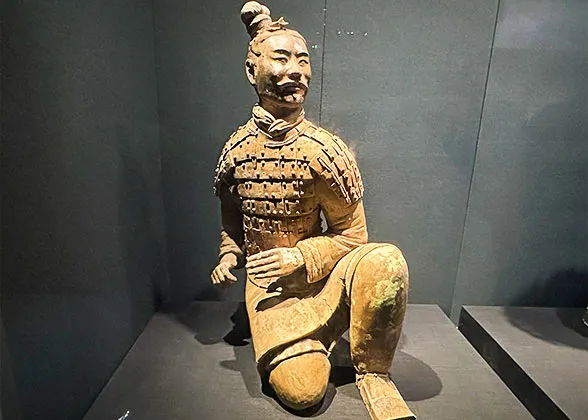
The final section is dedicated to the Qin Empire, China’s first unified dynasty. The Qin army was exceptionally powerful, boasting the world’s most formidable military force and outstanding generals of the time. Here, visitors can view the swords and spears used by the Qin army, as well as life-sized Terracotta Warriors, as if a battle from over two thousand years ago is unfolding before their eyes.
|
|
No.2 Exhibition Hall - 2F
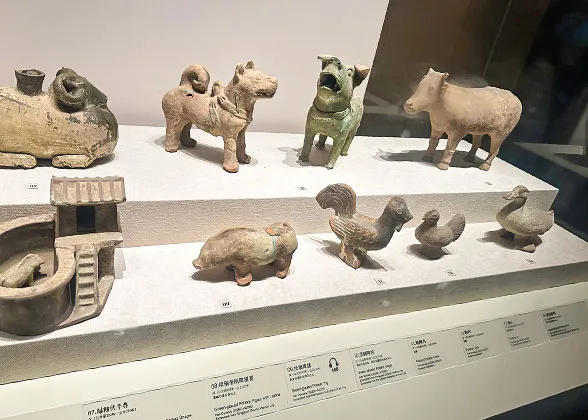
The Han Dynasty was the longest-lasting unified dynasty and one of the most powerful in Chinese history. Upon entering No.2 exhibition hall, roof tiles catch the eye, as the Han Dynasty marked the peak of roof tile art, engraved with auspicious animals and characters symbolizing good fortune. The Han people believed the afterlife should be as beautiful as the mortal world, so they crafted terracotta figurines of poultry, livestock and houses as burial objects. Therefore, this exhibition hall displays various terracotta figurines, with flocks of chickens and ducks and herds of cattle and sheep, indicating that people at that time were already living a prosperous and happy life.
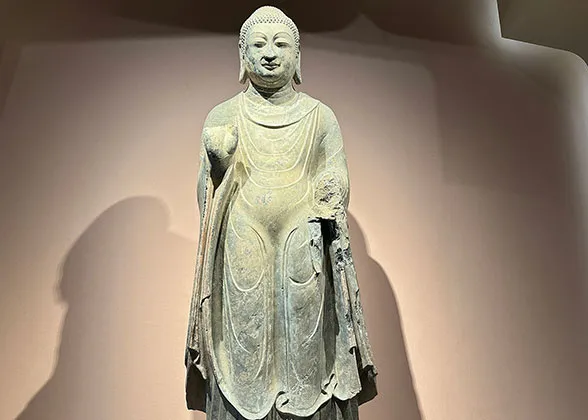
In contrast, the Wei, Jin, Northern and Southern Dynasties period was a dark “age of chaos”, marked by continuous warfare, frequent dynastic changes, and the displacement of the people. Exhibits from this period are mostly weapons, such as crossbows, spurs, as well as officer figurines and other war-related items. Moreover, amid the turmoil, people yearned for peace, and religion became their spiritual refuge. Buddhism flourished as a result, and various Buddha statues are exhibited in the hall.
|
|
No.3 Exhibition Hall - 2F
Sui and Tang Dynasties (581 AD - 907 AD) & Shaanxi after the Tang Dynasty (907 AD - 1911 AD)
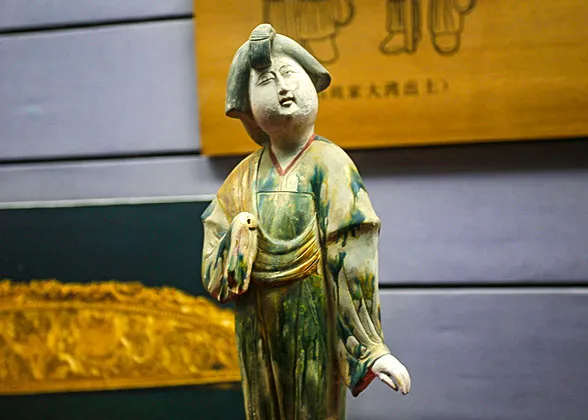
This hall mainly showcases cultural relics from the Sui and Tang Dynasties, a pivotal period in Chinese history marked by unprecedented economic and cultural prosperity. Chang’an, the capital of the Tang Dynasty, was a world-famous international metropolis that attracted merchants, scholars and artists from all over the world. People of the era placed great emphasis on quality of life and aesthetics, as seen in the exhibited silk garments, exquisite hair ornaments and gold and silver tableware, whose patterns blend traditional Chinese aesthetics with Western artistic elements. Plumpness was regarded as beautiful in the Tang Dynasty, reflected in the rounded and full-bodied terracotta figurines of the era.
The hall concludes with local cultural relics from Shaanxi after the Tang Dynasty. With Xi’an losing its status as the imperial capital, the relics became simpler and less luxurious.
|
|
Theme Exhibition Halls
No.4 Exhibition Hall - 1F
Treasures of the Great Tang Dynasty - Unearthed Objects from the Hejia Village Hoard
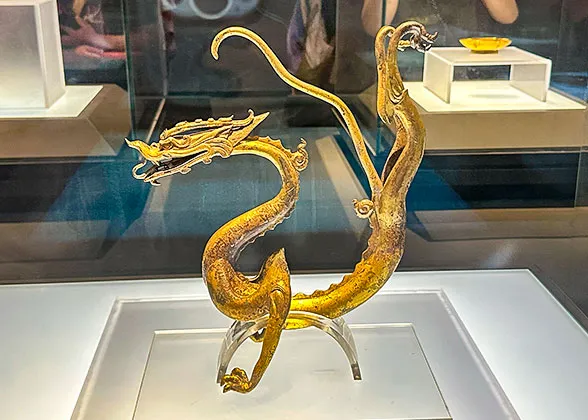
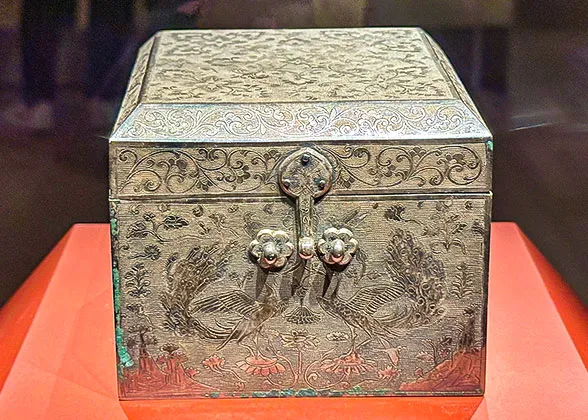
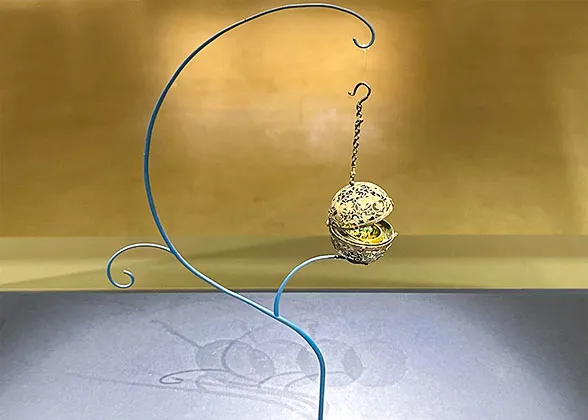
This is a must-visit hall in the Shaanxi History Museum, featuring the most exquisite and significant exhibits. It showcases over 300 precious artifacts unearthed from the Hejia Village hoard, buried by a Tang tax official. The collection includes gold and silver vessels, jade wares, precious ornaments, rare medicinal herbs and coins from both China and overseas. Through the dazzling array of exquisite artifacts, visitors can gain a clear insight into the affluent lives and superb craftsmanship of the Tang people.
|
|
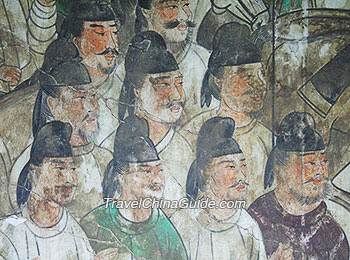
The Tang Dynasty tomb murals in the Shaanxi History Museum are its unique and precious collections. Nearly 600 pieces, unearthed from over 20 Tang tombs, vividly document the daily life and diplomatic affairs of the royal family. Among them, the Mural of Polo Match captures a game played in a mountain forest, and the Tang Dynasty Officials Greeting Foreign Envoys Mural vividly reproduces a diplomatic meeting. Compared to other cultural relics, these murals are like ancient photo albums, presenting the life scenes of people thousands of years ago directly to the visitors.
|
|

Temporary Exhibition Halls
Halls 5, 6 and 7 are temporary exhibition halls, hosting themed exhibitions of historical relics from different periods. If you are interested in a certain theme during your visit, you may go to explore these spaces.
The Qin and Han Museum is a new branch of the Shaanxi History Museum, focusing on the cultural relics of the Qin and Han Dynasties (221 BC - 220 AD), the most prosperous periods in Chinese history. Currently, over 1,500 cultural relics are on display, 90% of which are exhibited for the first time. Here, visitors can admire national treasures such as the “Silk Road No. 1” Wooden Vessel - the earliest wooden boat in China, the Golden Monster, the Tiger-Shaped Tally of Du, as well as Terracotta warriors and bronze wares.
 |
| Pottery Figurines in Han Dynasty |
Is It Recommended to Add the Shaanxi History Museum to Your Xi'an Trip?
For those with a strong interest in historical relics, the museum’s iconic artifacts are a must-see on a Xi’an trip, making the museum well worth a visit. For casual travelers, it is not recommended. Firstly, tickets are extremely hard to obtain, with the daily quota of around 10,000 tickets usually selling out within three seconds. Secondly, the exhibition halls are relatively small compared to other world-class museums and often crowded, making it rare for you to have the chance to stop and appreciate an exhibit at leisure.
In fact, Xi’an has many other worthwhile museums, such as the Shaanxi Archaeology Museum and the Qin Han Museum. Their tickets are not as hard to book, and you can enjoy the cultural relics in a more peaceful environment.
Tips for Visiting the Shaanxi History Museum?
1. If you want to visit in the order of historical development, you can follow the sequence of No.1 Exhibition Hall - No.2 Exhibition Hall - No.3 Exhibition Hall - No.4 Exhibition Hall - Other Exhibition Halls. However, this is the choice of most visitors, which means it will be very crowded. To avoid the crowds, you can start with No.4 Exhibition Hall and visit in the reverse order.
2. It is advisable to avoid visiting in January, February, July and August, as these are school vacation periods, leading to large crowds of domestic families.
You may like:
Opening Hours:
Mar. 15, 2026 to Nov. 14, 2026: 8:30 to 19:00, last admission at 18:00
Tickets:
| Entrance Fee | Free, but a reservation is needed. Children under 1.4 meters (4.6 feet) or under 6 years old, and seniors over 65 are exempt from reservation. |
|---|---|
| Murals Treasures of the Tang Dynasty | CNY 270 |
| Audio Guide Device | Deposit: CNY 100; Rental: CNY 30 |
Note: Tickets for the Murals Treasures of the Tang Dynasty can only be purchased on-site after you have reserved and entered the Shaanxi History Museum.
How to Reserve the Tickets?
Recommended Time for a Visit
How to Get to the Shaanxi History Museum?
By Bus
|
|

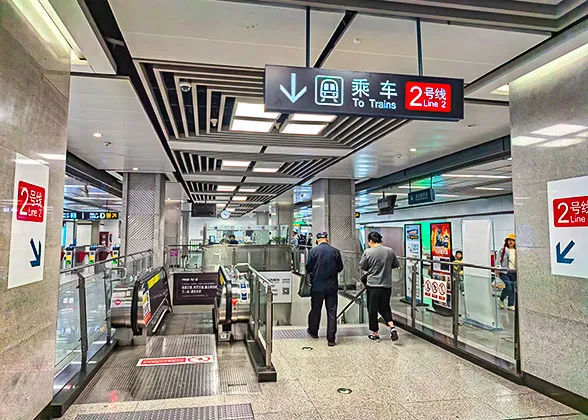
By Metro
Take Metro Line 3 or Line 4 to Dayanta Station. Exit from Exit A and then walk west for about 800 meters (880 yards) to reach.
Recommended Tours

Further Reading:
Top 10 Things to Do in Xi'an
Top 10 China Tourist Places for Culture Lovers
Recommended Nearby Attractions:
Tang Paradise
Qujiang Polar Ocean Park
Qujiang Pool Park
Cool Cave Heritage Park

- Last updated on Mar. 18, 2026 by Sherry Xia -