Chinese Nuo Drama (Nuo Xi) - Living fossil of Drama
History
The Chinese character Nuo originally meant a patterned step to drive away evil during the last month of the Chinese lunar year. Later, Nuo Drama evolved into a dance.
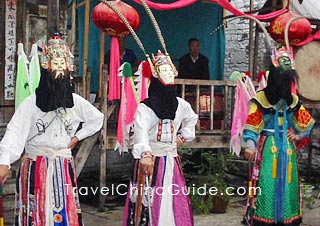 |
| Guizhou Nuo Drama |
It was probably during the Song Dynasty that Nuo became a drama. Nuo Drama is the most direct and important expressive media of Nuo culture. It covers primitive religion, folklore and art, and integrates literature, music, dance, drama, painting, calligraphy, sculpture, and paper-cut. It has great artistic value and is called the living fossil of drama.
Nuo Drama Mask
 |
| Nuo Drama is featured with its masks |
Studies show that the influence of the mask extends to the facial painting of Beijing Opera and the face changes of Sichuan Opera.
Nuo Drama was at one time very popular in every part of China, but with social development faded out in most parts, remaining popular only in southwest China, such as Guizhou, in eastern Yunnan, southern Sichuan and Chongqing, in southwest Hubei and western Hunan and in northern Guangxi. Nuo Dramas vary considerably in different areas.
Guizhou Nuo Drama
 |
| Nuo Drama in Guizhou |
Guizhou is the center of Nuo Drama in southwestern China, while Dejiang in northeast and Anshun in southwest Guizhou province are centers for Nuo Drama.
In Tunbu around Anshun, Nuo Drama is the primary entertainment activity. Here it is a branch of the ancient Military Nuo. Musical instruments include one gong and one drum. The drummer is very important during a performance. A patch of land serves as a stage. As a result, it is also called Dixi (ground drama).
The only two occasions for the performance of Nuo Drama are at Chinese New Year and at the middle of the 7th moon when rice tassels. The religious meaning is obvious. People hope the drama can drive away bad luck and bring good harvest. Year after year, numerous locals are attracted to this performance. Sometimes a drama can last a dozen days.
 |
| Nuo Drama Masks |
The number of masks used in one drama ranges from several dozen to two hundred. There are five kinds of masks used in Nuo Drama, namely: civilian general, military general, old general, young general and woman general with other minor roles like soldiers and Taoist monks. Generally speaking, the good are stately and dignified while the bad are ferocious. Mask carving abides by a set of strict rules. For example, eyebrows should be like a line for woman, an arrow for young generals and like fiery flames for military generals. The changes of facial expressions and decorations show the character of the figures in a Nuo Drama. They may be brave, ferocious, powerful, composed, arrogant, sly, tender, or amiable. Decorations include butterflies, grass, flowers, and ivies familiar to the locals.
As is true in most other areas, Nuo Drama in Tunbu is the privilege of men. The moment a dancer puts on his mask, he will not speak or act casually since putting on a mask means the spirit is on him already.
Yunnan Nuo Drama
Village rooftops connected by ladders or wood panels form the stage for the "leopards" At the climax of the dance, leopards run after young girls watching the show until the girls take them home where snacks have been prepared. Leopards eat some snacks as well as throw away some while continuing to dance. This devil-dispelling activity is performed in the rooms, kitchens and stalls of one family after another; the leopards dispel devils for all the villagers.
Nuo Drama in Other Places
Guichi Nuo Drama from Anhui is special because it is performed on a clan basis not by a troupe as in other places.
Shan Gu Nuo Drama in Quwo, Shanxi is worth noting as it is the only Nuo Drama preserved in the Yellow River area. The accompanying Shangu is a fan-shaped tambourine. The drama is staged from the 7th to the 15th of the 1st moon for the Lantern Festival.
In addition, Nanpu Nuo Drama from Zhangzhou, Fujian province, and Nanfeng Nuo Drama from Nanfeng, Jiangxi, are representative of local dramas.
Though much like the Japanese classical drama Noh, not enough importance is attached to Nuo Drama in China. It is still a folk art with a strong religious color. This, on one hand, preserves the authentic flavor of Nuo Drama, but on the other hand, Nuo Drama faces great difficulties in developing successors and in financing. Making Nuo Drama masks provides more income than does performing. Young people are no longer interested in the art; the youngest actors in many places are at least 40 years old.