Tour Code: 507

Tibet Train Travel Experience & Yangtze Cruise

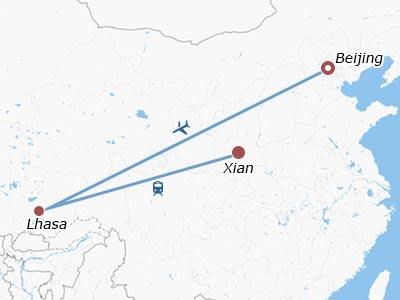
16 Days Luxury & Standard of Beijing - Xian - Lhasa - Lanzhou - Chongqing - Yangtze River Cruise - Yichang - Shanghai

Starting from $2299 per person Hotels & Price
Luxury & Standard

Day by Day Itinerary

Departure:Based on the cruise sailing date, Please click for Luxury series and Standard series.


Temple of Heaven, Beijing

Day 01Arrival in Beijing

Our guide will meet you outside the baggage claim area at Beijing Airport and transfer you to hotel. The rest day is free.

Day 02Beijing

Visit Tiananmen Square, the Forbidden City and the Temple of Heaven. A Beijing Duck Dinner is served at a famous restaurant followed by a lively Peking Opera performance at the Liyuan Theatre.(B+L+D)

Tips: Peking Opera is indispensable when you tour Beijing, for it is the quintessence of China. The repertoire is mainly related to significant historical events, fairy tales of the preceding dynasties, emperors or great beauties. The complete plot is performed through stylized actions, singing, dancing, acrobatic fighting, mime and dialogues by actors. The English lines shown on electronic board alongside the stage can help you fully comprehend the opera. There are basically four types of roles, sheng (male), dan (young female), jing (painted face male) and chou (clown male or female). Each character is vividly presented. The facial make-up is heavy and varied, you can see how the actors make up in the dressing room when you enter the theater.   

Descriptions: Tiananmen Square - the largest square in the world, around which there are several grand architectures, such as Mao Mausoleum, the Great Hall of the People, the delicate Tiananmen (Heavenly Peace Gate), the Chinese Revolution History Museum and Qianmen (Front Gate). A solemn flag ceremony is performed everyday at sunrise and sunset on the square drawing the attention of people who are passing there.
 
Forbidden City - In the Forbidden City, besides the most three important halls in the Outer Court and the four famous palaces in the Inner Court, you are recommended to visit the Imperial Kitchen for emperors. The kitchen in the Hall of Mental Cultivation is especially designed for emperors. The various table wares like golden dishes silver cups and jade spoons will probably give you an eye feast. Emperors were afraid of being murdered. In order to avoid food poisoning, they usually asked chefs and eunuchs to try the food first.


Forbidden City, Beijing

Day 03Beijing

Visit the Badaling Great Wall. You will be driven to have Sichuan food at a  popular local restaurant. Visit the Sacred Way and the Ming Tomb in the afternoon. On the way back downtown, drive by the Bird's Nest (Olympic National Stadium). You will see its appearance at a distance. (B+L, D is included for luxury series)

Differences Luxury Series: an a la carte dinner is served at a famous Cantonese cuisine restaurant in the Wangfujing area. Standard Series: We prefer to leave this dinner on your own since it is easy for you to find some good Chinese restaurants or western-style ones in this metropolis. Also you may ask for some useful suggestions from your local guide or the hotel reception.   

Tips: We advise you to climb the Mutianyu Great Wall instead during our National Day Holiday, because Badaling Great Wall is too touristy and congested. It is a must for nearly every new comer to Beijing. Compared with Badaling, Mutianyu is much flatter with nice landscape. Over 90 percent of the Mutianyu section is dominated by vegetation. It is crowned with many fruit trees like Chinese chestnut, pear, cypress, apple, peach and apricot. In autumn, they bear mellow fruits. Nowadays, more and more people like to visit this section.
 
Descriptions:
Ming Tomb - In the Ming Dynasty (1368-1644), there are mainly two kinds of ancestor worship activities: 'Qian Ji' and 'Gong Ji'. 'Qian Ji' means that the imperial court sends some officials to worship the Emperor's ancestors. 'Gong Ji' refers that the emperor personally worships his ancestors accompanied by his empress and concubines on certain festivals.


Our clients at the City Wall, Xian

Day 04Beijing - Xian

Visit the Summer Palace and see the lovely pandas in Beijing Zoo. Take a flight to Xian and transfer to the hotel. (B+L, D is included for luxury series)

Differences
Luxury Series: we have arranged a buffet dinner for you at your hotel this evening.
Standard Series: we would like to leave this dinner on your own. You may have dinner at your hotel or ask for your guide's suggestions. 
 
Tips: For your first night in Xian, we suggest you spend it leisurely. Just like the famous Sanlitun bar street in Beijing , the Dove Lane of Bars and Cafes is popular in Xian. The buildings here are decorated in modern Euro-continental style inside and constructed in classical Chinese architecture style outside. Lots of local people choose Dove Lane as a dating place or a place to meet friends, and many foreigners also come here. It's only a 10-minute taxi ride from your hotel. You may even come across friends from your home country.

Descriptions: 
Summer Palace - In the Summer Palace, the Hall of Joyful Longevity (Leshoutang) where many real furnishings are remained is a nice place to view. It is a grand hall originally built by Emperor Qianlong as his mother's residence in the Summer Palace. Later, Empress Dowager Cixi reconstructed it for pleasure.


Xian street scene

Day 05Xian

Visit the Terracotta Warriors and Horses Museum. You will take highway back to downtown to have lunch at a well-known Cantonese cuisine restaurant. In the afternoon, visit the Big Wild Goose Pagoda and the City Wall. This evening you will be entertained with the marvelous Tang Dynasty Show.(B+L+D)

Differences
Luxury Series: you will have a Tang Dynasty Dinner and Show at Tang Dynasty Palace (Add: No.75, Chang'an Road, Xian).
Standard Series: you will enjoy a Dumpling Banquet and Tang Dynasty Music and Dance Show at Shaanxi Opera Theatre (Add: No. 165, Wenyi Road, Xian).
 
Descriptions: Terracotta Warriors Museum - Visitors going to see the Qin Terracotta Warriors and Horses will appreciate the over 1,500 warrior figures. Among them, there is a green-faced warrior with distinctive characters. It is colored painted with complete facial paintings. The ears, neck and the face were colored light green and the eye ball and black pupil are in sharp contrast. Its seemingly weird appearance has aroused experts' great curiosity. Some say the artisan who made it must be color blind, and some think the green face was to frighten enemies. The final conclusion has not been drawn and the further study is continuing. 
 
Big Wild Goose Pagoda - Having a height of 64.5 meters (212 feet) and in a shape of square cone, Bid Wild Goose Pagoda is regarded as one landmark of the city and a must-see sight in Xian. Originally built in 652 AD, it was used to collect sutras that Xuanzang, the eminent monk, brought from ancient India. On the south square besides the pagoda, you can see the statue of Xuanzang.


Barkhor street, Lhasa

Day 06Xian - Lhasa

Visit the Hanyangling Museum, the Mausoleum of Western Han Emperor Liu Qi on the way to the airport. Take a flight to Lhasa where the altitude is 3,650 meters above sea level. Transfer to the hotel and acclimatize yourself to the high altitude. Dinner is served at your hotel.(B+D)

Tips: The flight from Xian to Lhasa lasts about two hours and a half. You may suffer from tinnitus as you enter the plateau area. Chewing some gum will help to ease your discomfort. Make sure you are healthy enough before getting to Lhasa. Please be aware of no smoking, drinking, bathing after arriving at this land. If you are really in need of some oxygen, please go to the reception desk of your hotel for help and pay the additional fee as required by the hotel.
  
Descriptions: Hanyangling Museum - it is the joint tomb of Liu Qi, the fourth emperor of the Western Han Dynasty (206BC-220AD) and his empress, the mother of the emperor Han Wudi. It is neatly laid out with the emperor's tomb in the center, which discloses the strict hierarchical system in ancient times.


Yuzhu peak of Mt Kunlun in Qinghai

Day 07Lhasa

Visit the Tibet Museum and a Carpet Factory. After having a western-style lunch, go head to visit the Sera Monastery and the Norbulingka Park. An a la carte dinner will be arranged for you at the best local Sichuan cuisine restaurant.(B+L+D)

Descriptions: 
Tibet Museum - The Tibet Museum is a good choice for visitors to learn everything about Tibet. It keeps a large amount of precious cultural heritage. The calligraphies and paintings vividly tell the friendship between Han and Tibetan People.
 
Sera Monastery - When you come to Lhasa City, the Sera Monastery should not be missed. There is a grand festival “The Sera Bengqin Festival” held in the monastery on each December 27 of the Tibetan calendar. In the past, on the early morning on this day, a Dorje Pestle would be sent to the Potala Palace. After being conferred strength by the Dalai Lama, it would be taken back to Sera Monastery. Next, the Khenpo of the Ngaba Zhacang would use it to knock the heads of those who believed that the blessings from the Buddha would be transferred in this way.

Day 08Lhasa

Visit the magnificent Potala Palace. After a western-style lunch, visit the Jokhang Temple, the thriving bazaar of the Barkhor Street and the Tibetan Traditional Medicine Hospital.  Dinner is served at your hotel.(B+L+D)

Descriptions: 
Potala Palace - The Potala Palace, the symbol of Lhasa City, is constructed along the mountain contour. The Palace stands out prominently against the undulating top of the mountain. The strong granite wall, magnificent golden top, Buddhist banners and flags contrast sharply with the white cloud and blue sky. The layer-upon-layer structure expresses the charm of Tibetan ancient architecture. The design of the palace followed the rules of the sunlight in plateau section. The bases of the walls are wide and solidate, beneath which there are underground tunnels and ventilation openings in all directions.
Jokhang Temple - Have you ever heard the saying that 'No visit to the Jokhang Temple equals to no visit to Lhasa. It was said by a notable Lama of the Jokhang Temple which was agreed by travelers to Tibet. It is the oldest wooden temple of Tibet and has been included in the list of the World Heritage in 2000.
 
Barkhor Street - The well-known Barkhor Street is located in the old district of Lhasa. It was originally thecircumambulation of the local people and now is the trade center of the city. Considered as the 'Holy Road' by the Tibetan people, the street has well preserved the traditional local dwellings.

Continue


B-- Breakfast     L-- Lunch     D-- Dinner

Attention: Please continue to read the itinerary of Day09-16, hotels and tour prices 
               in page 2.

 
Page:
1
2