Longshan Culture
Examples of Longshan Culture that were produced in the late period of the Neolithic Age (2900 BC to 2100 BC) can be found in the old town of Longshan, in the city of Zhangqiu which is located in Shangdong Province. Its influence can be found in the middle and lower areas of the Yellow River Valley flowing thru Shandong, Henan, Shaanxi, and Shanxi Provinces. Artifacts from the Longshan are characterized with the applications of both copper and stone.
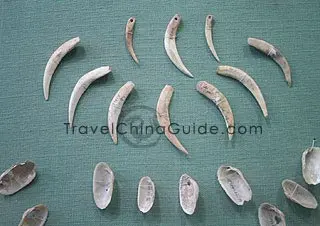 |
| Decorations Exhibited in Xian Banpo Museum |
The Longshan Culture also made great advancements in the area of pottery making, with black pottery being one of the more striking examples of this remarkable culture. Pottery was made using techniques that enabled the artisans of the Langshan Culture to produce large numbers of pieces while at the same time maintaining a sense of quality. Some of the walls of the pottery were as thin as eggshells with surfaces that were quite bright. Some of the more common pieces produced were bowls, basins, jars, urns and a variety of cooking vessels. Nowadays, the black pottery that was and continues to be produced have been regarded as works of art, and are appreciated and sought after by many people.
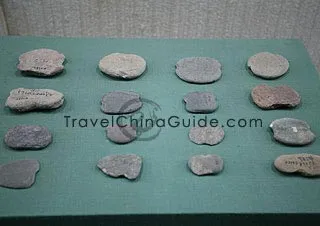 |
| Rudimentary Chipped Stone Tools |
A new site dating to the early Longshan period (c. 4800 - 4200 years ago) was recently uncovered in Luojiahe Village, Xianyang City, Shaanxi Province. This site features 17 storage pit relics, which served as specialized storage facilities for prehistoric communities. All the pits are bag-shaped, either circular or elliptical, with neatly finished walls and intentionally flattened, compacted bottoms. Notably, four of these pits contained carbonized grains of millet and broomcorn millet at the base, suggesting they were primarily used for grain storage. With a total volume of approximately 390 cubic meters (510 cubic yards), these 17 pits are estimated to have had a storage capacity of 300 tons of millet - enough to sustain the entire settlement for 4 to 9 years. This discovery attests to the remarkable capability of local communities during the early Longshan period to construct and manage storage facilities of large scale.
The Longshan Culture also had some rather interesting customs when it came to burying their dead family members in a cemetery that was usually separated from the area where they actually lived. It was common for one person to be buried in a rectangle pit, while occasionally a few would be buried together in a single pit. Children, as those of the Bampo Culture period would be put into urns before being buried. Bones used for predicting one's fortune, and made from the bones of sheep, pigs, deer and cow have been found in the graves from that period. With this in mind it is believed that the custom of augury or divination may have been popular and practiced.
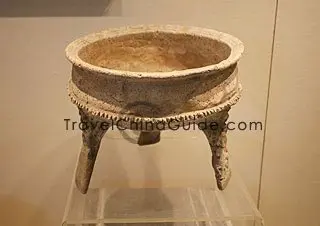 |
| Three-legged Jar |