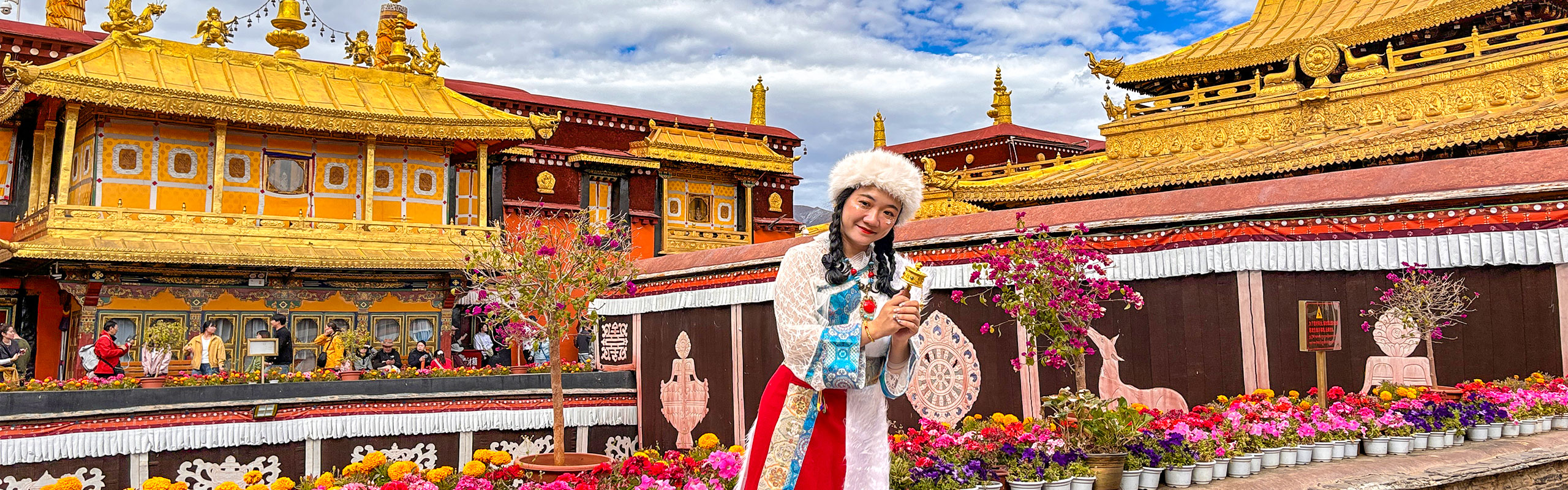
Expedition to the Everest
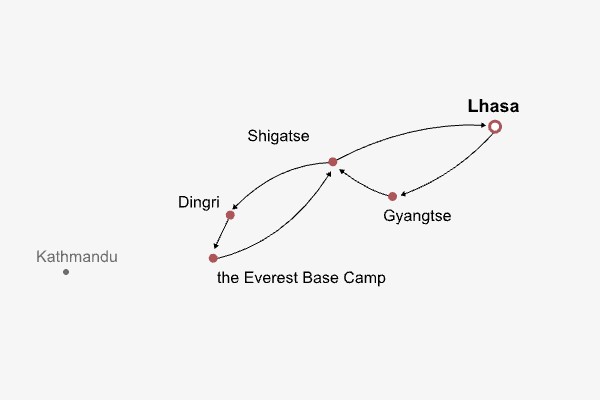
8 Days Lhasa - Gyantse - Shigatse - Dingri - Everest Base Camp - Shigatse - Lhasa

Trip HighlightsCode: 505-PrivateCode: 505-Group
- Savor Tibetan Buddhism and unique architectural art in world’s highest Potala Palace.
- Enjoy Thangka murals, Buddha statues, and monastic debates in diverse monasteries.
- Explore Tibetan life by visiting a local family, tasting their traditional food and sweet tea.
- Marvel at the sacred Mt. Everest, the world’s closest wonder to the sky from different angles.
- Intoxicate in natural charms of Yamdrok Yumtso Lake and Karola Glacier.
Book with Confidence: Free inquiry, only 10% deposit to confirm, full refund for cancellations up to 15 days prior.
Book with Confidence: Free inquiry, only 10% deposit to confirm, full refund for cancellations up to 30 days prior.
- Itinerary
- Prices
- Accommodation
1 / 14
Expand All
Collapse All
Day 1 Arrive in Lhasa, Airport or Train Station Pick-up
View More Videos
The Mysterious Potala Palace
► Important Note for Group Travelers with Flights:
Our group transfer service between the airport and your hotel is available at fixed times by minivan or minibus based on the number of arriving or departing guests at the same time. The pick-up times at the airport are set for 10:00, 13:30, 16:00, and 18:30, while scheduled see-off minivans depart from the hotel at 6:30, 8:00, and 12:00. Please contact us in advance if you wish to upgrade to a private car transfer.
► High-altitude Area Travel Tips:
Tibet is in a plateau region where oxygen is scarce, and it will get thinner as we climb from Lhasa at an altitude of 3,650 meters (11,975 feet) to Everest Base Camp at 5,200 meters (17,060 feet). Therefore, you should have a comprehensive physical examination to assess whether you can adapt to the high-altitude environment before embarking on this journey. When in Tibet, common symptoms of altitude sickness include headache, dizziness, nausea, palpitations, shortness of breath, and insomnia. If you feel unwell, please use supplemental oxygen immediately. If the s symptoms worsen, seek emergency help at once.
1. Individuals with heart, lung, brain, liver, or kidney diseases, pregnant women, or those with anemia, high blood pressure, asthma, diabetes, or colds should carefully consider whether to travel to Tibet.
2. Consult your doctor to prepare acetazolamide, oral glucose solution, Rhodiola rosea, and other necessary medications before departure.
3. Avoid alcohol and coffee during the first 24 hours. Do not shower or wash your hair for the first two nights; keeping warm is more important than ever.
4. The air in Lhasa is extremely dry, and coupled with the high altitude, your body will lose fluids very quickly! Be sure to drink plenty of water, at least 2,000 ml per day. The ultraviolet radiation is very strong at high altitudes, so protect your skin from sunburn by wearing sunscreen and a wide-brimmed hat.
Day 2 Lhasa
Visit Drepung Monastery and Sera Monastery with an impressive monk debate. A welcome dinner for group guests. (B+D)
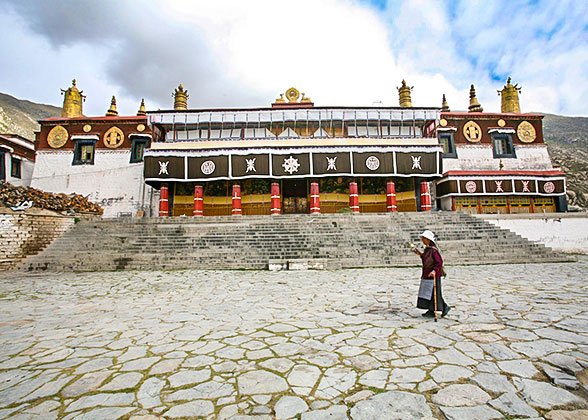
This morning, your guide will first accompany you to Drepung Monastery, the largest of its kind in Lhasa, which beckons to you on the western outskirts of the city. This 600-year-old Tibetan Buddhist sacred site is particularly charming in the morning, with Tibetans and believers coming from afar holding butter lamps to worship the Buddha, as well as Lamas in red robes that stand out strikingly against the white milk walls chanting sutras everywhere. Take your time to appreciate the exquisite porcelain, Buddha statues, Thangka paintings, and murals housed in its various halls. Up the steps all the way, the scents of ghee and Tibetan incense would linger around the nose. First, arrive at the tallest building in the temple, the Ganden Potrang, which was once the residence of the Second Dalai Lama and presents an architectural style similar to that of an ancient castle. Moving forward, we’ll then come to the core building, the Coqen Hall. Surprisingly, in the chest of the Buddha statue enshrined here lies the hallmark treasure of the temple, a white conch, which is said to be a token left by Master Tsong Khapa to his disciples. Then step into the four Zhacangs (academies) and delve into its religious educational system.
► Welcome Dinner for Group Guests
For group guests, we’ve included a welcome dinner at a popular local restaurant, where authentic Tibetan cuisine can delight your taste buds. Private tour guests enjoy the freedom to explore local dining options independently at their own expense.
Meals: Western buffet breakfast (Welcome dinner for group only)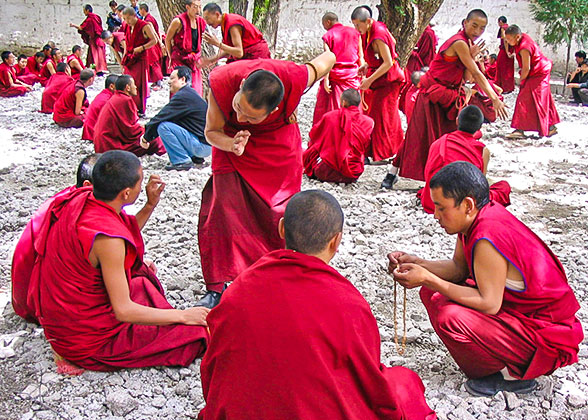
★ Unique Experience: Watch Buddhist Debate at Sera Monastery!
The afternoon sightseeing will kick off at one of Lhasa's three great monasteries, Sera Monastery, where you can watch the exciting debates practiced by monks in Buddhist philosophy and logic. The drastic debate in pairs draws numerous audiences, and the most interesting part is watching the monks' animated gestures and their excited, ever-changing expressions. The questioners often use various gestures to amplify the argument, such as raising their arms high and then slamming them down, indicating cutting away ignorance with the sword of Manjushri; pressing their palms down to suppress their own greed, anger, and delusion; clapping to urge the answers to respond quickly; or pulling on prayer beads to represent invoking the power of Buddha to defeat. The respondents have to provide rebuttals or answers without hesitation. If they cannot accurately answer, they have to relearn until they’ve fully mastered it. Finally, your guide and driver will escort you back to your hotel.► Welcome Dinner for Group Guests
For group guests, we’ve included a welcome dinner at a popular local restaurant, where authentic Tibetan cuisine can delight your taste buds. Private tour guests enjoy the freedom to explore local dining options independently at their own expense.
Meals: Western buffet breakfast (Welcome dinner for group only)
Drepung Monastery
Monks Debating in Sera Temple
Day 3 Lhasa
Visit Potala Palace, Jokhang Temple, and Barkhor Street. Have a tea break at a sweet tea house. (B)
After the hotel pickup, today’s journey will begin at the Potala Palace, which has been rated by UNESCO as the world’s highest ancient palace complex. When walking along the palace wall, the slogan ‘A must-visit place in a lifetime’ will come into your view, undoubtedly raising your expectations for this sacred land. After entering, as you ascend along the winding stone slopes and steps, you can come across believers prostrating themselves on a pilgrimage, with each move seeming so devout. Gradually, the splendor inside the Palace was revealed in front of you. According to the legend of the Tibetan region, when the Potala Palace was built, nearly half of the gold in the world at that time was used, and follow our guide to see how glittering it really is. In the White Palace on both sides, there are many resplendent stupas showcasing the quintessence of Tibetan architectural art. Also visit the central Red Palace, the soul of the Potala, which is filled with well-arranged Buddha statues and colorful Thangka murals that vividly depict the history and mythological legends of Tibetan Buddhism as well. After climbing more than 900 steps in all, you’ll eventually reach the top of the Palace, where you can overlook the breathtaking scenery of the entire Lhasa City.
 Visit Tips:
1.Wear comfortable, non-slip shoes for hundreds of steep steps.
2.If you wish to donate, please prepare banknotes and small change in advance, as exchanging money at the entrance is expensive.
3.The temperature between different areas of the Potala Palace differs. You may be sweating profusely on the open steps and be shivering in the cold wind inside the palace or corridors. Layering clothing is recommended.
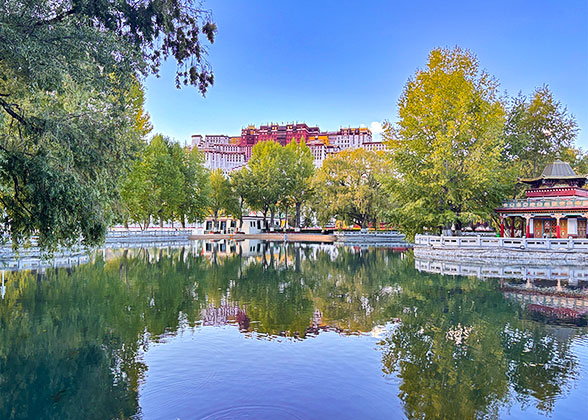
Next, let’s head to the Dragon King Pool Park located behind the Potala Palace. This hidden gem offers a picturesque reflection of the grand palace and an immersive experience of local Tibetan life, where you can see Tibetan women sunbathing on the lawn, elderly people spinning prayer wheels by the lake, and the lively Tibetan circle dance scene.
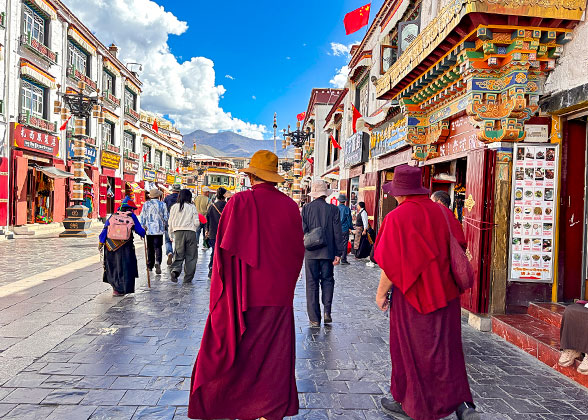
 In the afternoon, proceed to the heart of Tibetan faith, the Jokhang Temple, built in 647 AD by the Tibetan King, Songtsen Gampo, which even preceded Lhasa. The monastery is considered the most sacred place by Tibetans as it houses a life-size statue of the 12-year-old Shakyamuni Buddha, said to have been consecrated by Shakyamuni himself. As a spiritual home for pilgrims, the Jokhang Temple attracts Tibetans from all over the country to circumambulate it daily. They hold prayer wheels and chant mantras, walking clockwise along Barkhor Street outside the temple. There are even one-legged pilgrims who hop and stumble, laboriously completing a standard full prostration. The bluestone slabs have been worn smooth, bearing witness to centuries of devout footsteps. Barkhor Street is also a commercial center, filled with religious items such as bronze Buddha statues, prayer wheels, butter lamps, and prayer flags. You can browse daily necessities such as carpets, horse harnesses, snuff bottles, Tibetan knives, barley wine, sweet tea, and dried meat, as well as handicrafts such as Thangka paintings and Tibetan carpets.
At last, enjoy a tea break at a sweet tea house to taste their social culture, and then your guide and driver will escort you back to your hotel for rest.
Meals: Western buffet breakfast, Tea break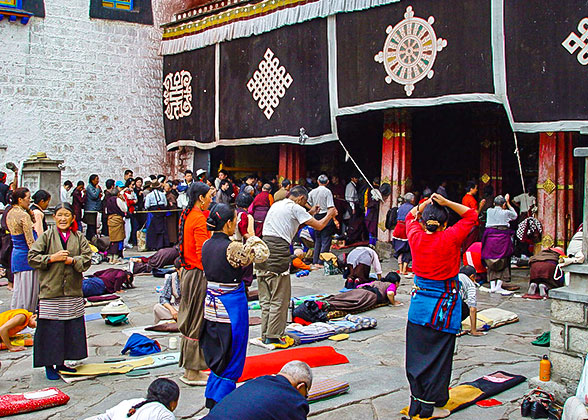
Visit Tips:1.Wear comfortable, non-slip shoes for hundreds of steep steps.
2.If you wish to donate, please prepare banknotes and small change in advance, as exchanging money at the entrance is expensive.
3.The temperature between different areas of the Potala Palace differs. You may be sweating profusely on the open steps and be shivering in the cold wind inside the palace or corridors. Layering clothing is recommended.
Next, let’s head to the Dragon King Pool Park located behind the Potala Palace. This hidden gem offers a picturesque reflection of the grand palace and an immersive experience of local Tibetan life, where you can see Tibetan women sunbathing on the lawn, elderly people spinning prayer wheels by the lake, and the lively Tibetan circle dance scene.
Our Guests at Potala Palace
Dragon King Pool Park, Lhasa
At last, enjoy a tea break at a sweet tea house to taste their social culture, and then your guide and driver will escort you back to your hotel for rest.
Meals: Western buffet breakfast, Tea break
Jokhang Temple
Barkhor Street outside Jokhang Temple
Day 4 Lhasa - Yamdrok Yumco Lake - Shigatse
Head to Shigatse and visit Yamdrok Yumco Lake en route. Visit a local family, drive past Karola Glacier and barley farmland to reach Shigatse. (B+L)
Today, we’ll drive to Shigatse, the second largest city in Tibet. On the way, we’ll stop to admire one of the Great Three Holy Lakes in Tibet, the Yamdrok Yumtso Lake, which literally means ‘Jasper Lake of Upper Pasture’ in Tibetan and is regarded by the Tibetans as ‘the turquoise earrings of the goddess scattered among the snow-capped mountains’. Standing at the Gampala Pass Platform and looking southward, it is just a sapphire, with white clouds, blue sky, and snow peaks reflected on it, creating an enchanting landscape painting. In the center of it, you’ll also see the Rutok Temple, known as the loneliest temple in the world, which is said to have only one monk living here all year round. The Tibetan antelopes, flocks of sheep, yaks, and horses on the surrounding grassland are also a beautiful sight for you. Later, you’ll be accompanied to visit a local family for their daily life.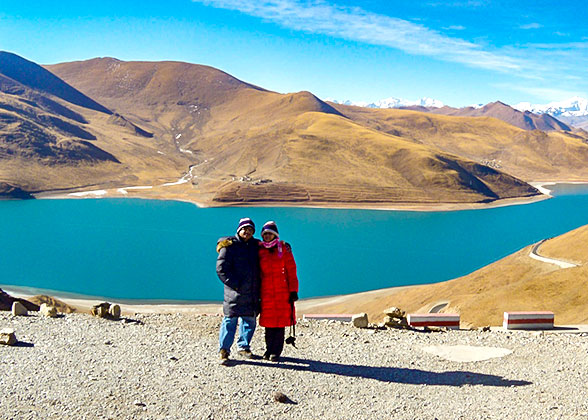
 After lunch, keep moving forward on the highway and we’ll pass by the Karola Glacier, one of the three famous continental glaciers in Tibet. It is like a huge ice waterfall falling from the sky and winding to the roadside. The white ice interweaves with the brown land, and then connects with the green barley fields, making you can't help but be amazed at the magical power of nature. Speaking of the barley farmland, it is just like an ocean with rolling green waves in spring, and in autumn, it seems to be coated with a layer of gold. As the farmland is at a higher altitude and enjoys more sunlight, you may find that it presents more bright colors than those in other places. Take the chance to take some instagrammable photos along the way!
Upon arrival in Shigatse, check in at the hotel we handpicked for you.
Meals: Western buffet breakfast, Lunch
Our Guests at Yamdrok Yumtso Lake
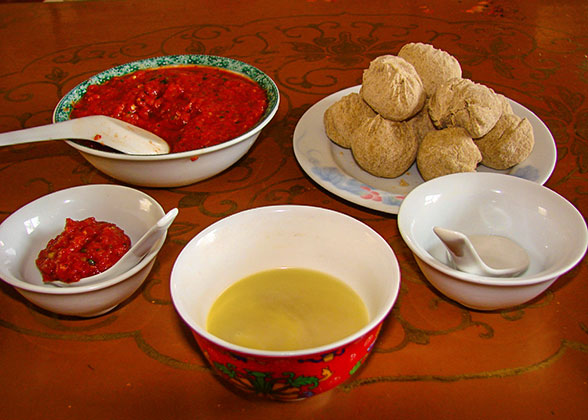
Zanba, Local Snacks
Upon arrival in Shigatse, check in at the hotel we handpicked for you.
Meals: Western buffet breakfast, Lunch
Day 5 Shigatse - Dingri - Everest Base Camp
Head to the Himalayas. Admire the Himalayas including the Mt. Everest at two viewpoints in Dingri. Enjoy sunset at Everest Base Camp if weather permits. (B)
In the morning, let’s make our way from downtown Shigatse to the Himalayas. Stretching for more than 2,400 kilometers (1,491 miles) along China’s Tibet border with Nepal, India, and other countries, the Himalayas are the highest mountain range in the world, with many peaks averaging more than 6,000 meters (3.7 miles) above sea level. Among them, the world’s highest Mt. Everest is its main peak, with an altitude of 8848 meters (29,028 feet). When passing through Dingri, first climb up to the Dingri Viewpoint and enjoy the majestic posture of Mt. Everest from a distance. Here, the natural scenery around Dingri, such as vast grasslands, can also be taken in at a glance. Then stand on the Gawula Viewpoint, the largest and most spectacular observation platform on earth, and prepare to be stunned by the five 8,000-plus-meter-high undulating mountains covered in white.
Around dusk, we’ll finally reach the Mt. Everest Base Camp, a protected zone set up to limit environmental damage to Mt. Everest's core by human activity, for the night. It is still an ideal place to enjoy a 360-degree panoramic view of Mt. Everest, and if it is a clear day, the beautiful sunset over it will also feast your eyes. The sunlight drapes the peak, which is faintly visible amid the misty clouds, in a golden coat, giving you a mysterious and awe-inspiring atmosphere.
Meals: Western buffet breakfast

Around dusk, we’ll finally reach the Mt. Everest Base Camp, a protected zone set up to limit environmental damage to Mt. Everest's core by human activity, for the night. It is still an ideal place to enjoy a 360-degree panoramic view of Mt. Everest, and if it is a clear day, the beautiful sunset over it will also feast your eyes. The sunlight drapes the peak, which is faintly visible amid the misty clouds, in a golden coat, giving you a mysterious and awe-inspiring atmosphere.
Meals: Western buffet breakfast
Our Guests at Everest Base Camp
Rongbuk Monastery
Day 6 Everest Base Camp - Dingyal - Shigatse
Admire Mt. Everest in the morning and visit Rongbuk Monastery. View east slope of Mt. Everest and Mt. Lhotse from Himalayan Xilin Viewpoint on the way returning to Shigatse. Dinner for group guests. (B+D)
When the sun slowly rises, you’ll see a ‘golden veil’ gently lifted from the Mt. Everest, showing its most primitive face. At this moment, all your senses may be awakened by this stunning scene. Later, the guide will accompany you to visit the Rongbuk Monastery, the highest temple in the world. It is worth mentioning that it is also the only temple where monks and nuns live together to practice Buddhist devotions, precisely reflecting the inclusiveness and harmony of Tibetan Buddhism. Walking into the small hall where the Buddha statue of Padmasambhava is enshrined, you’ll feel as if you have once again entered a dignified Buddhist world. Look south from the temple, and you can still see the Mt. Everest towering like a giant pyramid among the peaks 20 kilometers away.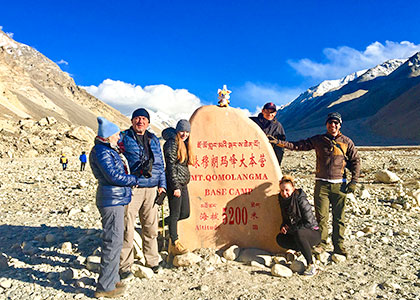
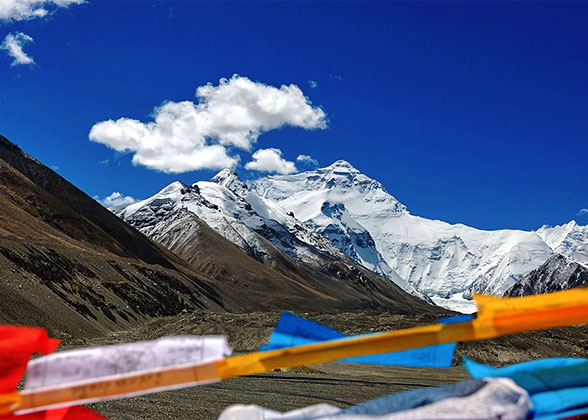 Then, we will escort you back to Shigatse via Dingyal and Sakya County. On the way, witness the eastern slope of Mt. Everest and the world’s fourth tallest Mt. Lhotse at the Himalayan Xilin Viewpoint as well. Upon arrival, check into your hotel for a well-deserved rest.
► Group Bonus: Dinner with Live Folk Performance
Our group guests will enjoy an included dinner featuring Tibetan specialties, accompanied by traditional music and dance performances by local artists.
Meals: Western buffet breakfast (Dinner for group only)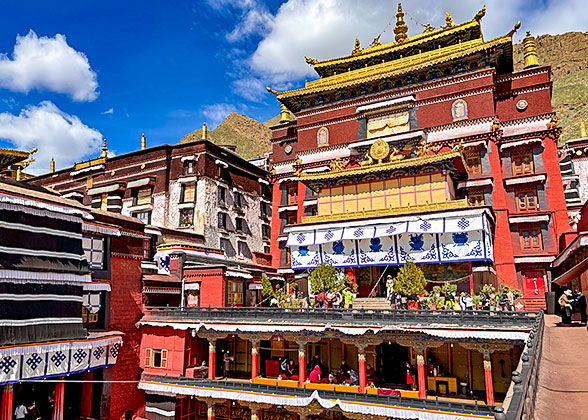
Everest Base Camp
Enjoy Sweeping Views of Snow Peaks
► Group Bonus: Dinner with Live Folk Performance
Our group guests will enjoy an included dinner featuring Tibetan specialties, accompanied by traditional music and dance performances by local artists.
Meals: Western buffet breakfast (Dinner for group only)
Tashilhunpo Monastery, Shigatse
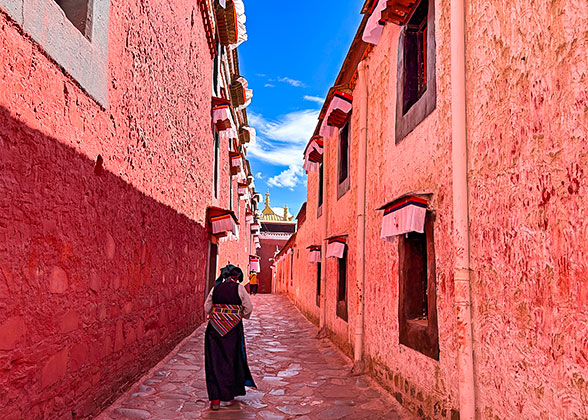
Alley of Tashilhunpo Monastery
Day 7 Shigatse - Lhasa
Visit Tashilhunpo Monastery, and then return to Lhasa. (B)
View More Videos
Tashilhunpo Monastery
Upon entering the temple, the first thing that greets you is a vast open-air preaching hall, whose four walls are dominated by 1,000 stone-carved Buddha statues, revealing a solemn and mysterious atmosphere. Pass through it and up the steps, and you’ll get to the oldest Kelsang Temple in the Monastery, which is large enough to accommodate about 2,000 lamas chanting sutras at a time. Then, follow our guide to the most famous Maitreya Chapel to marvel at the treasure of Tashilhunpo - the world’s tallest gilded copper seated Buddha statue. The 26-meter-tall Buddha is really jaw-dropping in its enormity; and to put it more vividly, it seems that an adult could fit into its nostrils, a truck could be parked on one of its shoulders, and two ping-pong tables could be placed in its palm. Next, lay your eyes on the most luxurious stupa-tomb of the Tenth Panchen Lama, which is wrapped in gold and inlaid with thousands of diamonds, pearls, agates, turquoise, and corals.
After the visit, hop in our vehicle for a road trip back to Lhasa along the magnificent Yarlung Tsangpo River, which is not only a geographical wonder but also the mother river of Tibetan culture. As the sun draws closer to the horizon, you’ll be intoxicated by the entire river canyon that has been dyed a warm orange-red and looks as if a painter's palette has been overturned.
Meals: Western buffet breakfast
Day 8 Departure from Lhasa
Transfer to the airport or train station and see you off. Wish you a pleasant onward trip! (B)
It’s time to bid farewell today, and your guide will escort you to the airport or train station for your return journey. Make sure to pack all your luggage when checking out of the hotel, and arrive at the airport two hours early if you are leaving by plane. Bon voyage!
Meals: Western buffet breakfast
Meals: Western buffet breakfast
B - Breakfast L - Lunch D - Dinner
Expand All
Collapse All
| Prices with 4 Stars Hotels | Prices with 5 Stars Hotels | ||
|---|---|---|---|
| 2-3 travelers | 4-5 travelers | 2-3 travelers | 4-5 travelers |
USD2649
|
USD1879
|
USD3049
|
USD2279
|
| Prices with 4 Stars Hotels | |
|---|---|
| 2-3 travelers | 4-5 travelers |
USD2649
|
USD1879
|
| Prices with 5 Stars Hotels | |
|---|---|
| 2-3 travelers | 4-5 travelers |
USD3049
|
USD2279
|
- Prices are per person based on twin sharing. Currency Converter
Destinations
4 Stars Hotels
5 Stars Hotels
Lhasa
Tangka Hotel
Shangri-La Hotel
Shigatse
Gesar Hotel - VIP Building
Shigatse Hilton
Everest Base Camp
Rongbuk Guesthouse – View Room
Rongbuk Guesthouse – View Room
Lhasa
Tangka Hotel
Shigatse
Gesar Hotel - VIP Building
Everest Base Camp
Rongbuk Guesthouse – View Room
Lhasa
Shangri-La Hotel
Shigatse
Shigatse Hilton
Everest Base Camp
Rongbuk Guesthouse – View Room
Similar Tour Options
6 Days Lhasa - Gyangtse - Shigatse - Lhasa
View Details
From
USD829
11 Days Beijing - Xi'an - Lhasa - Shanghai
View Details
From
USD2979
USD2621
11 Days Lhasa - Gyangtse - Shigatse - Dingri - Everest Base Camp - Dingri - Gyirong - Kathmandu
View Details
From
USD2579
Similar Tour Options
6 Days Lhasa - Gyangtse - Shigatse - Lhasa View Details
From
USD829
11 Days Beijing - Xi'an - Lhasa - Shanghai View Details
From
USD2979
USD2621
11 Days Lhasa - Gyangtse - Shigatse - Dingri - Everest Base Camp - Dingri - Gyirong - Kathmandu View Details
From
USD2579
Price Includes
- Lhasa airport/train station pickup and drop-off
- Hotel accommodation with breakfasts
- Meals as itinerary specifies
- Excellent Tibetan English-speaking guide
- Experienced driver & air-conditioned vehicle
- Entrance fees to tourist sites
- On-board oxygen supply for travel in high-altitude areas
- Tibet Travel Permit
Price Excludes
- Arrival and departure flights or trains
- Single room supplement for solo travelers who require single room
- China visa fee if applicable
- Gratuities
