Niujie Mosque
The Niujie Mosque, literally Ox Street Mosque, is Beijing's most historical and majestic mosque. It is situated on the Niujie Street (Ox Street) in the city's Xicheng District, hence the name. First built in 996, the Niujie Mosque has a history that stretches back over a thousand years, during which time it has undergone numerous refits and extensions, and has greeted Muslims from all over the world to worship. The mosque covers an area of over 7,000 square yards (6,000 square meters), and is structurally based on traditional Chinese wooden palaces, yet adopts typical Arabic-style decorations. There are no human or animal figures among these decorations as these are considered taboo in Islam.
|
|
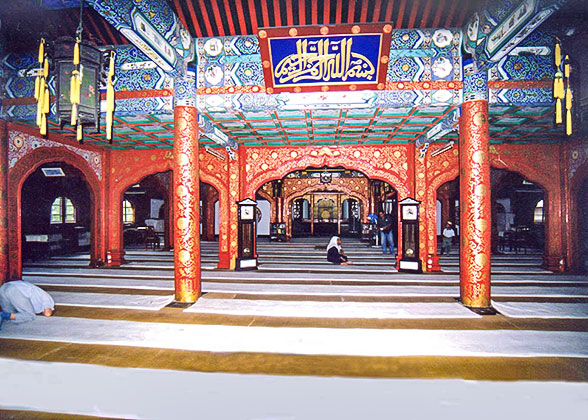
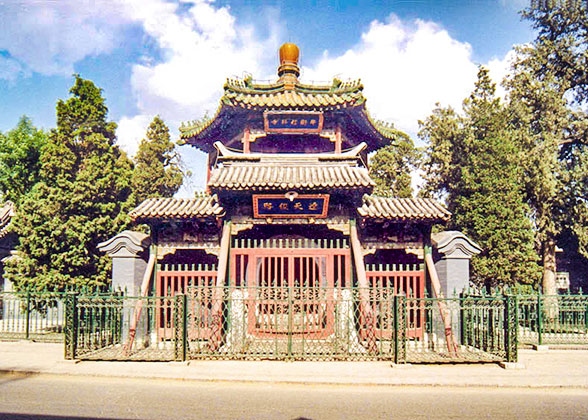
Unlike south-facing Buddhist temples, the Niujie Mosque faces towards Mekka, the holy land of Islam in the west. The layout is symmetrical and compact. The entrance gate is fronted by a large wall with a white marble pedestal, which stretches for around 44 yards (40 meters). A series of relief sculptures sit on the wall, depicting images of happiness and fortune. After passing through the entrance gate, visitors can see the Watching Moon Tower, a hexagonal, two-storied structure reaching over 33 feet (10 meters) tall and housed under a golden-glazed roof. The tower is so named because it was used by the imam to observe the position of the moon to determine times for fasting.Walking along the path that runs beside the tower, visitors eventually reach the Prayer Hall - the most important building in the Niujie Mosque. It is a place only open to Muslims. Covering an area of 700 square yards (600 square meters), the hall has the capacity for a few thousand worshippers. The hall's arched gate is decorated with script from the Koran and poems of worship. Some of the text is written in the ancient Arabic characters of Al-Kufi, which is rarely seen in China. The room is also adorned with various paintings of flowers, strings of glass beads and colored glass, which contribute to the hall's air of great importance and holiness.
Outside of the Prayer Hall, two stele pavilions sit either side of the hall. In each of them stands a stone tablet detailing the history of it. To the southeast of the hall, two black-brick graves of Shaykhs lie under a dense collection of cypress trees. Although hundreds of years old, the epigraphs on the gravestones remain clearly readable and are of great importance to research into the history of Islam in China.
The Niujie Mosque offers visitors not only the chance to admire a truly unique building, but also the opportunity to broaden their knowledge about Islam and its place in Chinese cultural history. It should certainly rank highly on any visitor's itinerary to Beijing.
Tips:
2. Admittance to the Prayer Hall is limited to Muslims only.
3. Some areas in it are not open to the public. Please refer to the information on the ticket.
How to get there
 By Bus:
1. Take bus 10, 48, 88, or 717 and get off at Niujie Libaisi (Niujie Mosque) Station.
2. Take bus Special Line 13 and get off at Niujie Station.
 By Subway:
1. Take Subway Line 7 and get off at Guang'anmennei Station. Get out from Exit C2. Then walk to the east along Guang'anmennei Street and turn south at the crossing with Niujie Street.
2. Take Subway Line 4 or Line 7 and get off at Caishikou Station. Get out from Exit E. Then walk to the west along Guang'anmennei Street and turn south at the crossing with Niujie Street.
| Entrance Fee | CNY 5 for Chinese, CNY 10 for foreingers; free for Muslims |
| Opening Hours | 08:00-16:00 |
 Recommended Nearby Attractions:
 Baoguo Temple Fayuan Temple Taoranting Park Guanganmen Food Street Further Reading:
7 Unusual Things to Do in Beijing Especially for Return Visitors
